.png)
How do you really truly determine whether or not your digital marketing efforts are a success? This is a huge challenge for many businesses.
According to eMarketer, digital marketing budgets are expected to keep growing. But the expectations to track Digital Marketing KPIs is even greater with CEOs, sales and more traditional marketing peers.
Whenever you launch a new product, roll out a new marketing campaign, or experiment with a new sales approach, you want to know as soon as possible whether or not things are working. In order to do so, you track certain metrics, or KPIs.
Most digital marketers are quite familiar with KPIs and understand why they are so important, but a major struggle that many teams have is knowing which ones actually matter.
Let’s talk about it.
Quick Takeaways:
- Many businesses don’t know how to track KPIs (or which to track, for that matter).
- Some KPIs will be totally irrelevant for one project but a critical component for others.
- Having too many or too few KPIs that have been tracked could actually give you a skewed view of the results.
- Link KPIs to business goals and then break them down by channels.
- Like goals, KPIs should be specific, measurable, attainable, relevant, and time-bound.
“Where Do We Start?”
According to Track Maven’s report on digital marketing, nearly half of all teams stated that their most difficult challenge was aligning KPIs with their greatest challenge. 42% struggled to define which KPIs to track and 33% found it difficult to analyze the data they were tracking.
When it comes to KPIs, a one-size-fits-all approach is not going to cut it for every single project and campaign. It is pointless to only follow the same set of KPIs and expect the numbers to actually prove the success rate of all marketing efforts.
So, it is important for you to narrow down your indicators to only the most important and relevant ones.
What are Digital Marketing KPIs?
Digital Marketing KPIs (or key performance indicators) are measures or metrics that show the success of digital marketing activities.
These metrics typically line up to specific business goals that digital marketing can support. These goals line up to the objective of the digital marketing strategy or content marketing goals, such as:
- Brand Awareness or Website Reach (SEO)
- Visitor Engagement or brand positioning
- Leads, sales
- Loyalty and Retention
- Employee Engagement (Hiring and Retention)
All of these are important, but mean completely different things. They may not apply to all businesses. Think about your goals and write them down.
Why KPIs Start With a Strong Marketing Strategy
KPIs don’t exist in isolation. They only make sense when they’re tied to the bigger picture of your marketing strategy. Without that connection, you’re just collecting numbers that don’t move your business forward.
Think about what a marketing strategy does. It lays out where you’re going, how you’ll compete in your market, and what channels or tactics you’ll use to get there. It’s the map. KPIs are the signposts along the road. If the two aren’t connected, you can end up measuring the wrong things and missing opportunities.
Strategy Keeps Teams Aligned
One overlooked benefit of aligning KPIs with marketing strategy is team alignment. When everyone understands what you’re tracking and why, there’s less confusion and debate over success. Marketing, sales, and leadership can look at the same numbers and agree on what they mean.
That alignment builds trust. It also prevents wasted effort. Teams won’t spend hours building reports filled with vanity metrics that don’t matter. Instead, they’ll focus on numbers that influence actual results.
A Strategy-First Approach Pays Off
Defining KPIs without a strategy is like trying to measure fitness progress without knowing your goals. Are you training for endurance or strength? Weight loss or muscle gain? The measurements only make sense in context.
The same is true for marketing. If you want KPIs that tell you the truth about performance, start with strategy. Set your business goals, identify the outcomes you need, and then choose the indicators that show whether you’re getting closer.
Once you do that, KPIs shift from being just numbers on a dashboard to being powerful tools that guide smarter decisions, better campaigns, and stronger business growth.
Why Measure Digital Marketing KPIs?
The goal of marketing is get and keep customers, as Peter Drucker famously once said. And in today’s digital world, measuring the activities that bring in and help companies keep new customers are more easily available.
Business leaders now expect marketing to measure the success of marketing efforts because digital signals provide all the data available. (Check out below one of my favorite videos of a CEO telling marketers to stop wasting marketing budgets on ads that don’t work.)
How Strategy Shapes KPI Selection
Every business has different goals, and your KPIs should reflect those differences. A B2B software company may prioritize lead generation and pipeline growth, while an eCommerce brand may care more about conversion rates and average order value. Both are valid, but they require different KPIs.
Your marketing strategy helps you answer a few core questions:
- What’s the main goal right now—awareness, demand generation, or retention?
- Which channels are you using to reach people?
- How does marketing tie into larger sales and revenue objectives?
By clarifying those answers, you can separate meaningful KPIs from “noise.” For example, social media impressions might look exciting on a dashboard, but if your strategy is built around nurturing qualified leads, then impressions alone won’t tell you much about progress.
What Digital Marketing Metrics Should Be Measured?
Typically, digital marketers measure the effectiveness of their budgets relative to each of the larger marketing strategy objectives (Reach, engage, convert, retain, and possibly HR goals.)
Reach Metrics:
- website traffic
- clicks / cost per click
- SEO rankings
- visitors by source (search, social, email)
- social media followers, likes, shares
- opt-in email addresses
- Addressable advertising audiences (for example “cookied” website visitors)
Engagement or Brand Metrics:
- Bounce rates
- Click through rates
- Time on your website or dwell time
- Repeat visitors
- Newsletter opt-ins
Conversion Metrics:
- leads (marketing and sales qualified, sales accepted)
- webinar registrations
- landing page conversions
- cost per lead / conversions at all levels
- Time to conversion at each stage or average sales cycle broken by stage
- Pipeline (value of leads)
- pipeline influenced (the dollar amount of pipeline that was “touched by a digital marketing tactic)
- ROI
Loyalty / Retention Metrics:
- Customer Lifetime value
- Retention rate
- Net Promoter Score
- Client satisfaction
- Brand perception
- Upsells / Cross sells
Digital Marketing HR metrics:
- Content Contributors
- Content Sharers
- % employees participating
- Employee engagement with various forms of content
There are more metrics out there, but these are the main ones most businesses track. Here’s some deeper insight.
Linking KPIs to Business Goals
Too often, teams measure what’s easy instead of what matters. Website traffic, email opens, or follower counts are simple to track, but they don’t always tie back to outcomes that leadership cares about. That’s why every KPI should be connected to a business goal.
Here’s a practical breakdown:
- If your goal is awareness, measure reach, branded search volume, or referral traffic.
- If your goal is engagement, measure time on site, click-throughs, or repeat visits.
- If your goal is conversion, measure leads, cost per acquisition, or deal velocity.
- If your goal is retention, measure churn rate, lifetime value, or expansion revenue.
By tying each KPI to an outcome, you create a clear line between marketing activity and business impact.
How To Measure Digital Marketing KPIs
Here’s what many find to be the most difficult part of tracking metrics.
1. Ask Yourself the Most Important Questions
Remember learning proofs back in high school geometry class? One rather confusing (at the time) rule that you may remember is the fact that all squares are rectangles but not all rectangles are squares.
Well, in digital marketing, all KPIs are metrics but not every metric is a KPI. Some metrics are simply more important than others – but it is very dependent on the situation and objectives that your company is setting.
In order to find your specific KPIs you must start with some basic but important questions that will lay the groundwork.
First: How does this project or strategy influence revenue?
It’s all about the money – revenue rates are almost always going to be included in your KPIs. But not everything that you need to track will have a direct or obvious influence on sales. For instance, say that your company is setting up a booth at a business expo and giving away free merch with your brand name and logo.
The point here is not to make any sales, but instead to boost brand awareness and hopefully generate some viable leads.
When it comes to measuring event marketing ROI, you will need to think about the metrics related to this ultimate goal – such as the number of items handed out, number of people that spoke to a sales rep, and the number of leads that were created by exchanging contact information.
Second: What are reasonable goals based on the maturity of your market and the capabilities of your business?
This is often where many marketing and sales teams trip up. They either set the bar too high or too low, and they base their end goals on what they think marks success. There is no excuse for shooting in the dark in these cases.
Take a look at your current internal data to see what your results are now, as well as the highest and lowest the numbers have ever been. You should also do some external research on your competitor’s numbers (if possible) as well as generalized studies on the averages of other companies with similar budgets and market shares.
This will help you define what a reasonable yet still challenging goal should be.
2. Connect Leading Indicators
Setting KPIs is a lot like using a GPS: first off, you need to know where you want to end up. So, let’s start with the end by defining where you want to be and what your actual quantifiable goals are that can be measured.
Obviously, these will change from objective to objective. Sometimes, your main priority will be to increase conversions or generate more leads; other times, it may be more focused on boosting website traffic or improving retention rates. But you need to be incredibly clear and specific with the exact metrics that you want to see improved.
Say for instance that your company is launching a new personalized trigger-based emailing strategy to better nurture leads. Ultimately, the main metric that you will want to see change is the number of leads coming in, right?
But there are other related KPIs that you need to know, too. For example:
- How many of those leads actually converted?
- Did the sales cycle slow down or speed up?
- Did these trigger emails help to reduce cart abandonment?
- Did converted leads spend more or less on each purchase?
- Did the profit margin from these converted leads increase or decrease?
See how these KPIs would also be important to track in order to get a full view of the results of this kind of strategy? The KPIs you need to track are the ones that have a link to ultimate goals.
Say that you want to track keyword traffic. Just because a specific keyword is driving in high numbers does not mean that it is necessarily successful. High traffic with low conversions is not optimal; instead, you should be tracking converting traffic, new versus return, organic versus paid, and so on to give you a true 360-degree picture of what’s going on.
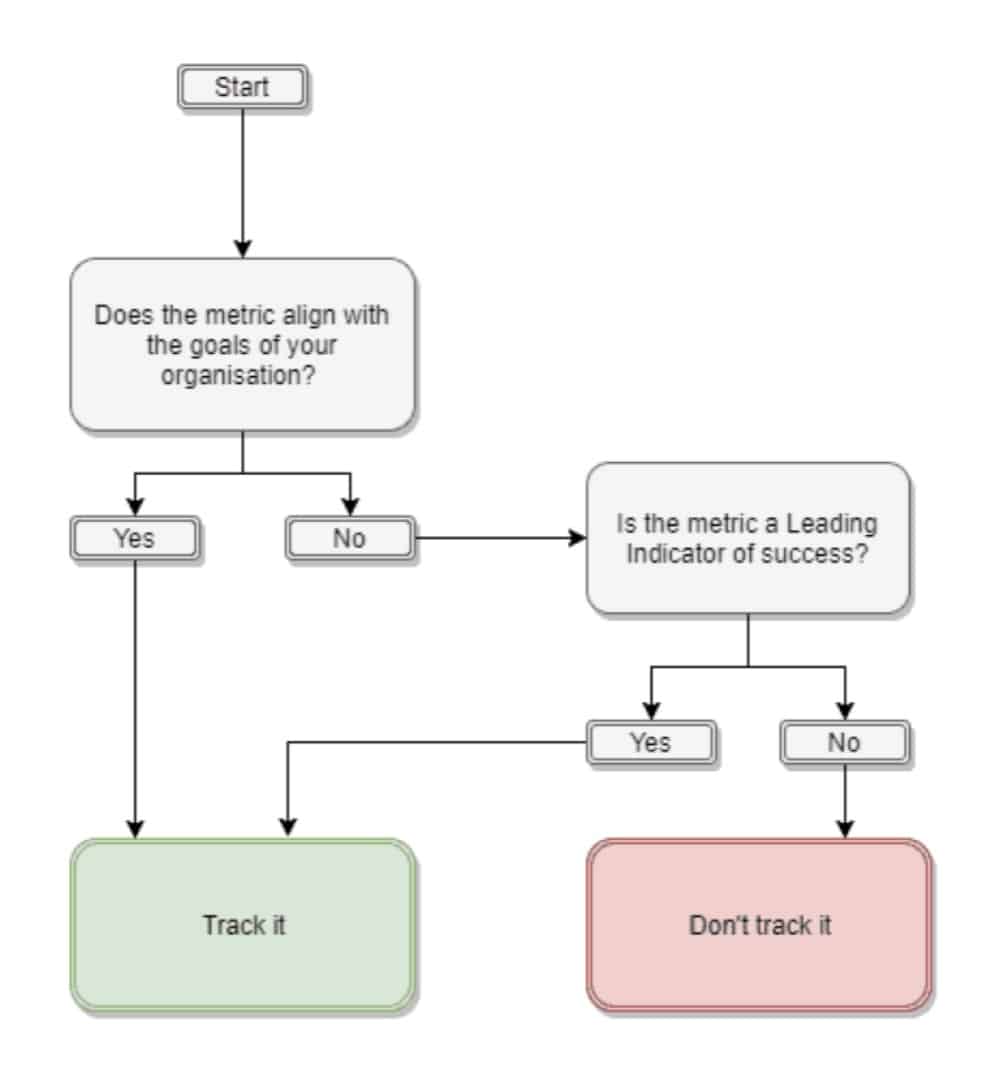
Image Source
3. Set Channel-Specific KPIs
Again, KPI tracking is not a one-size-fits-all approach. Your KPIs need to change depending on which channels you are utilizing, such as social media, email marketing, PPC, referral, email, and so on.
Now, there are some KPIs that do pretty much apply to all channels. According to the Track Maven report we referred to earlier, nearly 91% of marketers agreed that engagement metrics were necessary to track to evaluate the success of any strategy. Consumption, audience growth, and sales and leads numbers also topped the list.
You also need to be aware of how various metrics will change, depending on the channel. For influencer campaigns on social media, you may want to measure metrics like views or engagement and interactions (likes, shares, comments).
However, with on-site content such as blog posts, KPIs like time spent per post, percentage of content that was consumed, and impact on conversion rates are more relevant.
4. Find Where SMART Goals Fit in the RACE Model
You’re probably familiar with the SMART goal acronym: specific, measurable, attainable, relevant, and time-based. It is important that every single KPI you choose fits into all of these categories – otherwise they are a waste of time, energy, and resources, and could lead to confusion or inaccuracies.
Once you have these KPI goals set, you should ensure that they fit into the RACEmodel. RACE stands for Reach, Act, Convert, and Engage. Each of these words represents a phase of the buyer’s journey as well. If your goal is to reach a wider audience, then you are focusing at the top of the funnel i.e., the exploration and discovery phase. So, in addition to meeting the SMART criteria, each KPI should also have a specific place in the RACE framework.
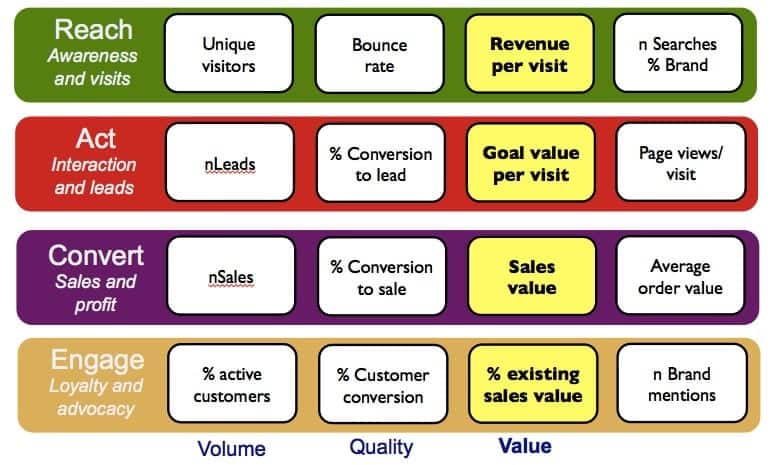
Image source
Challenges in Measuring Digital Marketing KPIs
Measuring digital marketing KPIs isn’t always easy, but as we’ve shown, it’s becoming more and more of a modern marketing requirement.
Some of the challenges in measuring digital marketing include people, processes and of course the technology. Just because the data is available, doesn’t mean every organization has the people to analyze them, the process to turn them into insights and action, or the systems to store those insights.
The main challenges in measuring digital marketing KPIs include:
- Analytic skills and training on understanding digital marketing KPIs in tools like google analytics
- Clear understanding of digital marketing business goals
- Lack of Marketing Dashboards
- A culture of test and learning
- No A/B testing platforms
- Systems to combine data from multiple platforms
Many large companies have experimented with approaches like multi-touch attribution modeling, marketing mix modeling and predictive analytics to help address these challenges. (Nerd alert: Should I write more about this stuff? Let me know because I find it really interesting!)
Define Your KPIs for Success
Defining KPIs is a very important first step for any marketing, sales, or general business initiative – but it is unfortunately often overlooked. The key here is to understand your business, your audience, and your true goals. The ideal way to go about setting and achieving KPIs is:
- Identify the area where you want to measure performance.
- Describe strategic questions to which you need answers.
- Identify your data needs and know your intended results.
- Establish a benchmark against which to measure performance. Set thresholds, milestones, and targets.
- Compare current performance with the benchmark.
- Review results and tweak strategy.
Before you set any new goals or implement a new strategy or campaign, really take the time to consider whether or not you know what you should be looking for, and how you define success or failure. This will lay the foundation to success in achieving your objectives.
Ready to Get Started?
Measuring digital marketing success isn’t just about collecting numbers. It’s about asking the right questions, tracking metrics that connect to real business goals, and avoiding the trap of chasing vanity stats. When you tie KPIs directly to outcomes like revenue, engagement, or retention, the data starts to paint a clear picture of what’s working and what needs adjustment.
You don’t have to overcomplicate the process. Start with a handful of KPIs that matter most to your strategy, set benchmarks, and review results regularly. Over time, you’ll build a smarter, more data-driven approach that helps you prove the value of your marketing and make better decisions for future campaigns.
And if you want to figure out how to set your organizational goals and KPIs, MIG is happy to help! Contact us today so we can get you on track to achieving your business goals.
Read More
By: Lauren Basiura
Title: How to Define Digital Marketing KPIs That Align with Your Business Goals
Sourced From: marketinginsidergroup.com/marketing-strategy/define-digital-marketing-kpis/
Published Date: Tue, 02 Dec 2025 11:00:27 +0000