.png)
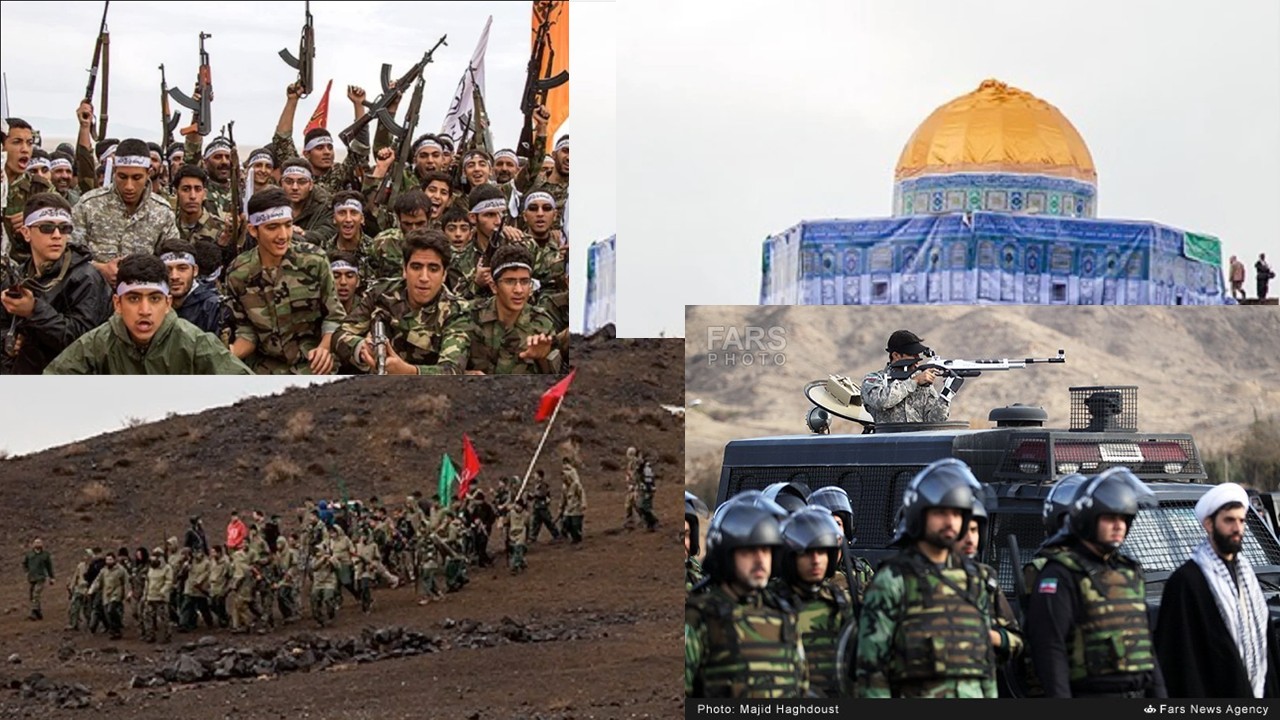
Since the beginning of the U.S.-Iran conflict, media and government sources have become aware that the IRGC is a force distinct from and parallel to Iran’s official armed forces. There is, however, yet another military force that needs to be considered, particularly concerning mine-laying and drone operations in the Strait of Hormuz, as well as any potential ground invasion of Iran.
With Iran’s conventional air and naval forces largely destroyed, the Basij militia has emerged as the regime’s primary surviving instrument of coercive power, one that most coverage has not adequately examined.
The Basij, formally the Sazman-e Basij-e Mostaz’afin, or “Organization for Mobilization of the Oppressed,” is a paramilitary militia of volunteers constituting one of the five branches of the IRGC, alongside the Ground Forces, Aerospace Force, Navy, and Quds Force. Ayatollah Khomeini established the group in 1979 to mobilize ordinary Iranians, especially youth and working-class volunteers, to defend the fledgling regime against internal and external threats.
Estimates vary widely depending on source methodology. Iranian government-linked figures have cited 12.6 million members, including women, with perhaps 600,000 combat-capable. Independent Western analysts, however, place mobilizable or combat-capable Basij forces in the 450,000–600,000 range, with upper-range wartime mobilization scenarios reaching 1 million.
Internal sources suggest the real number fluctuates between 1.5 and 3 million personnel organized into approximately 2,500 battalions. According to the IISS Military Balance 2026, the Basij can mobilize an estimated 600,000 to 1 million personnel in wartime, though training and equipment levels vary dramatically.
Membership is divided into three tiers: regular, active, and special. Regular members are part-time volunteers who receive basic benefits such as coupons and discounts; they serve primarily as a passive intelligence and early-warning network. Active members undergo formalized indoctrination and basic military training and serve more frequently at local bases. Special members constitute the leadership tier, with access to resources and capabilities not available at lower levels.
The Basij consists primarily of young working-class men, or boys under 18, who have yet to begin a career, marry, or have children. Benefits for members include exemption from the 21 months of compulsory military service, reserved university spots, and a small stipend, alongside an initial month and a half of military and ideological training.
The Basij has cells in practically every Iranian city and is present in schools, universities, healthcare, the military, law enforcement, and other social institutions.
Following the destruction of conventional Iranian military assets, the Basij has adapted structurally. As a result of the 2026 conflict, the Basij has been broken into tens of thousands of cells fanned out across mosques, schools, and encampments under bridges. Since the start of the war, Iranian police have deployed 1,463 “special checkpoints,” and in mid-March Israeli drones began attacking Basij and IRGC checkpoints, forcing some to relocate under highway overpasses and bridges.
Critically, analysts note that despite the scale of U.S. and Israeli strikes, the Islamic Republic’s true believers in the IRGC and Basij are operating without known defections, using intimidation to suppress any Iranian who might heed calls for revolt.
An Iranian military official announced that security forces were recruiting children as young as 12 to man checkpoints and perform logistical duties as part of the Basij, a move that contradicts Iran’s commitments under the Convention on the Rights of the Child.
The Basij is the human backbone of Iran’s formal military doctrine. The IRGC has developed a wartime mobilization plan for the Basij called the Mo’in Plan, under which Basij personnel augment regular IRGC units in an invasion scenario. Stay-behind cells are pre-positioned to interdict enemy supply lines as they stretch into Iran’s interior through rugged mountain terrain.
Iran’s “mosaic defense” strategy, formalized in 2005 under General Mohammad Jafari, restructured IRGC command and control into 31 separate provincial commands capable of launching an autonomous insurgency in the event of invasion, a decentralization designed to survive decapitation strikes on leadership.
Basij units, while lightly equipped, are organized at the neighborhood and village level across Iran’s population centers, creating a resistance infrastructure that no invading force could ignore.
Unlike conventional military assets, the Basij represents the regime’s domestic enforcement arm, through which it manages protests, suppresses dissent, and maintains social control. Targeting its facilities signals an effort to diminish the regime’s ability to exert domestic control, not merely its external military capability.
The militia has been linked to violent suppression methods including torture, rape, and other forms of abuse against anti-regime activists, and has threatened hospital staff who attempted to provide medical care to injured protesters.
The Basij’s commander, Gholamreza Soleimani, was killed in an Israeli strike in March 2026, but the cellular, decentralized structure means leadership decapitation does not neutralize the force. As long as the regime survives politically, the Basij, embedded in every mosque, school, and neighborhood, remains its most durable and least targetable instrument of power.
The post Beyond the IRGC: The Basij Militia as Iran’s Third Military Force appeared first on The Gateway Pundit.
------------Read More
By: Antonio Graceffo
Title: Beyond the IRGC: The Basij Militia as Iran’s Third Military Force
Sourced From: www.thegatewaypundit.com/2026/04/beyond-irgc-basij-militia-as-irans-third-military/
Published Date: Mon, 20 Apr 2026 14:15:00 +0000
Did you miss our previous article...
https://trendinginbusiness.business/politcal/the-world-is-waking-up-germans-and-englishmen-join-the-irish-in-protesting-the-farlefts-tyrannical-policies