Exclusive: How a Civil Disobedience Movement Gave Way to a Revolution in Burma
By Cindy HopkinsFebruary 18, 20266 mins read74 Views
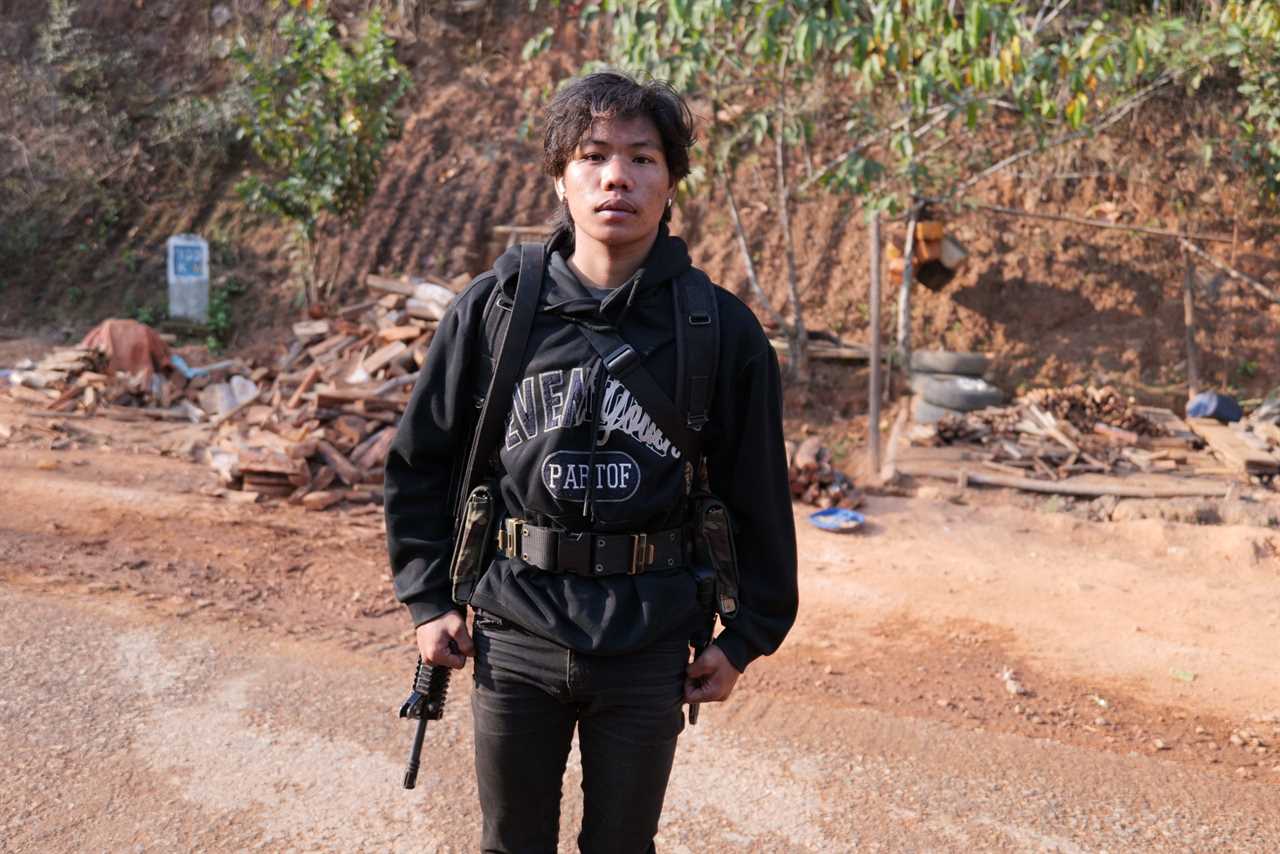
Before the coup, many resistance soldiers were students, tradesmen, and professionals who began in the Civil Disobedience Movement and then transitioned into resistance fighters. They receive no salary. They fight to protect their families and with the hope of gaining a free and democratic Burma. Photo by Antonio Graceffo
From far off, a motorcycle can sound like a drone. The sound always causes my anxiety to rise as I wait to see what materializes over the horizon.
Fortunately, this time it was a motorcycle coming down the dusty trail to the resistance camp where I was staying.
The driver was Saw Emmet, a thirty-four-year-old civil engineer who joined the revolution shortly after the Burma army overturned the election and seized control of the government in 2021.
His first move was to participate in the Civil Disobedience Movement, a widespread protest by teachers, doctors, nurses, and other government employees who refused to serve the generals.
Originally, he and many others tried to remain in the city, launching a campaign of guerrilla warfare. But a friend warned him that the army was coming for him, so he fled to the jungle.
After spending several years on the front lines with combat units, he decided to dedicate himself to volunteering as an engineer wherever his skills were needed in resistance-controlled areas.
Over a cup of instant coffee from my rucksack, Saw Emmet told me about the time before the military coup.
“When we had the NLD government, there were a lot of work opportunities for people in Burma,” he said, recalling the period after the 2015 election, which was won in a landslide by Aung San Suu Kyi’s National League for Democracy.
Although the military retained most of the decision-making power, conditions improved for ordinary citizens under quasi-civilian rule. People had choices.
“People could choose what kind of work they want to do. We had medical work, engineering work, and also business. Some of the young people, they did online business,” he said.
“But after the coup, it was difficult for everybody to find a job,” he added.
Irrespective of official unemployment numbers to the contrary, a significant proportion of Burma’s population is unemployed, and the average citizen has a cash income of about $100 per month. That figure is only an average, however, as the estimated 4 million displaced people often have no income at all.
He noted that the country has been like this, in one form or another, since the 1962 coup led by General Ne Win.
“That is a very long time,” he lamented. Referring to the succession of dictators, he said, “The SAC government, they govern since then.”
The current government under General Min Aung Hlaing, formerly calling itself the SAC, is politically and ideologically the successor to the system established by Ne Win.
Ne Win established the “Three National Causes”: non-disintegration of the Union, non-disintegration of national solidarity, and perpetuation of sovereignty. The current SAC leader, Min Aung Hlaing, uses these same phrases to justify the 2021 coup.
Ne Win pioneered the idea that the military should not only defend the country but also manage its economy and politics. The SAC’s structure, which places military officers in charge of civilian ministries, is a direct continuation of Ne Win’s 1962 Revolutionary Council.
In 1988, there was a pro-democracy movement that resulted in thousands of people, mostly students, monks, and ordinary citizens, being killed in the streets of Yangon and other cities.
Daw Aung San Suu Kyi became the face of democracy at that time and was arrested the following year along with thousands of others.
In 1990, elections were held, and her party, the National League for Democracy (NLD), won by a landslide. However, the military refused to honor the results, and hope for democratic change evaporated.
In 2010, the first general election in 20 years was held. It was widely criticized as a “sham” because it was designed by the military to ensure its proxy party, the USDP, won.
This led to the formation of the Thein Sein government in early 2011. It was called “quasi-civilian” because, although the leaders wore suits instead of uniforms, most were retired generals. Still, conditions improved somewhat for the population.
Saw Emmet explained, “Before 2010, under the dictator government, the people could not own a cellphone. It was very expensive. It cost about $2,000 to $3,000 for one SIM card. Only the cronies, the businessmen, and the generals, the government leaders, could own cell phones. The people could not.”
He continued, “But in 2010, the first civilian government came out, so the SIM card price dropped to about $180. After five years, in 2015, when the NLD government won the election, the SIM card price fell to $12. So we could have our own SIM card, our own cell phone, and freely use the Internet.”
“Almost all of the young people in Burma, our eyes were wide open when we used the Internet at that time,” he said. He began seeing things about Burma that he had never known before.
“It was shocking, very shocking. Before that, we could not hear the news about what was happening in the ethnic areas, like Karen or Kachin or Chin or Arakan.”
He explained that most of Burma’s ethnic minorities, who comprise about 40 percent of the population, previously had little access to outside information.
“After the civilian government, from 2010 to 2020, we could widely use the Internet and share information,” he said.
Ethnic communities often did not realize there was violence in other ethnic regions, particularly in areas, far from his home. “It was impossible to empathize about the violence because we didn’t know,” he said.
This was when solidarity slowly began to take root among people of different ethnicities, who started to realize that the government was abusing all the minorities.
“So from 2015 to 2020, our people in Burma, we had full human rights, a democratic country. At that time, we had freedom. We could criticize the government if they were doing wrong. We had free speech. Before, if we criticized the government, they would send us to jail.”
But everything changed after the coup. Human rights and civil rights came to an end, and protesting became deadly. Saw Emmet referenced the first civilian killed during the protests, Mya Thwe Thwe Khine.
“She got shot in the head,” he said. “When I heard about this, I asked, why did the government shoot their own people? They are supposed to protect us. But they killed that girl.”
That was the turning point for Saw Emmet and many like him who had pinned their hopes on parliamentary procedure and protest as a means of gaining a democratic government. “So, we cannot win in this way, with this kind of protesting. So, we must prepare for the revolution.”
He explained that once people could freely use the Internet, he began researching Burma’s history on his own. What he discovered shocked him.
The SAC, he said, had committed “very terrible things since 1962,” including the violence of 1988, events that were never taught in government schools.
With access to witnesses and video evidence, he began to see proof of killings that he had previously struggled to believe. “When you have access to information and start to find out that people are being killed, I didn’t want to believe it, but I saw the witnesses and the evidence,” he said.
That realization changed him. Concluding that protest alone would not succeed, he decided the revolution had to take another form. “So at that time, I decided we needed to prepare for the revolution in another way. I chose to join the revolution in May 2021.”
This is how an educated civil engineer ended up at a resistance army camp to receive frontline training. Across Burma, thousands, perhaps tens of thousands, have a similar story.
The Burma government succeeded in turning everyone from teachers to accountants into resistance operatives.
The author, Antonio Graceffo, reporting from the war in Burma.
The post Exclusive: How a Civil Disobedience Movement Gave Way to a Revolution in Burma appeared first on The Gateway Pundit.
------------ Read More
By: Antonio Graceffo Title: Exclusive: How a Civil Disobedience Movement Gave Way to a Revolution in Burma Sourced From: www.thegatewaypundit.com/2026/02/exclusive-how-civil-disobedience-movement-gave-way-revolution/ Published Date: Wed, 18 Feb 2026 15:00:10 +0000
.png)