.png)
Eric S. Robinson highlighted the natural beauty of Tybee Island for his dad, stepmom, and two teenage stepsiblings' voluminous house.
Welcome to From the Archive, a look back at stories from Dwell’s past. This story previously appeared in the September 2003 issue.
There is something very reassuring about a house that, for all intents and purposes, slaps you on the back when you cross the threshold and extends a hearty welcome. The house that architect Eric S. Robinson designed for his father, Paul, on Tybee Island, some 20 minutes east of Savannah, Georgia, is such a place. "Pull up a chair," it seems to say. "Make yourself at home."
Which, when I visited recently, was precisely what I did. I was fortunate in that not only did the Robinsons take me on a tour of this splendid house, but they also offered to give me sole possession of it for the better part of three days. Naturally, I said yes. I’m usually diffident in other people’s homes, but not this one. In fact, I became so fond of it, I acted as if I owned the place. One morning, I made myself a nice breakfast, on another, I ended up polishing the bathroom mirrors. It’s a good thing I left when I did: Such is the power of this structure that had I stayed much longer, its residents might have had trouble getting rid of me.
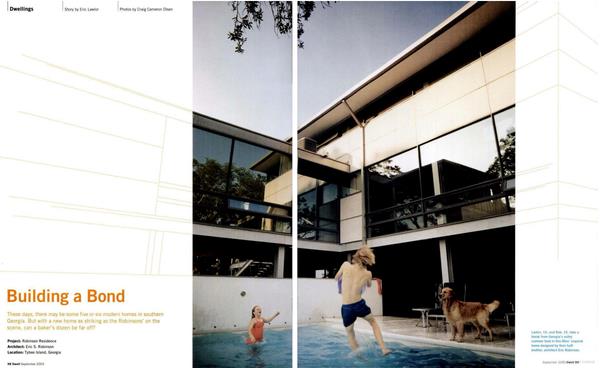
Photo by Craig Olsen
From the outset, Eric wanted the home to function as a viewing platform from which to enjoy, he says, "the changing qualities of the river." Accordingly, the views are stunning. Beyond the estuary lies a deep swath of marshland, and beyond that, the Atlantic Ocean. Among the species that feed in these waters are herons, their legs echoing the pylons of the raised beach houses that line the riverbank, solemn pelicans, and playful dolphins (who swim in for a fish dinner in the evenings and frolic about gleefully in the surf afterward).
The building, bordered on the south by the Back River, echoes somewhat Mies van der Rohe’s Farnsworth House. It wasn’t Eric’s intention to invoke Mies, but once he’d made up his mind to use a steel frame, he explains, the influence couldn’t be disregarded. The T-shaped house, which stands in a floodplain, is raised eight feet off the ground. Savannah’s building code requires six feet of clearance in this area, but Eric opted for the extra space in order to utilize the structure’s underside.
What Eric wanted to capture, he says, was the serenity of the place. To achieve this, he was abetted by what he calls the "horizontal extension" of the river. The trees—mostly oaks, pines, palms, and cedars—also helped. Unlike most people, who cut down trees when they buy land, Paul and Eric preserved every single one—and even planted more. The decision was an enlightened one, because the foliage provides this half-acre site with much of its character. Virtually surrounding the house, the trees shelter it and provide privacy. Looking back from the water, the house is barely visible.
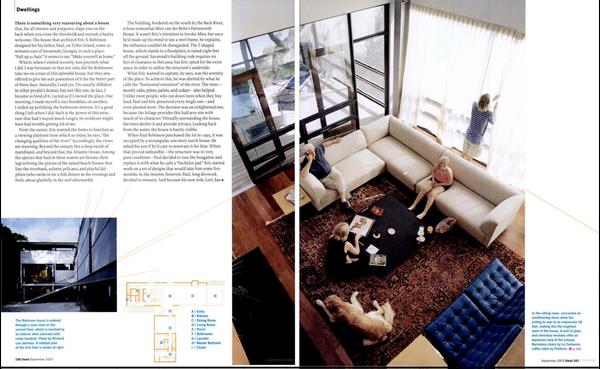
Photos by Richard Leo Johnson (left) and Craig Olsen (right)
When Paul Robinson purchased the lot in 1995, it was occupied by a rectangular, one-story ranch house. He asked his son if he’d care to renovate it for him. When that proved unfeasible—the structure was in very poor condition—Paul decided to raze the bungalow and replace it with what he calls a "bachelor pad." Eric started work on a set of designs that would take him some five months. In the interim, however, Paul, long divorced, decided to remarry. And because his new wife, Lori, has two teenage children, it was determined that the original plan would need to be reconceptualized. Instead of a bachelor pad, what Paul needed now was a year-round house big enough to accommodate a family of four.
The younger Robinson began anew and, six months later, came up with a set of designs to which Paul and Lori gave their approval. There is nothing ostentatious about the building that resulted. The materials used to clad the exterior are understated: tern-coated stainless steel, cedar siding, and fiber-cement panels. In appearance, the panels suggest compressed cardboard, but in Eric’s design, screw fasteners, shop-painted aluminum storefront windows, and neoprene gaskets have been added. "It’s a way of showing how the building was put together," he says.
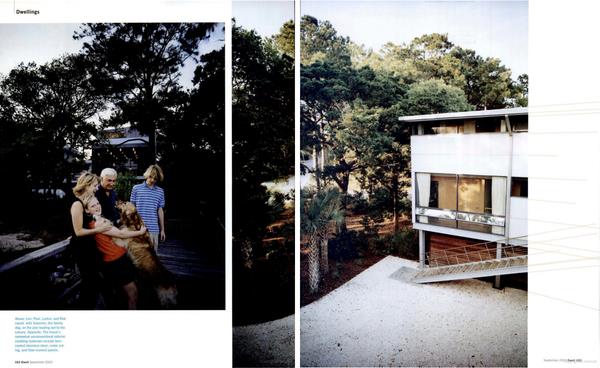
Photos by Craig Olsen
See the full story on Dwell.com: From the Archive: After His Father Remarried, This Architect Designed a New Home for His Stepfamily
Related stories:
- From the Archive: I Grew Up in My Dad’s Modern Masterpiece. It Wasn’t Exactly Kid-Friendly
- Is the Door Closing on First-Generation Homebuyers?
- Vineyards Meet Vintage Furniture at One of Ibiza’s First Passive Houses
Read More
By: Eric Lawlor
Title: From the Archive: After His Father Remarried, This Architect Designed a New Home for His Stepfamily
Sourced From: www.dwell.com/article/from-the-archive-architect-stepfamily-home-5682f736
Published Date: Thu, 29 Jan 2026 19:59:00 GMT