.png)
The midcentury renaissance man, whose career was "a flurry of interiors and fabrics, signage and record albums, and architecture," might not have minded if you judged his book covers.
As a part of our 25th-anniversary celebration, we’re republishing formative magazine stories from before our website launched. This story previously appeared in Dwell’s December/January 2007 issue.
Alvin Lustig summed up the central theme of his short, prolific career when he wrote in 1946, "The words graphic designer, architect or industrial designer stick in my throat, giving me a sense of limitation, of specialization within the specialty, or a relationship to society and form itself that is unsatisfactory and incomplete. This inadequate set of terms to describe an active life reveals only partially the still undefined nature of a designer."
He was, as he put it, "a designer with a capital D," one who didn’t see an inequity between painting and designing business cards, and, in fact, found the distinctions between fine and applied arts superfluous. It’s precisely this democratic approach that made his work so effective.
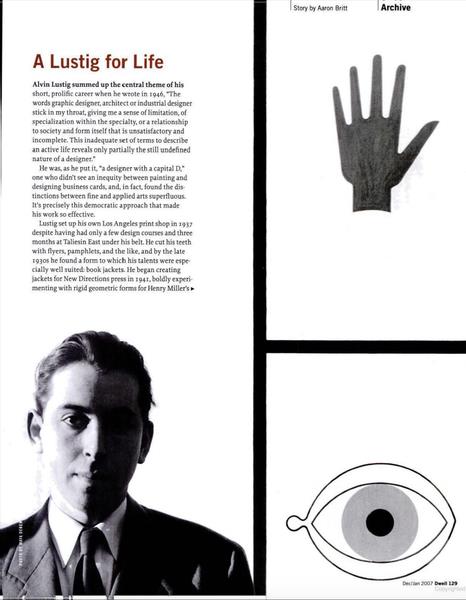
Photo by Maya Deren
Lustig set up his own Los Angeles print shop in 1937 despite having had only a few design courses and three months at Taliesin East under his belt. He cut his teeth with flyers, pamphlets, and the like, and by the late 1930s he found a form to which his talents were especially well suited: book jackets. He began creating jackets for New Directions press in 1941, boldly experimenting with rigid geometric forms for Henry Miller’s The Wisdom of the Heart. But his truly classic jackets came in New Directions’ New Classics series, a quirky batch of reissues of literary fiction, poetry, and drama that constituted a remarkably serviceable primer of modernist lit.
The New Classics designs eschewed both the hard geometry of his early work and the well-trod paths of Deco calligraphy and overwrought representation popular at the time in favor of a style more akin to Joan Miró and Paul Klee. In many ways, the series acted as a canny conduit of modernist ideas and forms, bringing them down from the rarefied gallery and into the small-town bookstore. But perhaps even more rewarding was the way in which the series illustrated Lustig’s deep empathy for the plays, novels, and poems he designed jackets for. New Directions founder and publisher James Laughlin put it this way: "His method was to read a text and get the feel for the author’s creative drive, then to restate it in his own graphic terms."
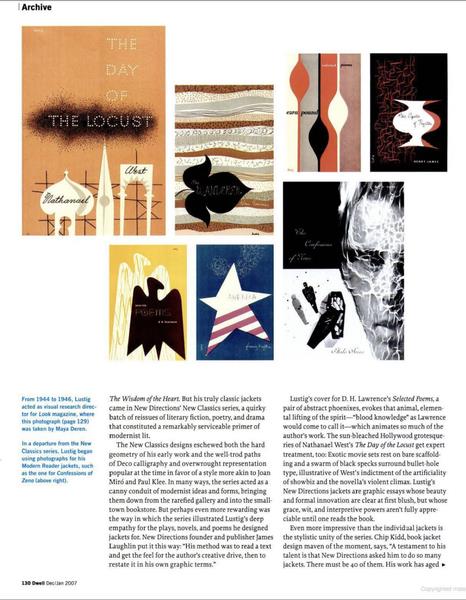
Lustig’s cover for D. M. Lawrence’s Selected Poems, a pair of abstract phoenixes, evokes that animal, elemental lifting of the spirit—"blood knowledge" as Lawrence would come to call it which animates so much of the author’s work. The sun-bleached Hollywood grotesqueries of Nathanael West’s The Day of the Locust get expert treatment, too: Exotic movie sets rest on bare scaffolding and a swarm of black specks surround bullet-hole type, illustrative of West’s indictment of the artificiality of showbiz and the novella’s violent climax. Lustig’s New Directions jackets are graphic essays whose beauty and formal innovation are clear at first blush, but whose grace, wit, and interpretive powers aren’t fully appreciable until one reads the book.
Even more impressive than the individual jackets is the stylistic unity of the series. Chip Kidd, book jacket design maven of the moment, says, "A testament to his talent is that New Directions asked him to do so many jackets. There must be forty of them. His work has aged so well. Fifty some years on it still looks fresh." There were 36 in the New Classics series, but some would call the photographic collages adorning the covers of New Directions’ Modern Reader series his best work.
"To be frank, the most important jackets are the photographic ones," Elaine Lustig Cohen, Lustig’s widow and colleague, opines. "No one was doing that when he was, no one was putting it together that way. They have a rhythm, even when they’re geometric, and all of them were very evocative of the text." The Modern Reader jackets marry Dada-inspired collage, clean composition, typography, and Lustig’s own brand of artful abstraction seen with the New Classics. Especially chilling is his nightmarish collage for Italo Svevo’s The Confessions of Zeno, whose design cuts straight to the essence of the compulsive and dissipated title character.
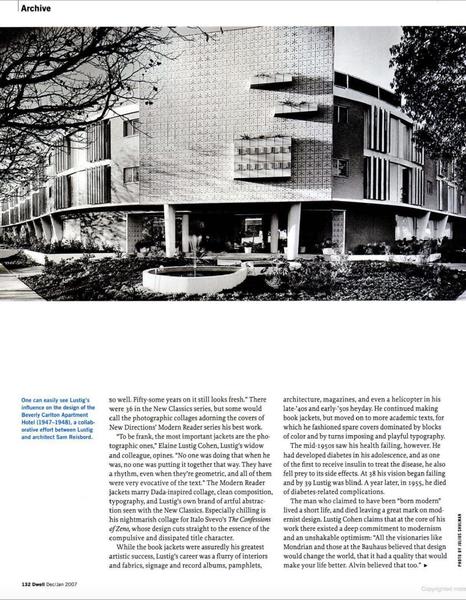
Photo by Julius Shulman
See the full story on Dwell.com: From the Archive: Alvin Lustig, the Designer Who Did It All
Related stories:
- From the Archive: The Lesser-Known, "Lone Wolf" Modernist Master You Should Know
- These Tiny DIY Furniture Kits Inspire a Woodworker’s Life-Size Creations
- The Curators and Dealers Making the Next Generation of Design Stars in America
Read More
By: Aaron Britt
Title: From the Archive: Alvin Lustig, the Designer Who Did It All
Sourced From: www.dwell.com/article/from-the-archive-alvin-lustig-biography-41935162-053b748b
Published Date: Thu, 04 Dec 2025 13:02:18 GMT