.png)
His clients figured a prefabricated log cabin was all they could afford. Massie built something with more personality for less cash.
Welcome to From the Archive, a look back at stories from Dwell’s past. This story previously appeared in the August 2002 issue.
Keith and Sylvia Owens are a suburban London couple who like to indulge in travel and architecture, albeit in a modest fashion. Seven years ago, they found their way to Montana. The clarity of the sky and horizons that stretch for miles so inspired them that when, a year later, Sylvia read an English magazine, Build-It, advertising 2o-acre plots near White Sulphur Springs, they decided to investigate. After arriving in this tiny town in 1997, they bought the smallest available parcel of Grassy Mountain Ranch. "It was the price of a new car," remembers Keith, an art teacher. They planned to erect a cheap, prefabricated log cabin, sit back, and enjoy the spectacular views. Keith would finally have the time to read more about one of his heroes, Le Corbusier.
Then they met William Massie, a 38-year-old architect who designed solely on the computer and planned to build his concept houses in cheap materials like concrete. At that point, back in 1999, he had never built a home, but he promised the Owens that his experiment would be cheaper than anything they could truck in. Even that log cabin. The cautious-inclined couple took another chance.
Two years later, their 2,000-square-foot summer home is a gleaming four-story tower with shimmering, white elliptical sides. The glass facades front and back make the interior so open to the wild Montana landscape that, according to Sylvia, "we feel like we’re living in it." For the Owens, the house fulfills a lifelong ambition to live in an architecturally daring home. What’s more, they could afford it: The price tag was just $145,000.
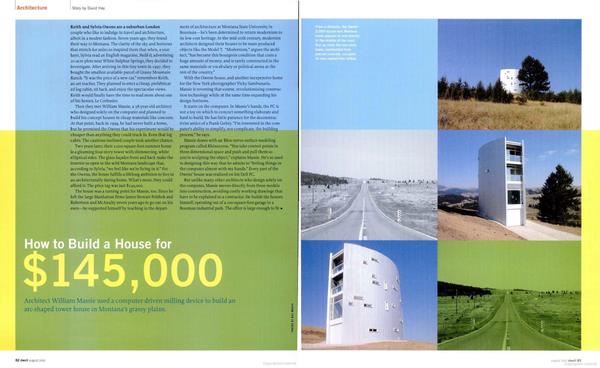
The house was a turning point for Massie, too. Since he left the large Manhattan firms James Stewart Polshek and Robertson and McAnulty seven years ago to go out on his own—he supported himself by teaching in the department of architecture at Montana State University in Bozeman—he’s been determined to return modernism to its low-cost heritage. In the mid-2oth century, modernist architects designed their houses to be mass-produced objects like the Model T. "Modernism," argues the architect, "has become this bourgeois condition that costs a huge amount of money, and is rarely constructed in the same materials or vocabulary or political arena as the rest of the country."
With the Owens house, and another inexpensive home for the New York photographer Vicky Sambunaris, Massie is reversing that course, revolutionizing construction technology while at the same time expanding his design horizons.
It starts on the computer. In Massie’s hands, the PC is not a toy on which to concoct something elaborate and hard to build. He has little patience for the deconstructivist antics of a Frank Gehry. "I’m interested in the computer’s ability to simplify, not complicate, the building process," he says.
Massie draws with an $800 nerve-surface modeling program called Rhinoceros. "You take control points in three-dimensional space and push and pull them so you’re sculpting the object," explains Massie. He’s so used to designing this way that he admits to "feeling things in the computer almost with my hands." Every part of the Owens’ house was realized on his Dell PC.
But unlike many other architects who design solely on the computer, Massie moves directly from these models into construction, avoiding costly working drawings that have to be explained to a contractor. He builds the houses himself, operating out of a 200-square-foot garage in a Bozeman industrial park. The office is large enough to fit a bank of computers and four architecture students as adept at programming as they are at pouring concrete.
Massie’s designs all feature low-cost materials, such as plywood and concrete, that can be bought at Home Depot. He’s especially fond of concrete because it’s highly malleable. "It allows me to experiment, and when it’s poured into a beautiful form, there’s nothing more beautiful in the world," he asserts. (He never misses the annual World of Concrete Convention in Las Vegas.)
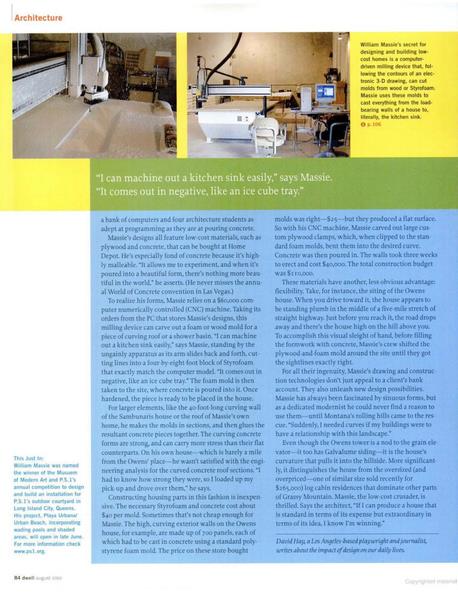
To realize his forms, Massie relies on a $60,000 computer numerically controlled (CNC) machine. Taking its orders from the PC that stores Massie’s designs, this milling device can carve out a foam or wood mold for a piece of curving roof or a shower basin. "I can machine out a kitchen sink easily," says Massie, standing by the ungainly apparatus as its arm slides back and forth, cutting lines into a four-by-eight-foot block of Styrofoam that exactly match the computer model. "It comes out in negative, like an ice cube tray." The foam mold is then taken to the site, where concrete is poured into it. Once hardened, the piece is ready to be placed in the house.
For larger elements like the 40-foot-long curving wall of the Sambunaris house or the roof of Massie’s own home, he makes the molds in sections, and then glues the resultant concrete pieces together. The curving concrete forms are strong, and can carry more stress than their flat counterparts. On his own house—which is barely a mile from the Owens’ place—he wasn’t satisfied with the engineering analysis for the curved concrete roof sections. "I had to know how strong they were, so I loaded up my pickup and drove over them," he says.
Constructing housing parts in this fashion is inexpensive. The necessary Styrofoam and concrete cost about $40 per mold. Sometimes that’s not cheap enough for Massie. The high, curving exterior walls on the Owens house, for example, are made up of 700 panels, each of which had to be cast in concrete using a standard polystyrene foam mold. The price on these store-bought molds was right—$25—but they produced a flat surface. So with his CNC machine, Massie carved out large custom plywood clamps, which, when clipped to the standard foam molds, bent them into the desired curve. Concrete was then poured in. The walls took three weeks to erect and cost $40,000. The total construction budget was $110,000.
These materials have another, less obvious advantage: flexibility. Take, for instance, the siting of the Owens house. When you drive toward it, the house appears to be standing plumb in the middle of a five-mile stretch of straight highway. Just before you reach it, the road drops away and there’s the house high on the hill above you. To accomplish this visual sleight of hand, before filling the formwork with concrete, Massie’s crew shifted the plywood-and-foam mold around the site until they got the sight lines exactly right.
For all their ingenuity, Massie’s drawing and construction technologies don’t just appeal to a client’s bank account. They also unleash new design possibilities. Massie has always been fascinated by sinuous forms, but as a dedicated modernist he could never find a reason to use them—until Montana’s rolling hills came to the rescue. "Suddenly, I needed curves if my buildings were to have a relationship with this landscape."
Even though the Owens tower is a nod to the grain elevator—it too has Galvalume siding—it is the house’s curvature that pulls it into the hillside. More significantly, it distinguishes the house from the oversized (and overpriced—one of similar size sold recently for $265,000) log cabin residences that dominate other parts of Grassy Mountain. Massie, the low-cost crusader, is thrilled. Says the architect, "If I can produce a house that is standard in terms of its expense but extraordinary in terms of its idea, I know I’m winning."
See more from the Dwell archive on US Modernist.
Related Reading:
From the Archive: The Iconoclastic Rise of Charles Haertling
From the Archive: Andrea Zittel’s Tiny, Prophetic Joshua Tree Laboratory
Read More
By: David Hay
Title: From the Archive: For $145K, Architect William Massie Built a Curvy Concrete Home From the Ground Up
Sourced From: www.dwell.com/article/from-the-archive-for-dollar145k-architect-william-massie-built-a-curvy-concrete-home-from-the-ground-up-b5fb55af
Published Date: Thu, 16 Apr 2026 17:29:58 GMT
Did you miss our previous article...
https://trendinginbusiness.business/real-estate/after-a-total-overhaul-this-250k-airstream-is-ready-to-hit-the-road