.png)
In 2001, writer Lynn Gordon reflected on the hazards and harmonies of being a child in the curated and clean-lined home her father designed with architect Stanley Prowler.
Welcome to From the Archive, a look back at stories from Dwell’s past. This story previously appeared in the December 2001 issue.
The "modern masterpiece" was finished a few months before I was born. My mother suspects the paint fumes caused my premature birth. It was the first sign that childhood and this house would perhaps be an awkward fit—not unlike the contrast between my mother’s orange Eames rocking chair and the traditional furniture depicted on the illustrated pages of Beatrix Potter’s Peter Rabbit.
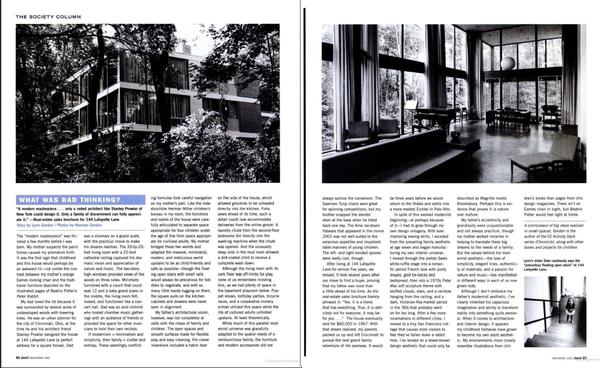
My dad loved the lot because it was surrounded by several acres of undeveloped woods with towering trees. He was an urban planner for the city of Cincinnati, Ohio, at the time he and his architect friend Stanley Prowler designed the house at 144 Lafayette Lane (a perfect address for a square house). Dad was a visionary on a grand scale, with the practical moxie to make his dreams realities. The 33-by-20-foot living room with a 22-foot cathedral ceiling captured his dramatic vision and appreciation of nature and music. The two-story-high windows provided views of the woods on three sides. Minimally furnished with a couch that could seat 12 and a baby grand piano in the middle, the living room felt, looked, and functioned like a concert hall. Dad was an avid violinist who hosted chamber music gatherings with an audience of friends or provided the space for other musicians to hold their own recitals.
If modernism = minimalism and simplicity, then family = clutter and entropy. These seemingly conflicting formulas took careful navigation on my mother’s part. Like the indestructible Herman Miller children’s bureau in my room, the functions and rooms of the house were carefully articulated to separate space appropriate for four children under the age of five from space appropriate for civilized adults. My mother bridged these two worlds and adapted the massive, minimalist, modern, and meticulous world upstairs to be as child-friendly and safe as possible—though the floating open stairs with small rails would always be precarious for toddlers to negotiate, and with so many little hands tugging on them, the square pulls on the kitchen cabinets and drawers were never seen in alignment.
My father’s architectural vision, however, was not completely at odds with the chaos of family and children. The open spaces and smooth surfaces made for flexible play and easy cleaning. His clever inventions included a hatch door on the side of the house, which allowed groceries to be unloaded directly into the kitchen. Forty years ahead of its time, such a detail could now accommodate deliveries from the online grocer. A laundry chute from the second-floor bedrooms fell directly into the washing machine when the chute was opened. And the unusually deep sink in the mud room allowed a dirt-coated child to receive a complete wash down.
Although the living room with its cork floor was off-limits for play, none of us remembers minding this, as we had plenty of space in the basement playroom below. Puppet shows, birthday parties, tricycle races, and a cooperative nursery school utilized this space while the life of cultured adults unfolded upstairs. At least theoretically.
While much of this parallel modernist universe was gracefully adapted to the spatial needs of a rambunctious family, the furniture and modern accessories did not always survive the conversion. The Saarinen Tulip chairs were great for spinning competitions, but my brother snapped the slender stem at the base when he tilted back one day. The Arne Jacobsen flatware that appeared in the movie 2001 was not well-suited to the voracious appetites and impatient table manners of young children. The left-and right-handed spoons were really cool, though.
After living at 144 Lafayette Lane for almost five years, we moved. It took several years after our move to find a buyer, proving that my father was more than a little ahead of his time. As the real-estate sales brochure frankly phrased it: "Yes, it is a home that has everything. True, it is definitely not for everyone. It may be for you…" The house eventually sold for $60,000 in 1967. With that dream realized, my parents packed us up and left Cincinnati to pursue the next grand family adventure of life overseas. It would be three years before we would return to the States and settle into a more modest Eichler in Palo Alto.
In spite of this evolved modernist beginning—or perhaps because of it—l had to grow through my own design ontogeny. With ever-improving sewing skills, I seceded from the prevailing family aesthetic at age seven and began manufacturing my own interior universe. I moved through the prefab Sears white-ruffle stage into a romantic period French look with poofy drapes, gold tie-backs and bedspread, then into a 1970s Peter Max soft sculpture theme with stuffed clouds, stars, and a rainbow hanging from the ceiling, and a dark, Victorian-flea-market period in the ’80s that probably went on for too long. After a few more incarnations in different cities, l moved to a tiny San Francisco cottage that causes most visitors to feel they’ve fallen down a rabbit hole. I’ve landed on a lesser-known design aesthetic that could only be described as Magritte meets Bloomsbury. Perhaps this is evidence that proves it is nature over nurture.
My father’s eccentricity and grandiosity were unquestionable and not always practical, though my mother worked miracles in helping to translate these big dreams to the needs of a family. But the values behind his modernist aesthetic—the love of simplicity, elegant lines, authenticity of materials, and a passion for nature and music—has manifested in different ways in each of us now grown kids.
Although I don’t embrace my father’s modernist aesthetic, I’ve clearly inherited his capacious imagination and ability to transform reality into something quite personal. When it comes to architecture and interior design, it appears my childhood fantasies have grown to become my own adult aesthetic. My environments more closely resemble illustrations from children’s books than pages from chic design magazines. There isn’t an Eames chair in sight, but Beatrix Potter would feel right at home.
See more from the Dwell archive on US Modernist.
Related Reading:
From the Archive: A Restoration Expert Turns a Crumbling "Archetypal" Barn Into His Family’s Getaway
From the Archive: How I Rediscovered My Parents’ Style—and Myself—in an East Village Loft
Read More
By: Lynn Gordon
Title: From the Archive: I Grew Up in My Dad’s Modern Masterpiece. It Wasn’t Exactly Kid-Friendly.
Sourced From: www.dwell.com/article/from-the-archive-dads-modernist-masterpiece-cc0f548d
Published Date: Thu, 22 Jan 2026 18:21:49 GMT