.png)
I’d dreamed of an at-home schvitz for years, and after meticulous research and a couple of days of assembly, that dream has finally come true.
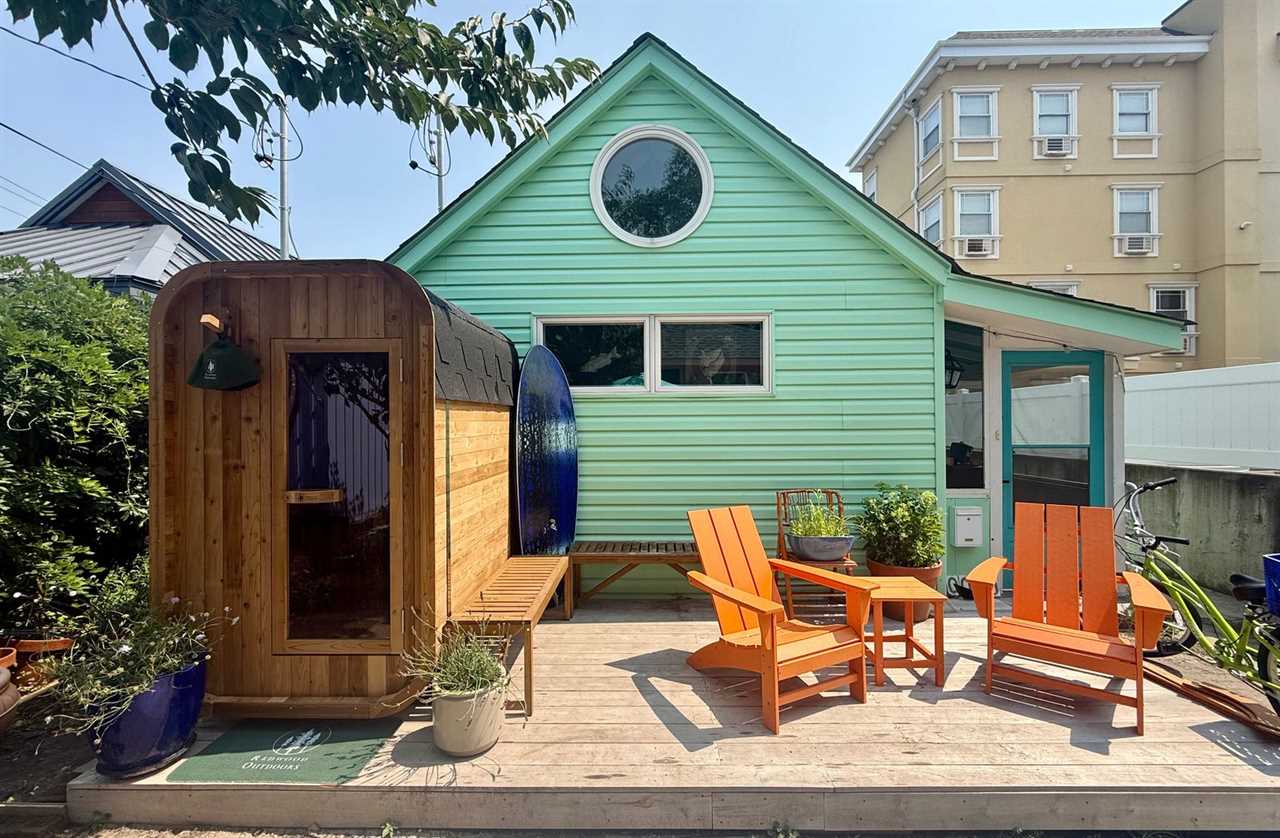
According to my Instagram Explore page, I am certainly not the first (or last) person to get hooked on sauna over the past few years. Where I live in New York City, we’ve gone from having to seek a schvitz at our local Equinox or YMCA to now having a multitude of spaces solely dedicated to sweating to enjoy. (Or freezing and then sweating again—whatever your preference!) But pricing tends to restrict the average New Yorker to only occasional visits (like you might treat massages, facials and the like), when sauna is supposed to be a weekly—if not daily—experience. For so many lucky people across the globe, the bathhouse (or hammam or banya or jjimjilbang or sento) is more of an amenity as opposed to an occasion. Perhaps we’ll get there someday! I’d like to think bathing culture is something our water-surrounded city will embrace wholeheartedly. But until then, I decided I needed to take sauna access into my own hands.
If you’re a city dweller like me, you have quite a few options to get your regular sweat on. There’s the "sauna bag" strategy—a few of my friends swear by Higher Dose’s $700 set up—a schvitz you could achieve while supine and bingeing your favorite Netflix show. There are tents that pop up with machines that pump steam while you sit inside on a folding chair. There’s also this hideous portable sauna where you become the sauna, with your head and arms poking through so you can scroll while you cook? (Show this thing to a Finnish person for a guaranteed scream.) All somewhat acceptable in various ways, but providing nowhere near the exhilaration (and ultimately, relaxation) you get from a more traditional setup of hot rocks in a wood box. And, sorry, I’ll never be an infrared sauna girl: there’s just something that feels wrong about being heated up "from the inside out", no matter the health benefits they claim! I believe you, but I think it’s important to break a real sweat.
Small apartment renters might be out of luck, but even if you only have a bit of space, you might be surprised at the number of compact sauna structures on the market. In 2021, when I bought a 400-square-foot Rockaway Beach bungalow and renovated it, I never imagined that the small space in front could hold anything more than some comfy Adirondacks and a small garden. But after a few years, I saved up to build a teak deck across the approximately 90 square feet of space, which created a ton more usable space in front of the small house. I’d always had the fantasy of building my very own sauna, but could never figure out where exactly it would go. Was there now finally a place?
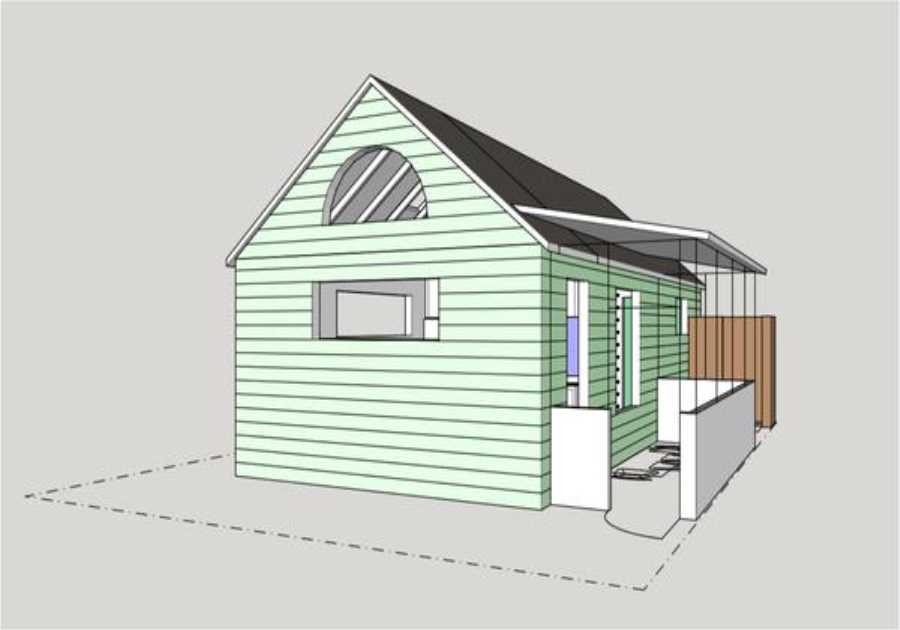
Behold the original design by my incredible architect, Andrew Daley. Notice the outline of the front "yard."
Courtesy of the author
From the side of the deck to the left edge of the centered window, I found out that I had four feet nine inches (along with the depth of the deck, which is six feet nine inches) to work with. And despite the appeal of a traditional Finnish savusauna, for safety reasons, I didn’t think my neighbors (whose houses are quite close to mine) would appreciate a wood-burning stove so close to their properties. (Although if you live in the middle of nowhere or have a huge yard space to work with, a wood-burning steam gets you the best schvitz there is.) Luckily, an electric stove with sauna rocks can achieve a gorgeous steam (that’s what the water-filled buckets are for) and, as I was told by a customer service agent I spoke with, could be easily routed directly into my nearby electrical box, requiring a 240V capacity. (Luckily I’d already upgraded my electrical. More on that in a bit.) Through many rounds of measuring and internet scouring, I learned that the most affordable electric saunas were not usually the smaller ones—the oft-recommended "Costco Barrel Sauna" is a great deal at $3,500 (which includes the Harvia heater), but would cover my front window with its rounded shape. They also have a slightly more expensive version that’s less rounded, which would be a great option if I was willing to cover just some of the front window. Which I wasn’t.
Because so many outdoor sauna makers are often committed to the barrel (and provide space to fit 2-plus people), it wasn’t exactly easy to find a more rectangular shape that would accommodate my smallish footprint. That was my main requirement. Otherwise, I was hoping to find something that would stand up to the wet, salty environment of the Rockaways, be relatively easy to keep up, and fit in with the existing look and feel of my house and our community. Here are a few I did find that fit the bill at varying price points:
- Finlandia Outdoor Sauna Room (48" x 48", $8,655, with heater) — built in red cedar, mahogany with a thoughtful "Starline roof" for easy water run-off
- The Sweat Pod Traditional (53"W x 61.25"D x 77.375"H, $6,045, with heater) — built in red cedar with clean, rounded edges
- Plunge’s The Sauna Mini (94"H × 52"W × 57"D, $10,990 with heater) — built in cedar with an oversized glass door and unique slanted roof
- REVIVE 2-Person Traditional (77.5"H × 47.4"W × 59"D, $6,499, with heater) — built in hemlock with backrests, LED lighting and WiFi capability
- Redwood Outdoors Duo (62 ¾"D x 50 ¾"W x 82 ¾"H, $5,899, with heater) — built in hemlock and propped up on solid sleepers with a compact rounded design
- Cielo Sky View Heritage (rounded diameter 57.5", $3,900, without heater) — built in pine with a fully rounded exterior and bold sunroof
- SunRay Saunas 2 (50"W x 50"D x 98"H, $4,990, with heater) — built in hemlock with a weather-proofed metal roof and internal Bluetooth speakers
They were all chic in their own ways: ranging from fully rounded with expansive sunroof to a more stall-type shape—with varying features like glass doors, WiFi-connected stoves and the Plunge’s "Sauna Phone Mount", which is a genius (or unnecessary, depending on your perspective) exterior perch to "keep your phone cool while still being able to view the timer or monitor incoming calls." A few different types of wood were represented, but all promised to be "heat-treated" aka wood that has been heated to high temperatures (356°F to 428°F) without chemicals. (Which extends the sauna’s longevity by removing natural resins, preventing rot and lowering thermal conductivity aka keeping the bench comfortable to sit on.) All claimed to be water and weather-proofed, but each had a different way to protect the sauna: from pitched roofs, to shingles to metal slopes.
As for the sauna itself, I went with Redwood Outdoors Duo. Why? While I received mine gratis as a tester, for me the Duo’s price point is ideal: smack in the middle between the famously affordable Costco Barrel (which wouldn’t fit on my deck anyway) and some of the higher end saunas, loaded with (often unnecessary) bells and whistles. I also noticed that Redwood Outdoors had the most detail when it came to actually building the sauna: PDFs I could access before I even pressed purchase (very useful for electrician planning!), as well as a slew of YouTube instructional videos. They also very clearly advertised a phone number that would lead you to a hotline with actual human beings available to help with any snags along the way. Plus, the almost four foot three width booth-style sauna was practically tailor-made for my space, snugly sitting between the window’s edge and the end of the deck.
Duo Outdoor Sauna
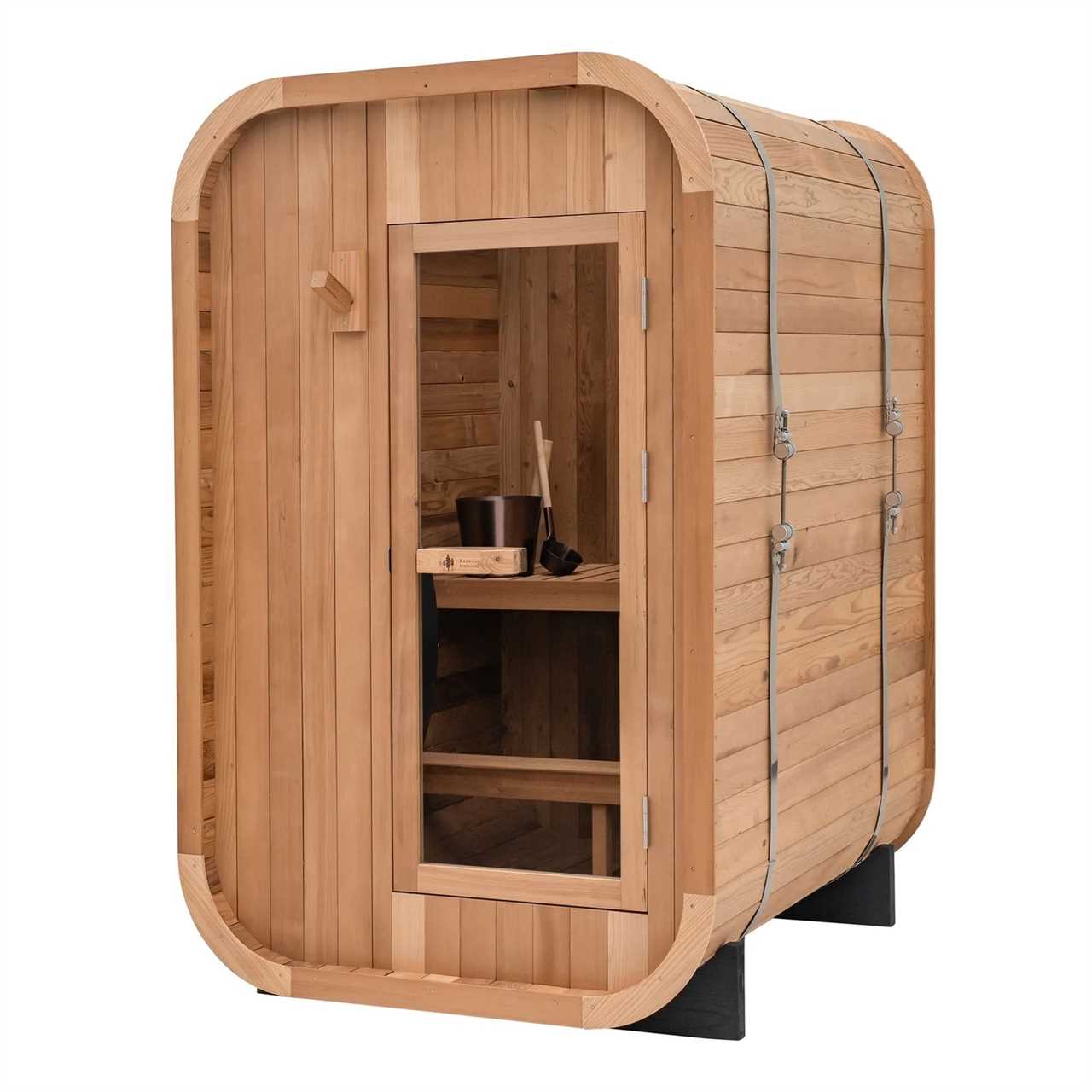
Its compact minimalist design fits well into any outdoor space, perfect for transforming urban backyards or rooftop gardens into a wellness oasis.
Because some saunas come with a heater while others require you to buy one separately, I also had the option of a few different heaters. Some included the Harvia KIP ($954 to $1,172), a petite, wall-mounted stove, complete with sauna stones perfect for producing a bit of steam when sprayed with some water. There was also the more pricey HUUM Drop ($1,334 to $1,751) and Harvia Spirit ($1,715 to $1,777)—both more stylishly rounded and with space for more rocks (therefore more access to steam.) With such a small footprint, and a budget in mind, the more compact Harvia line (as well as comparable Amerec or Finlandia) will do. And make sure you check the wattage; that’s useful information for your electrician. They’ll usually run anywhere from 3 kilowatts to 8 kilowatts. For a small sauna, you don’t need huge heating power—3 to 5 kilowatts will do! I ended up with a 6 kilowatt Harvia Spirit, which heats my sauna up to 170 degrees in about 25 minutes (fantastic), but is almost a little too big for the space. The sauna also doesn’t come with a safety rail, which I ended up buying myself and was very much needed. But before adding that extra accoutrement, first I had to put the sauna itself together.
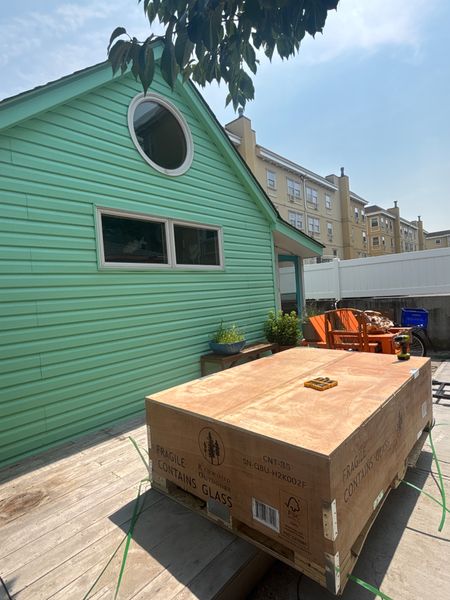
At 1000 pounds, unpacking the box the sauna pieces are inside of is a challenge in its own right.
Courtesy of the author
Pre-assembly
If you’ve ever wondered how a ~1,000 pound package arrives, well, it’s in one huge crate and a slightly-smaller (but still quite heavy) box. Shipping for the Duo is around $600 (to the New York area, specifically), but other more expensive saunas will ship for free. Anything that arrives by freight will also come with the ability to schedule a specific delivery time frame, so don’t worry about making sure you’re around to receive. Perhaps you should ask a friend if you can borrow a spare dolly (or buy one in advance.). Especially if your sauna is heading to a location off a main road, be warned that freight truck drivers will not deliver your new ~1,000 pound sauna directly to your door. (Unless, let’s say, you have a generous cash tip on hand and ask very, very nicely. Something I will not confirm or deny that I did.)
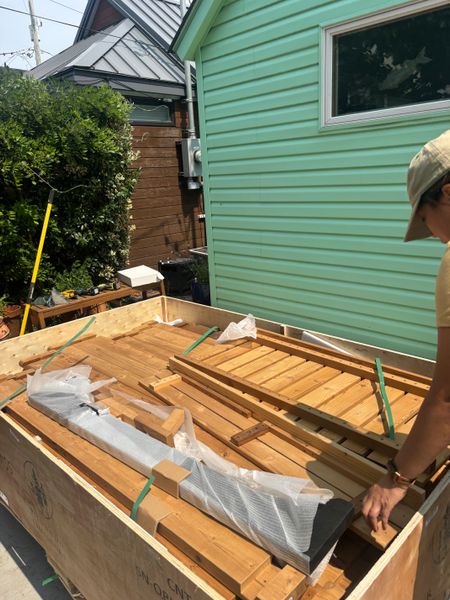
A reminder to check what’s in the box before you begin to put things together.
Courtesy of the author
See the full story on Dwell.com: I Built a Sauna in My Tiny New York City Front Yard in Just One Weekend
Related stories:
- A Guide to Preapproved ADU Plans in Your City
- Forget Gatekeeping, Annie Meyers-Shyer’s "This Oak House" Shares Every Single Source for Her Home
- How Food Influencer Dan Pelosi Built an Upstate New York Garden Where Everyone’s Invited
Read More
By: Lindsey Weber
Title: I Built a Sauna in My Tiny New York City Front Yard in Just One Weekend
Sourced From: www.dwell.com/article/new-york-city-at-home-sauna-diy-e99ee47d
Published Date: Tue, 06 Oct 2026 14:18:34 GMT
Did you miss our previous article...
https://trendinginbusiness.business/real-estate/this-900k-cottage-is-a-little-slice-of-scandinavia-near-joshua-tree