.png)
Two grassroots groups formed by local design professionals after the L.A. wildfires are creating paths for residents to rebuild with speed, cost, and the area’s architectural identity in mind.
How do you rebuild a town? In Altadena, California, that’s the question everyone’s been asking since thousands upon thousands of residents were suddenly and unwillingly thrust into the home-building marketplace in the wake of January’s Eaton Fire. Already reeling from the trauma of losing their homes, neighborhoods, and possessions, Altadenans are having to reckon with the reality of what it means to rebuild, dealing with the rising costs of construction to the reality of being underinsured to the tedious logistics of actually getting through the permitting process.
But with so many people being forced to rebuild all at once, couldn’t there be a better way? A way where people could team up, block by block or neighbor by neighbor and share the burden of a rebuild? And a way that could pay tribute to Altadena’s architectural character, which was a mishmash of Craftsman, Spanish-style, and midcentury homes, all imbued with equal love and care? Even if Altadena can’t be what it was, could there be a way to aesthetically streamline the home-design process, creating a sort of "new-old Altadena" look for the houses to come?
A few local groups certainly think so, and are attempting to do just that. There’s the Foothill Catalog Foundation, which was founded one week after the devastating L.A. wildfires by local residents and design professionals, and is providing affected residents with preapproved, setting-appropriate plans so they can more easily rebuild. And there’s the Altadena Collective, also formed by local design professionals, which is taking advantage of the economy of scale, encouraging neighbors to act as groups throughout the rebuilding process to help one another make more informed and affordable decisions.
Prefab plans
As a resident of nearby Pasadena, Cynthia Sigler says she was all too aware of how many people were suffering in the aftermath of the fires, not just from the loss of their homes but from the mental load of everything that came after. "My husband [Alex Athenson] and I are architects and we know the process of rebuilding and all that it entails," Sigler says. "We knew that, at this scale, there were going to be so many people that may not have the resources, whether financial or emotional, that are required to go through the design and build process."
In an effort to help, as she says, "more than just one individual client or even the handful of clients one architect might be able to take on," Sigler and her husband leapt into action in the weeks following the fire, recruiting like-minded friends and professionals to develop what would become the Foothill Catalog nonprofit. Together, the group worked to figure out how to not only speed along residents’ rebuilding processes, but also to maintain what made Altadena special.
"Altadena has such a strong, palpable character from an architectural perspective," Sigler says. "It’s very eclectic and diverse in its styles and I think a lot of people really love that about it. We thought that could be at risk if we weren’t able to help provide some affordable options that still helped retain that character."
The group thought of the catalog model of home building, first popularized by companies like Sears and Aladdin in the early 1900s. "At the time, people could flip through this catalog and pick a home that fit their budget and their family size, and while it wasn’t custom, it was well-designed and well-built of good materials," Sigler says. "We wanted to take that ethos to the masses, modernizing it for our needs and regulations today."
The group started by surveying what the fire had taken, gathering data on lot and home size for all properties lost in Altadena. They also thought about design styles, reckoning with the region’s architectural diversity and local history before deciding to focus on a blend of mostly California Craftsman, Spanish Mission Revival, Tudor Revival, American Colonial Revival, California ranch, and midcentury-modern designs. They put out a call to action throughout the design community, asking designers and architects in Los Angeles, but also around the country, to submit concept designs based on the framework developed, taking into consideration architectural styles, typologies, lot sizes, home size, and beyond. From there, the group—which was at the time made up entirely of volunteers but has now grown to 10 paid employees, all of whom have their salaries covered by grants or charitable donations—held a community open house to get residents’ feedback on the homes.
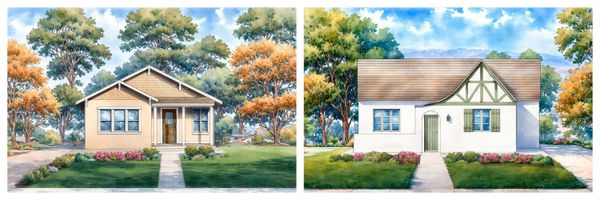
From left: Concept art of the Foothill Catalog’s Elderflower and Cromwell house plans.
Courtesy Foothill Catalog
After all that feedback and buildup, the Foothill Catalog launched its first 10 plans in July 2025, ranging from a 1,075-square-foot Craftsman dubbed the Elderflower to a four-bed, 1,915-square-foot Tudor Revival-style cottage known as the Cromwell. While only some of the actual architectural plans have been finalized and prepermitted, the designs and mock-ups have given homeowners a way to visualize how they might rebuild—especially if they’re looking to recapture some of the original charm of their now-gone homes—albeit with more of an eye toward fire resiliency than their houses might have had previously. (The organization says all of its plans "are reviewed for compliance with current building codes and fire-resistant construction standards" on its website.) The plans aren’t reinventing the wheel, though: Sigler notes that some of the now 20 home options (and three ADUs) have the same essential layouts with different exteriors, but they’re solid, well-designed, and aesthetically pleasing. And, Sigler says, Altadenans seem to love them.
"At least sixty people have filled out our intake form saying that they’re interested in rebuilding with a phase one design," she says. "We’ve also talked to hundreds of homeowners over the past several months, all of whom are assessing their options." So far, the catalog’s California bungalow, the Lewis, seems to have the most admirers, but Sigler says there’s also a lot of interest in the Spanish Colonial Revival La Solana and Spanish Mission Revival La Mariposa designs. She also says that there are at least "a handful of people" interested in each of the group’s plans, and that the nonprofit aims to introduce even more preapproved designs in the weeks and months to come, including a new set of plans for the Palisades, where in January the Palisades Fire also destroyed thousands of residences. And production has actually started, with walls just recently going up on the first one, a Lewis, that’s being built for a family by San Gabriel Valley Habitat for Humanity.
Should a fire survivor choose to rebuild with a Lewis, they’d simply have to license the finished plans at a cost of $5 per square foot for the design. Plans for a 1,500-square-foot home, for instance, would cost $7,500. (Before licensing preapproved plans, Sigler says the Foothill Catalog team members have consultations with homeowners to determine which designs are feasible for their property, budget, and lifestyle.) From there, the licensee would receive a full set of construction documents, structural engineering, Title 24 calculations, and preapproved permit status. And the license fee would support the organization’s insurance costs and contributing designers who put the concepts and schematics together, having signed away their partially completed plans to the catalog, who takes them over the finish line.
Should that per-foot cost prove too high for some people, as a nonprofit, the Foothill Catalog says it’s both working in partnership with Habitat for Humanity to build homes and actively fundraising to cover licensing costs for those who are underinsured and uninsured and "of the greatest need." Hiring an architect for custom residential design typically costs 10 to 15 percent of construction costs, meaning fees for a 1,500-square-foot home built at $550 per square foot—which is within the reported range for rebuild cost estimates in Altadena, with some almost double that—would run between $82,500 and $123,750. It’s clear that, any way you slice it, the catalog is a deal.
Using a preapproved, standard plan could mean savings for builders and homeowners alike. MacKenzie Champlin, the Foothill Catalog’s director of programs and partnerships, says that if a whole block of residents were to use catalog designs and the same builders, for instance, they could work to coordinate their construction timelines across projects. "There are a lot of lessons to be learned from doing things at scale," Champlin says. "You have to help the community reap those benefits while finding their own character and their own approach and their own selection of whatever design they choose. It’s an interesting line to walk because there’s a little bit of stigma [around volume building] and that’s deserved, but this is also an opportunity to disrupt things."
Building in bulk
Elsewhere in town, the Altadena Collective is looking to do a little disrupting of its own.
Tim Vordtriede, who started the group alongside local architects Chris Corbett and Chris Driscoll, says he’d just left his last firm and opened up his own office above his garage five days before the Eaton Fire. His home was destroyed, and in an effort to keep moving forward, he decided to focus his efforts on rebuilding what he’d lost. But as he cruised local Reddit pages, WhatsApp groups, and Instagram posts looking for news in the wake of the fire, he discovered that the prices other survivors were being quoted were surprisingly high. "Seeing that, in the marketplace, you might pay $80,000 for architecture fees for a home just made me very upset," Vordtriede says. "Someone’s trying to build a 1,500-, 1,600-square-foot traditional home. We’re not trying to sell dreams to people. We’re trying to help them get out of a nightmare."
Vordtriede had lived in a 100-year-old English-style cottage built by a developer/con artist named Elisha P. Janes. More than 300 of Janes’ creations dotted the Altadena landscape, all built around the same time, and many were lost in the fire. With that in mind, Vordtriede says, working together to rebuild "just made sense to me as a production model." It was, he adds, "the notion of turning lemons into lemonade."
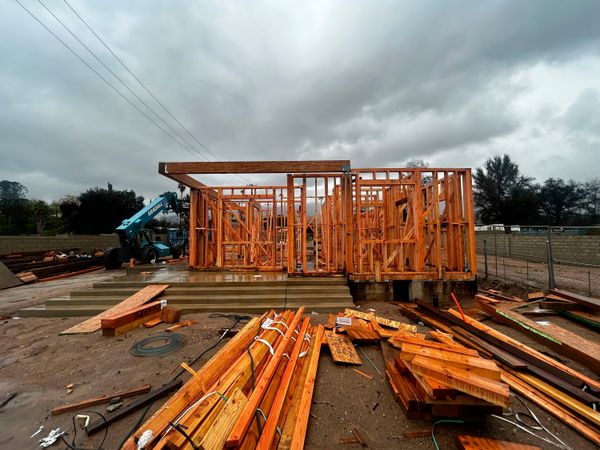
A home plan from the Altadena Collective under construction.
Courtesy Altadena Collective
Hooking up with a group of like-minded Janes Cottage owners, the Altadena Collective founders and other industry professionals started to think about what they could do to take the burden off their neighbors, if only a little. They decided to put their job skills to good use, analyzing unburnt Janes Cottages along with historic and recent news articles, photos, and real estate listings to help them create technical documentation of the devastated structures. Eventually, they designed a collection of updated plans for new Janes Cottage catalog-style semicustom houses.
Identifying six distinct Janes Cottage designs, the collective assigned each a name based on local lore. The three-bedroom Butler, for instance, is named after Altadena native and author Octavia Butler, while the Cobb is a tribute to a once grand Altadena estate owned by the Marx Brothers. In May, the collective created a request for qualifications (RFQ) and request for proposal (RFP) based on those designs and sent it out to about 60 different local general contractors, inviting them to use the cottage designs as a framework on which to estimate pricing. From there, the group got 18 bids from builders, which they whittled down to nine they deemed qualified, then compiled into a spreadsheet and presented to the collective members (many of whom also lost their homes in the Eaton Fire).
Jodie Mendelson, an architect who lives in L.A. and joined the group wanting to help, says that, if you think about it, architects are the perfect people to shepherd people through a rebuild. "We’re taught to be good communicators, and we care a whole lot about what we do," she explains. "We got really great data on what the approximate square foot of construction is going to cost for each builder," Mendelson adds, noting that "they were actually surprisingly within range of each other at somewhere between $450 and $550 a square foot."
"A rebuild doesn’t have to be this expensive, hoity-toity thing that people might think of it as, especially when you’re not in the market for architecture," Vordtriede says. "It can be the mechanics by which you approach any project, from the simple perspective of AIA contracts to how it’s good to negotiate with contractors. All the kinds of unsexy parts of architecture, but those are the important parts that can make or break a project’s success."
All builders vetted by the group have to agree to use the AIA’s contract documents, so as to keep homeowners from falling prey to scammers, like companies who might disappear mid-job or blow through stated deadlines, and all builders were asked to estimate how many homes they thought they could do in one year. Some builders said they’d only have the capacity to do a few houses at a time, while others said they could do 30 in a year—a figure that sounds impressive until you realize that with more than 6,000 homes lost in Altadena, it would still take dozens upon dozens of those companies to come on board before you got anywhere near the amount of workers the town needs.
"First and foremost," Mendelson says, "our goal is to expose our homeowners to the vetting process to prevent them from being scammed. The next goal is to educate them on the different types of builders out there, exposing them to a wide range of professionals so that they can decide who they think feels best to work with." The group isn’t recommending any particular builder, but by giving fire survivors information about industry standards and protocols for contractor selection, they think they’ll be able to help people make more informed choices.All builders vetted by the group have to agree to use the AIA’s contract documents, so as to keep homeowners from falling prey to scammers, like companies who might disappear mid-job or blow through stated deadlines, and all builders were asked to estimate how many homes they thought they could do in one year. Some builders said they’d only have the capacity to do a few houses at a time, while others said they could do 30 in a year—a figure that sounds impressive until you realize that with more than 6,000 homes lost in Altadena, it would still take dozens upon dozens of those companies to come on board before you got anywhere near the amount of workers the town needs.
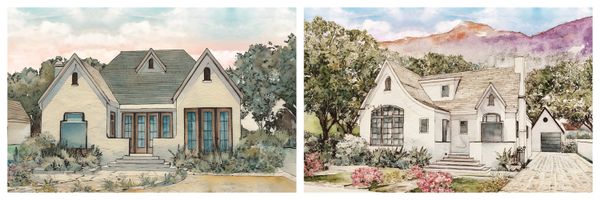
From left: Concept art of the Butler and the Cobb by the Altadena Collective.
Courtesy Altadena Collective
See the full story on Dwell.com: Inside the Community Effort to Affordably and Beautifully Rebuild a New-Old Altadena
Read More
By: Marah Eakin
Title: Inside the Community Effort to Affordably and Beautifully Rebuild a New-Old Altadena
Sourced From: www.dwell.com/article/foothill-catalog-foundation-altadena-collective-rebuilding-efforts-ad58f913
Published Date: Mon, 08 Dec 2025 18:37:20 GMT
Did you miss our previous article...
https://trendinginbusiness.business/real-estate/this-brick-house-melds-mexican-and-nordic-traditions