.png)
New York City’s $16 billion plan to close Rikers Island involves four smaller facilities that tout a more humane vision of carceral buildings. Some activists think that’s an oxymoron.
In the fall of 2024, Chloë Bass opened her email to see a congratulatory subject line from Percent for Art, the arm of New York City’s Department of Cultural Affairs that ensures one percent of the budget for city-funded construction projects is spent on public artwork. She was a semifinalist, the email read, being considered to create art for five yet-to-be designed projects around the city. She hadn’t applied or signed up for this, but as a born-and-raised New Yorker and multidisciplinary artist, it’s not surprising her work would be identified. She curiously scrolled to the list of locations. Nearly all of them were jails.
Bass is one of multiple artists who was prospected to work with the Borough-Based Jail program (BBJ), which seeks to replace all jail facilities on Rikers Island with "four modern, more human jail sites" in Queens, Brooklyn, Manhattan, and the Bronx. The artist publicly refused the offer, sharing with me that "signing a contract that says this jail will exist certainly beyond the bounds of my lifetime" is not something she could agree with as a self-proclaimed abolitionist. She said if anyone were to benefit from the $900,000 project, "it should be a person whose life has been adversely impacted by the criminal legal system."
Some consider the BBJ program as a whole an upgrade compared to the cruel shell that is Rikers, a complex comprising 10 jails and over 14,000 beds, excluding a recently removed barge. Edwin Santana, a community organizer at the Urban Justice Center’s Freedom Agenda project, did time on both the island and barge and recalls "feeling like nobody knew I was there, like I was trapped in a different world amongst rats, roaches, and people who didn’t care about my wellness." As part of the leading organization behind the Campaign to Close Rikers, Santana supports the BBJ plan as one that simultaneously decarcerates—it will purportedly reduce the city’s total jail capacity by up to 75 percent and could bring down the current jail population by roughly 39 percent—and improves the material conditions of those still confined in New York City jails. "The pieces around culture change are ongoing work for all of us, but everyone feels pretty clear that’s not going to happen at Rikers," adds Sarita Daftary, cofounder and codirector of Freedom Agenda. She says the plan "will directly address the problems related to incarcerating people in crumbling buildings on an isolated island built on toxic land." Projected to save the city $1.2 billion a year, it would cut staffing costs for the Department of Corrections (DOC), where overtime expenses alone account for $20 million monthly. Daftary says that staff cuts can be attributed to both a reduced jail population and design that doesn’t require as much staff, like people being able to walk directly to a recreation area without escorts down long corridors and fewer transportation costs because the jail is closer to the courthouse. The Close Rikers campaign’s goal is to encourage the city to reinvest that money into resources for communities most impacted by the criminal legal system. That said, Santana recognizes that "the plan to close Rikers is not a magic wand…that’s gonna cure everything."
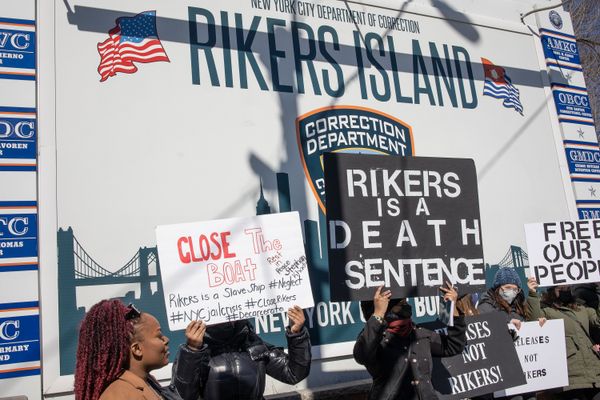
Activists stage a demonstration at the gate to Rikers Island in February 2022.
Photo by Andrew Lichtenstein/Getty Images
I’d never make an argument that the city should keep warehousing people in such traumatizing, violent conditions as at Rikers (where 14 people died in DOC custody in 2025). But each time I pass the $2.95 billion, in-progress facility in Brooklyn that’s part of the proposed plan to replace it—just two blocks down from Boerum Hill’s stretch of Atlantic Avenue that has become increasingly dense with expensive, design-oriented home goods shops and clothing boutiques—I wonder what it could have looked like if the city had designed for a solution that meant no one had to be jailed. HOK, the architecture firm partnering with general contractor behemoth Tutor Perini on the 15-story, 712,150-square-foot Brooklyn jail site (and the $3.8 billion Manhattan jail project) declined my request for comment for this article, stating they are "not authorized by our client to discuss the project with the media at this time."
Many of the releases about the BBJ designs, from both the city and the firms behind them, cite transformation and human dignity as core elements of the project—language mirroring that used by prison abolitionists. The first paragraph of the NYC Department of Design and Construction’s "Design Principles and Guidelines" for the BBJ program mentions George Floyd’s death; the outline positions the plan as one solution to "deep racial inequities," a "transformed approach to criminal justice." And among the program’s publicly listed goals are claims that the four new facilities will "embody a generative spirit."
For the Brooklyn jail, HOK’s site shows renderings of an entry plaza with planters and sculptural benches, a "calm" double-height lobby with tall windows, and an underground tunnel to the adjacent courthouses (referred to as a "dignified connection") beneath it. The facade alternates glass with terra-cotta to complement the surrounding area’s brick and brownstone buildings. Inside, plans for cells, visitation areas, and spaces that the firm calls "horticulture classrooms, mental health suites, and vocational training rooms" claim to emphasize daylight and "familiar materials." And the city’s Department of Cultural Affairs is seeking artist commissions for works inside the new jails through the Percent for Art program, Bass among them. HOK’s site says the team calls its guiding design vision "sculpted by light" and that every design decision—wood-grain ceiling finishes, soft seating—was evaluated "for its ability to uphold dignity and lower stress." But subtle language about surveillance is still couched within the project descriptions—in one video, a HOK team member discusses "sculpt[ing] the light poetically"; a few slides later the brief says, "lighting stays even so faces are easy to read."
How can a space that strips people—many of whom simply cannot afford bail—of their liberties at all be considered humane? How can a design guideline cite "a sense of dignity" in the same sentence as "maintaining visual oversight" and "processes such as body scans, searches, and clothing changes"? Why as a society do we refuse to be creative when it comes to the physical infrastructure of the criminal legal system? The latter question is a key guiding force for abolitionist architect Deanna Van Buren. Her California-based firm, Designing Justice + Designing Spaces, works on projects spanning a prototype for short-term transitional housing for people reentering their communities from prison to restorative justice centers like that of Community Works in San Francisco. "We’ve trained ourselves to only act like a hammer," Van Buren says of this country’s collective treatment of jail or prison as a one-stop-shop for resolving harm. "We should get specific and ask why people are in jail in the first place. Design is a problem-solving activity; it requires a premise from which you’re designing from." In the U.S., that premise is consistently punishment. The architect underlines that while people often invest in a myriad of supportive programs for those impacted by incarceration, there’s a "lack of understanding and holding of an ecosystem required." In essence, rather than continuing to invest in jails and prisons with programming or improved infrastructure, what if we designed sites for care that could anchor communities, actually prevent incarceration, and put real estate ownership into the hands of grassroots organizations?
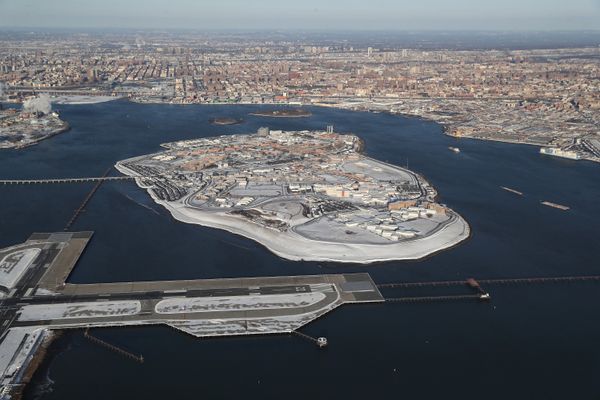
An aerial view of Rikers Island. The 10-jail complex is legally mandated to shutter by August 2027.
Photo by John Moore/Getty Images
Van Buren’s firm’s collaboration with Community Works is one such example. The Bay Area organization has long grounded itself in restorative justice: the antipunishment, relationship-based practice of repairing harm with facilitated dialogue between survivors and those who have committed harm. Six months since its opening, their newest hub combines healing-centered design—reclining chairs, colorful rugs and walls, potted plants, natural light, and circular architecture—with wraparound services that span violence prevention, therapy, and afterschool programming. Intentional design choices like comfortable furniture that members can move themselves, rather than the bolted-down tables typical in a detention facility, make all the difference. "These welcoming spaces reduce fear and shame of participants," says Adrienne Hogg, coexecutive director of Community Works. Before they secured their own space, the organization operated out of a shared office. Hogg tells the story of a young man seeking services who felt watched by other tenants at a coworking space when staff escorted him from the entryway to their office; that people started to hold their belongings closer. Since the move, he said he "feels relaxed, like I’m not always being scrutinized." He joined Community Works as part of their precharge diversion program and has since joined other workshops.
Having served 550 people in the last six months, Community Works’ restorative justice hub cost $600,000 to build and, according to Hogg, operates at an annual expense of $258,500. That doesn’t even constitute one percent of the Brooklyn jail’s cost, which currently is set to have 1,o40 beds. This type of financial comparison is consistent across other Alternative to Incarceration (ATI) programs, like New York’s Avenues for Justice (AFJ). AFJ’s chief program officer Gamal Willis says that the organization worked with 400 individuals aged 13 to 24 in 2025, adding that it costs $8,000 to provide one of these young people with mentorship, case management, court advocates, mental health and wellness workshops, food and education support, individualized and group counseling, and job readiness programming. Willis parallels the BBJ plan to fixing a leaking hole in the roof with mops. "It can soften certain things, but the real issue is the hole in the roof," he says. "Will the jails really address the inequality, the violence, and the stigmas that go with the system?"
One piece of logic for building the new borough-based jails directly within the city’s neighborhoods is that their proximity to New Yorkers’ everyday lives might support increased awareness in those communities. But Willis argues that the more locally embedded locations of youth detention facilities in New York City like Horizon and Crossroads, in Mott Haven and Brownsville respectively, have not deterred the typical overcrowding or general violations that come with incarceration. Both buildings tout their titles on tall brick buildings streaked with age, sandwiched between multiple apartment complexes and warehouse buildings. Kandra Clark, director of policy at Urban Pathways, an organization addressing housing insecurity (and a partner of the Campaign to Close Rikers), recalls a day she spent in the now-closed Queens Detention Complex. Being in a jail immersed within the boroughs across from restaurants, banks, and storefronts didn’t change that she had to sit or lie on cement floors in a cell with a woman over the age of 80 and another with multiple sclerosis. Clark, however, is in support of the BBJ plan as a means of improving conditions for incarcerated people and as a channel for community reinvestment. She says that in order to "fully end incarceration someday," we have to invest in and expand ATIs like that of East Harlem’s Exodus, which extends programming to people all types of charges, including those that are sexual or gun-related.
An installation of "Mobile Refuge Rooms," a prototype for short-term housing designed for people reentering their communities after incarceration, by Designing Justice + Designing Spaces, pictured on view at the Making Home—Smithsonian Design Triennial at Cooper Hewitt, Smithsonian Design Museum.
Photo by Elliot Goldstein © Smithsonian Institution
See the full story on Dwell.com: Is Dignified Jail Design Even Possible?
Related stories:
- A Love for Midcentury Palm Springs So Strong, They Recreated It 1,500 Miles North
- Hear Me Out: Designing for Others Is a Love Language
- "That Is a Number One F U": A Conversation With the Creators of HBO’s "Neighbors" Docuseries
Read More
By: Abigail Glasgow
Title: Is Dignified Jail Design Even Possible?
Sourced From: www.dwell.com/article/is-dignified-jail-design-even-possible-new-york-city-close-rikers-borough-based-jail-program-c71fe3a8
Published Date: Fri, 20 Feb 2026 17:25:05 GMT