.png)
A photographer visits his extended family during the island’s olive harvest and documents a tradition of relatives working together—and basically living together too.
Photographer Will Pippin grew up in the United States, where, in response to an increasingly unaffordable housing market, intergenerational households and co-ownership by family members or friends have recently become hot topics. But for Pippin, a childhood spent visiting his mother’s cousins and their children in Trapani, Sicily, gave him a window into a shared living setup that’s more rooted in cultural and familial traditions than financial solutions. Living with two generations—three sisters; in total 11 adults and children—in three units in one apartment building and another sister and her two children just down the street near their family-run bakery, Pippin’s cousins were raised in an arrangement that resembled a multigenerational household more than a nuclear one. "They’re comfortable in each place," Pippin says. "It’s like one big house, but still separate apartments."
His mother’s cousins (Pippin calls each zia, or "aunt" in Italian) maintain the family bakery, along with an olive farm in the surrounding countryside, which supplies the olive oil for the bakery, and a shared beach house on Sicily’s northwestern coast. The sisters inherited the properties from their late father—called "Nonno Vito" by the younger generation—who also passed down his former apartment above the bakery (and bought the sisters’ three neighboring units nearly four decades ago). The communal spaces translate to deeply intertwined lives: Though two of the sisters primarily run the business, other family members pop in regularly to help…or sneak a few baked goods. They use the farmhouse for their 20-plus-person family meals during and after full days of picking olives together during harvest season or for outdoor feasts in the summer. It’s exactly what Nonno Vito likely pictured and, to many on the outside, looks like an idyllic life.
But the question of who from the next generation will shepherd the setup is on the horizon, as many of Pippin’s cousins have moved to other Italian cities, where there are more jobs. "Fifty years ago it was a gift to be given the fruits of—literally and figuratively—your family’s labor," he says. "Now, it’s more complex." In the fall, Pippin visited his family to help during the olive harvest. He also documented how their fluid arrangements allow their tight-knit structure to function—and reflect the tensions many families experience adapting to cultural shifts that impact whether their domestic traditions are livable today.
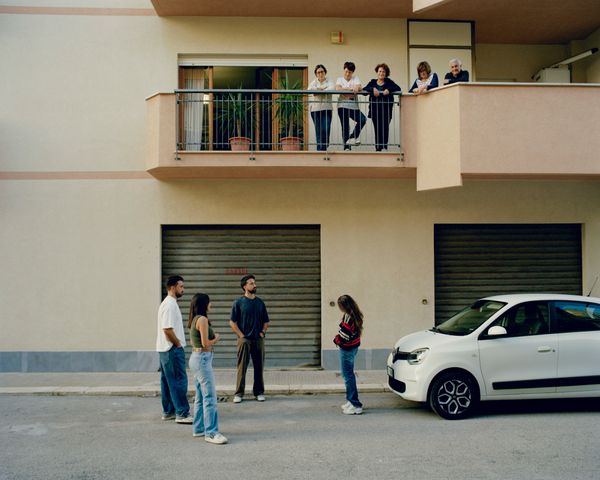
Sisters Loredana, Francesca, Giuseppina ("Pina"), and Daniela (from left) and Dino, Francesca’s husband, greet some members of the family’s younger generation from a terrace of the Trapani, Sicily, building where three of the four sisters live in separate units. Daniela’s four sons, including twins Enrico and Dario (from left), grew up in the building, as did Francesca’s two daughters, including Federica (middle), who still lives with her parents in the apartment with the pictured terrace. Loredana, who has two daughters, including Chiara (right), lives down the street. Enrico and Dario live in Turin, and Chiara lives in Rome. "They left to start their lives and businesses," Pippin says, "but they all want to go back after they’ve done their careers."
Photo: Will Pippin
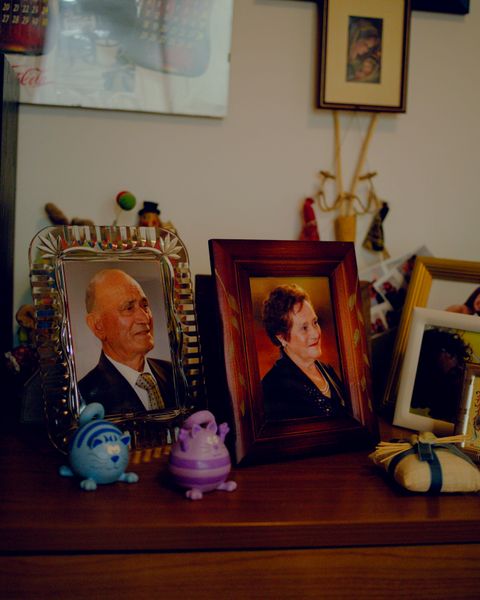
The four sisters’ father, whom Pippin and his cousins call "Nonno Vito," is shown in a framed photo next to one of his wife, "Nonna Lina." "Nonno Vito kind of set up all this shared living for them," says Pippin. He started the family bakery, Panificio Mazzara, in the early 1950s—taking over an existing bakery and building owned by his father—and lived between an apartment above the business and a campagna (country) house he built around the same time on an olive farm just outside Trapani. After he died, the sisters inherited his properties and kept them in the family. Francesca’s oldest daughter, Claudia, and her husband, Fabio, lived in the apartment above the bakery until recently, when they moved into a house with their two young children. Now, Pippin says, it’s used as another shared family space—mostly for lunch breaks from the bakery.
Photo: Will Pippin
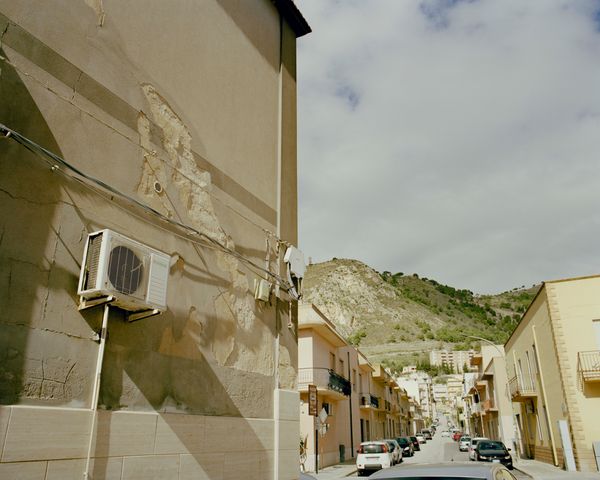
A street view with the family bakery behind looks toward the medieval hilltop commune of Erice. "From here, if you just took a right and drove five minutes, you’d be at the campagna house," Pippin says. During the olive-harvest season in October and November, family members from every generation—even the young grandkids—chip in in the fields on weekends. Some of the olive and other fruit trees were planted by Nonno Vito.
Photo: Will Pippin
See the full story on Dwell.com: Multiple Sicilian Generations. One Family Business. And Lots of Shared Properties
Related stories:
- The Best Thing for Your Child Is Cheap and Easy
- To Save Their Family Home on a Greek Island, a Couple Import a Prefab
- Design for Kids, Reviewed by Actual Kids
Read More
By: Sarah Buder
Title: Multiple Sicilian Generations. One Family Business. And Lots of Shared Properties
Sourced From: www.dwell.com/article/sicily-multigenerational-living-photo-essay-bakery-olive-farm-a37055c1
Published Date: Tue, 13 Jan 2026 13:02:18 GMT
Did you miss our previous article...
https://trendinginbusiness.business/real-estate/after-a-complete-overhaul-a-luminous-warehouse-loft-in-barcelona-seeks-13m