.png)
Musicians have long used buildings as devices for visual storytelling. But today’s top artists are increasingly turning to domestic backdrops to help project their inner worlds to audiences—and welcome them in.
The K-pop-inspired girl group Katseye blew up in 2025, in part because of their frenetic single "Gnarly," which applies the slang term to things they find alternately cool and gross. But watch its music video closely, and you might discover the gnarliest thing of all is the set: a kitchen with a black-tiled backsplash, a shock of white cabinets, and a black granite kitchen island—which the group sweeps away to vamp through choreography on a surprise tile dance floor, right next to the silver refrigerator. "I designed the whole kitchen around how their choreography would work," says Cody Critcheloe, the video’s director, who says he was inspired by late-1980s aesthetics—glass bricks, geometric floor patterns, laminate cabinets. "I’m constantly in search of my childhood idea of what luxury was. It’s harder to curate, too, because it’s harder to find, so it makes it a bit more special. It feels like a point of view, you know?"
"Gnarly" was one of YouTube’s Top 50 most-viewed videos of 2025 (clocking in at number 33, with 135 million views at the time of writing), and while it couldn’t quite catch up to the 459 million views of Number 7 ("La Plena," in which Colombian star Beéle raps from a neon-lit man cave), the videos had something in common: a focus on the home setting, with interiors purposefully appointed in order to express the songs’ mood.
Contemporary musicians have long used interiors and architecture to signify a mood, whether because they can provide dramatic backdrops for impactful visuals or, more interestingly, to project specific narratives about their personas. Sometimes, architecture elicits a sense of aspiration—think Rick Ross vamping across the streets of Paris in his 2014 "Rich Is Gangsta" video—and other times, it can convey intimacy or relatability. Cue the cover of the 2022 album Harry’s House, on which Harry Styles poses in an upside-down living room of 1970s vintage, including a Giandomenico Belotti Spaghetti lounge chair and a chrome loveseat in a dusty rust upholstery. The increase in homey visuals for music videos in recent years, like SZA’s "Snooze" or Olivia Rodrigo’s "Deja Vu," suggests artists turning inward toward comfort in uncertain times, an enduring reflection of the way the home became the primary site of identity building during the pandemic (a phenomenon that transcends music into advertising and fashion). But the disciplines of music and architecture have long had a symbiotic relationship, argues Paul Groenendijk, author of a Dutch book about architecture on album covers (who’s working on an extended version in English) which explores this history, and mines the architectural historian’s massive collection of records with architecture on the covers. Speaking over Zoom from his home in Rotterdam, Groenendijk says he first became enamored with well-designed album covers after Pink Floyd’s Dark Side of the Moon was released; as an architecture student and music obsessive, he began collecting covers that married the two, citing the design backgrounds of artists like Art Garfunkel, the Talking Heads, and Greek composer Iannis Xenakis (who, as a young architecture student, worked with Le Corbusier).
In the mid-20th century, Groenendijk says, putting buildings on album covers was a practical matter for designers. "A sleeve is meant to sell your record, and in the old days, you’d go to a record store and you’d browse," he says. "For difficult music with no real interesting people behind it—because a guy who plays piano is not very interesting to put on a sleeve—you try to bring out an atmosphere." He cites the example of stock cocktail jazz and easy listening records from the 1960s, which often had photographs of the New York City skyline on the covers, though he’s got rap, disco, jazz, and even Chicago blues records with Manhattan buildings on the covers. "Penthouse lights...it’s trying to convey a sophistication," he says. "With the New York skyline, you can sell anything."
Digging through his meticulously organized crates—Groenendijk is an archivist as much as a collector—he notes the way some 1980s new wave album covers tended toward brutalist architecture, discusses a 1960s Dutch pop star whose cover art for an LP called Vrijgezellenflat (which translates to "bachelor pad") was shot in front of a famous Amsterdam housing project, and shows me the art for an album by the 19th-century German composer Richard Wagner depicting the Neuschwanstein Castle (not very subtle). When he pulls out This Is the Modern World, the 1977 album by the British rock band The Jam, he points out the housing estate beyond where the group poses under London’s Westway, and notes the way the architecture expresses something about the group’s identity. "This is where they live, where they came from, and this is a statement," says Groenendijk.
In music videos these days, architecture still serves the purpose of forming or fomenting an artist’s identity, even while suggesting luxury or high art. In the clip for "Mood 4 Eva," from Beyoncé’s 2020 film Black Is King, she and Jay Z stroll regally through the Beverly House, a 1925 Spanish Revival estate in Beverly Hills—a mansion once occupied by newspaper magnate William Randolph Hearst, and where John F. Kennedy and Jacqueline Bouvier honeymooned—to project an image of Black royalty, reflecting their status as both consequential pop culture-bearers and actual billionaires. (The Black Is King scenes shot outside the historic Sylvester Manor, a 1737 mansion in Shelter Island, New York, were even more pointed—a reclamation of the site’s status as a former slaveholding plantation.) Contrast that with the mansion in Tyler, the Creator’s 2022 video for "C’mon, Let’s Go," with its exterior window frames painted in a turquoise so bright they appear neon, amplifying the song’s impatience for a date who’s taking too long—and a heightened sense of suburban malaise. Even more evocative was the Mediterranean-style estate in Sabrina Carpenter’s 2024 "Taste" video, in which she and Jenna Ortega transform a Beverly Hills mansion into a murder playground between rival exes.
That kind of extravagance would be antithetical for artists looking to project a sense of their roots, though. La Casita, the salmon-colored set piece for Bad Bunny’s 31-date 2025 concert residency in Puerto Rico, was built to replicate an existing house in Humacao on the island’s eastern coast that he featured in his Debí Tirar Más Fotos rollout short film, reflecting the album’s emphasis on home. (The homeowner, however, didn’t love it; he sued Bad Bunny for damages owing to the musician’s fans who tracked it down.) Kendrick Lamar’s cover art for his 2022 album Mr. Morale and the Big Steppers features the rapper, his fiancée, and their two young children in a sparse bedroom with patched-up walls and lived-in furniture, hallmarks of photographer Renell Medrano. Justin Bieber tapped Medrano to photograph a similar concept for his 2025 album Swag (though the suggestion of a hardscrabble upbringing may have been less evocative for a musician who has been famous since age 12).
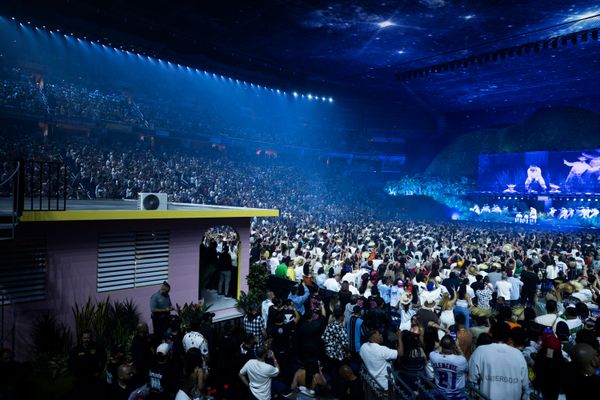
Bad Bunny’s "No Me Quiero Ir de Aquí" concert residency in San Juan, Puerto Rico, featured a pink-and-yellow house replica, nicknamed La Casita, built to resemble some of the island’s vernacular architecture. The structure served as a secondary stage set where the artist held a mid-show house party, or a party de marquesina.
Photo by Ricardo Arduengo / AFP via GettyImages
Interiors in music visuals have recently tended more toward the minimal: the emptying apartment in Haim’s 2025 "Relationships" video, reflecting a home’s sparseness after a partner moves out and takes all their stuff; the cleared-out, carpeted room in Charli XCX’s 2024 "Guess" video (better for dancing), or the cozy glow of Noguchi-inspired lamps on Clairo’s living room-inspired 2021 Sling tour stage set. (The latter two were both designed by creative director Imogene Strauss.) More and more musicians have been keen to bring this world-building of their album covers and music videos to the concert setting as well, extending the illusion of intimacy to clubs and even stadiums. Some sets are seemingly meant to codify a musician’s identity—Bad Bunny’s emphasis on his Boricua heritage, Sabrina Carpenter’s play on pin-up and the domesticity of a 1950s housewife with the grand staircase of a classic Hollywood doyenne and heart-shaped conversation pit from her Short n’ Sweet tour. Others, like Clairo’s cozy seating and The 1975’s full-stage living room rebuild (with lamps, TV, and even part of a roof), were just tapping into the particular quasi-agoraphobic mood, recognizing the primacy that the home took on during the pandemic.
When Critcheloe (whose extensive directing credits beyond Katseye’s "Gnarly" include music videos for Kylie Minogue, Gossip, Yves Tumor, and his own musical project, Ssion) was planning the visuals for Perfume Genius’s 2025 album, Glory, with co-art director Andrew J.S., he wanted a location that was "aesthetically similar to the record," so he found a house in his native Kansas City where they could "create a world."
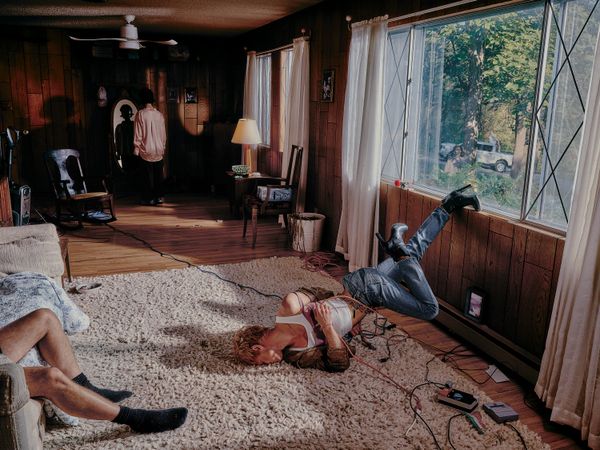
The promotional photography for Perfume Genius’s 2025 album, Glory, was shot at a house in art director Cody Critcheloe’s native Kansas City, Missouri. The album cover (a similar but slightly different image as the above) is one of five nominees for the inaugural Best Album Cover category in the 2026 Grammy Awards.
Photo by Cody Critcheloe
"It was aesthetically very confused," says Critcheloe. "Parts were super modern, parts felt very seventies; it was just a hodgepodge of feelings." Other than adding a strip of wallpaper in the kitchen that can be seen in the "No Front Teeth" video, Critcheloe mostly didn’t alter the house’s wrought-iron bannisters and prefab cherry cabinets; the most significant element might have been a preexisting patchwork carpet in the living room, which ended up on the album cover.
Renting out a house is Critcheloe’s preferred method of directing when he has a smaller budget—he did the same for Kim Petras’s Slut Pop Miami in 2024, for visuals he describes as "if Tim Burton had done South Beach." In contrast to the midcentury album-cover designers who were trying to use the idea of luxury to hawk instrumental cocktail jazz albums, Critcheloe scouts out such locations out of creative necessity: it cuts down on costs for production and art departments, eliminating the need for massive builds on sound stages, as his team did for Katseye’s "Gnarly" video. A house in Kansas City, especially, affords him the ability to "be ambitious and make something great without having to spend a fortune on it," he explains. So while the proliferation of the home in music visuals may suggest a mass cultural turn toward the interior, it might also just be that we’re on the cusp of yet another vibe shift, in which musicians are trying to conjure the energy of a DIY house party, one clip at a time.
Top still from the music video for "Gnarly" by Katseye courtesy Cody Critcheloe.
Related Reading:
How Architecture and Design Took Over Gaming
That TV Mansion You’re Coveting? Here’s How Major Series Film at Luxe Real Estate
Read More
By: Julianne Escobedo Shepherd
Title: Music Has an Architecture Obsession
Sourced From: www.dwell.com/article/music-has-an-architecture-obsession-100f0120
Published Date: Tue, 23 Dec 2025 17:07:35 GMT
Did you miss our previous article...
https://trendinginbusiness.business/real-estate/the-5-lessons-one-homeowner-learned-rebuilding-after-the-woolsey-fire