.png)
Eager to indulge my love for literature with a Scottish setting, I went straight to a spot with its own backstory: a restored boat with 17 guest "cabins" in the Leith port district.
Welcome to One Night In, a series about staying in the most unparalleled places available to rest your head.
As a lifelong bookworm, I’ve always loved literary travel, and Edinburgh, with its cozy bookshops and strong literary background, has been a dream destination. When I planned a mid-September trip to the Scottish capital, I knew I wanted to include a stay somewhere evocative of the city’s character and history. Between the medieval and Scottish Baronial (a 19th-century Gothic Revival style) buildings in Old Town and the Georgian-era developments in New Town, there’s plenty of still-standing dramatic architecture from long-ago eras in the city. But the Ocean Mist, a restored ship turned floating hotel in the harbor district of Leith, seemed like a perfect fit for its mix of old-world romance that might feel like the setting of a period novel and its connection to the area’s centuries-old maritime trade history. (Leith was Scotland’s most significant port for trade from about the 14th century until its decline in the late 20th century.)
Originally built in 1919 as a minesweeper for the Admiralty (a U.K. government department that was in command of the Royal Navy from the early 1700s to the mid-1960s), the Ocean Mist (née the Ocean Rover) changed many hands over the decades. Never actually used for its original purpose, the boat was sold to Guinness heir Kenelm Guinness, an avid race car driver and yacht enthusiast, who converted it into a motor yacht for himself and his high-status friends during the 1920s. In the late 1930s, the Admiralty requisitioned the boat and used it as a torpedo recovery vessel during World War II. After switching ownership a few more times during the ’40s and ’50s, including a period laid up in an English port city, the boat was bought by a wealthy whisky distiller to run liquor from Scotland to California during Prohibition. The ship arrived at its current home on the Water of Leith in the early ’80s and operated as various establishments—restaurants, nightclubs—for the next three decades before being abandoned and falling into disrepair.
In 2019, the Pedley family (of Edinburgh businessman Alan Pedley) purchased the Ocean Mist and, following a three-year restoration, opened it as a boutique hotel and bar that offers "maritime heritage and modern comfort," according to its website. I was thrilled when the hotel agreed to host me for an overnight stay. To get there, I took a train from London through England’s Peak District. (En route, I couldn’t miss the opportunity to pop into Chatsworth House, one of the filming locations for the 2005 Pride & Prejudice film.)
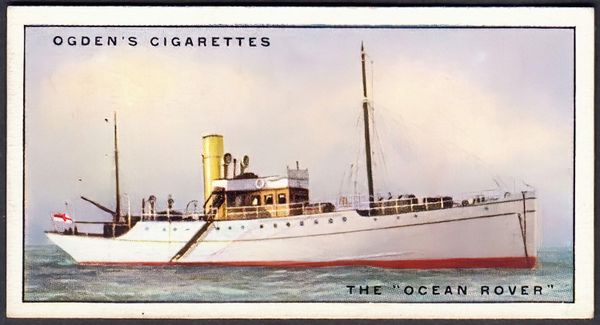
The Ocean Mist was named the Ocean Rover from the early 1920s until the mid ’50s, when it was given its current moniker.
Photo from Alamy
Monday
2:30 p.m.: In true Edinburgh fashion, it starts to rain as I hop off the tram at The Shore stop near the namesake cobbled waterfront street where many restaurants and pubs are located. I pass the stately 19th-century statue of Scotland’s national poet, Robert Burns, as I head toward the water; according to Google Maps, the Ocean Mist hotel should be berthed just a little way down the Water of Leith riverfront. My excitement builds as I approach the corner.
I spot the navy-blue hull with its bright-red stripe first, where a Scottish flag sits proudly on the stern above the words Ocean Mist. The converted boat hotel is moored opposite the main strip of restaurants, and I feel a smidge of self-importance as I cross the somewhat soggy red carpet over the short gangway.
My first impression of the interior is the captain’s office. It’s an intimate reception space with dark polished wood walls, leather Chesterfield chairs, a compass design inlaid into the center of the floor, and, as I find out later, the ship’s original safe. To my right, a glass chandelier and steampunk clock hover above a curved stairwell to the lower deck. Daniel, looking the part in his nautical-style uniform and low ponytail, greets me and confirms my reservation details. He lets me know I can find the bar and lounge up on the top-level bridge deck and hands me the key to my "cabin," the Duke of Leeds. The hotel’s 17 accommodations are spread across the upper, main, and lower decks, and each is named after a person tied to the boat’s history, from previous owners (like the Duke of Leeds) to Lindsay Burnett, the boat’s boiler builder. There are snug "berths" inspired by traditional shipboard sleeping quarters, standard cabins, and more spacious suites (with larger portholes for better views). The three "staterooms"—the largest room option—incorporate designs specific to their positions on the ship; one, for example, near the original triple-expansion steam engine, has cork walls that are slanted and rounded to the boat’s form and a window that looks into the engine room.
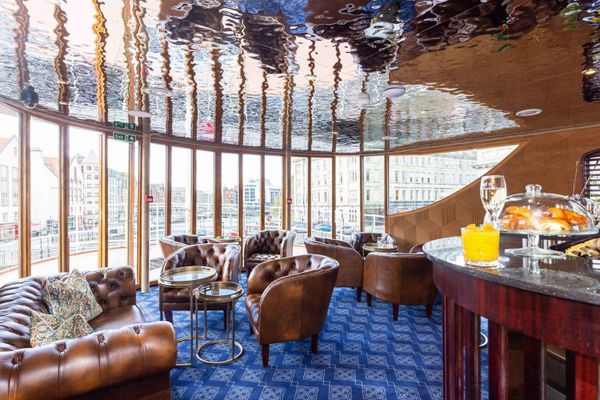
Floor-to-ceiling glass separates the Castle View Bar from the rear deck, which has a spiral staircase that leads down to the boat’s lower levels where the cabins are.
Courtesy Ocean Mist
My cabin is on the upper deck and at the end of a narrow wood-paneled corridor. Inside, the room is lined with portholes and decorated in shades of bronze, navy, and white, with natural cork walls, some of which are topped by full-length beige silk wallcoverings. There’s a geometric dark wood headboard, an Art Deco-patterned navy carpet, and bronze bedside pendant lights. The thick rope cornice at the top and bottom of the walls feel on the nose, but not corny. It’s cozy but a little dim, as the size of the portholes limits the amount of natural light. (Although they have great views, I’ll close them when getting changed just in case someone across the river has super sharp vision.)
My eyes quickly land on a wax-sealed letter on the bed. While it’s not an invitation to dine with the captain, the welcome letter introduces the family-run business, hints at the boat’s rich history, and invites me to learn more about the restoration at reception. I continue to settle into the room, and play with a vintage telephone that I think is a prop before I hear the dial tone and realize it’s connected. (I quickly hang up.)
I love the ambience, but the space itself is not quite as luxurious—or, old glamour—as I imagined. This could come down to simple practicality; for instance, I find out later some of the rooms’ silk wallcoverings were replaced with natural cork because they were hard to maintain. I can imagine certain materials wouldn’t fare super well in an "onboard" environment like this one.
The amenities are typical of a hotel room, with the addition of some loose leaf teas and shortbread, but there’s no mini fridge or TV. I don’t mind, as I’m here for a short stay, but other guests could find this inconvenient. I pop into the bathroom and am delighted to find it’s well-lit and also on theme, with glossy green wall tiles and a classic pull-chain toilet. I grin when I see the toilet paper origami in the shape of a boat, stamped with a hotel seal.
3 p.m.: It’s time for a late lunch. I cross the Water of Leith river and stroll five minutes to Roseleaf, a homely bistro where I sit next to a window with a typewriter on the sill and am handed a menu folded into an old issue of National Geographic. I can’t get past the cullen skink: a creamy Scottish soup made with smoked haddock, potatoes, and onions. It’s indulgently hearty.
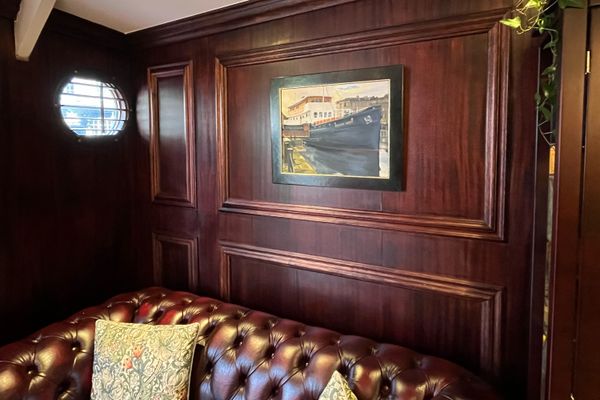
Dark wood-paneled walls, leather Chesterfield sofas, and portholes feel right at home in the converted boat hotel.
Courtesy Jade Raykovski
See the full story on Dwell.com: One Night in a 1919 Ship Turned Floating Hotel in Edinburgh
Read More
By: Jade Raykovski
Title: One Night in a 1919 Ship Turned Floating Hotel in Edinburgh
Sourced From: www.dwell.com/article/one-night-in-a-1919-ship-turned-floating-hotel-in-edinburgh-b80e0cd0
Published Date: Thu, 18 Dec 2025 19:02:32 GMT