.png)
Two-years after it opened, I went to Campfield Long Beach to test the limits of the Japanese outdoor gear brand’s cult following.
Welcome to One Night In, a series about staying in the most unparalleled places available to rest your head.
As the saying often goes, there are two types of people in the world, and for my particular purposes for this piece, those two types are people who like to camp and people who don’t. As far as I’m concerned, since I went to sleepaway camp for seven years, I’m definitely not a person who doesn’t like to camp, and yet somehow my family has labeled me as being less of the land and more of the house. For example: I’ve seriously considered hiking Scotland’s West Highland Way, because someone else will drive your bags between locations and you get to sleep every night in a real inn, in a real bed, with a real shower and toilet, eating food someone else made you in a kitchen. Best of both worlds!
I know there are a lot of people out there like me—people who enjoy nature, but only to a point. They can do it the hard way, but would prefer to do it a softer way. That’s how glamping came about anyway. This long preamble is all to say: when I told friends that my partner and I would be taking our 21-month-old daughter from New York City to the Pacific Northwest to camp for four days in March, I got some surprised faces.
But don’t worry, I said to them. There were a lot of caveats. First of all, the flight there—arguably the most risky part of the whole operation—would be from Los Angeles, because we’d be taking this journey after visiting family on the west coast. Not even three hours! Short! Secondly, we’d be staying in an actual cabin—a high-design mobile cabin, actually, one of the accommodation options at Japanese camping brand Snow Peak’s first U.S. campsite, which opened two years ago. Yes, it’d only be 228 square feet, and we’d be going in early March, not exactly the warmest or driest time of year to visit Long Beach, Washington, but we have to lean into life! And what better way to do than make our first real vacation with our daughter harder than lying on a beach within driving distance? Sure, this trip was initially pitched by the property’s publicist as a great opportunity to "work remote," but she also said the campsite was family-friendly!
Soon, I find myself going back and forth with said very patient publicist about logistics, and she is reassuring me that even with a child, we will "be comfortable no matter the weather." She has booked us flights, and a car rental has been confirmed. We are going. And so I tell myself: When in doubt, even if the worst happens, it will make a good story.
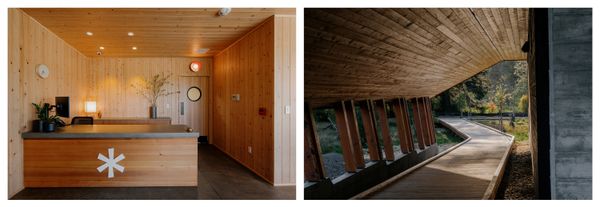
The Guesthouse, where visitors check in, was intended to create a sense of calm. Its saltbox rooftop mirrors a common style choice for homes in the Pacific Northwest. The desk countertop is a cast concrete and the base is reclaimed cedar. Next to the Guesthouse is a boardwalk path that leads to the rest of the campsite.
Photos courtesy Snow Peak
Sunday
4:30 p.m.: We fly into Portland from Los Angeles. It is, I have come to understand from popular culture, a very normal looking Oregon day in March—cloudy skies. Immediately, it becomes clear Portland International Airport is in the middle of a large renovation helmed by ZGF Architects, which includes numerous art installations. While the mass timber ceiling is very impressive (the wood, I later learn, "was locally sourced from landowners and mills within a 300-mile radius of the airport, including small landowners, tribal lands, and community forests practicing sustainable forestry"), I’m comforted by the ’70s-style carpet, which is, at least for now, still intact.
As this is the second flight we’ve taken in a week with two checked roller bags (one almost overweight), a car seat, a stroller, a crib, and a "personal item" for each of us, I’ve become an old pro at maneuvering our massive amounts of travel items (though ask me about my thoughts on both the price and price differences of Smarte Cartes at various U.S. airports another time). Because with all my obsessive planning I neglected to realize that this flight would be in the middle of my daughter’s nap, she has skipped it, and almost immediately falls asleep in the rental car, leaving us to enjoy the slowly setting sun and scenic two-and-a-half hour drive to the Washington coast in relative silence, staring at the truly majestic mountains, trees, and lakes. It also gives me plenty of time to ponder whether this whole trip could have been one of my worst ideas ever. Right now, I’m feeling optimistic.
It’s now that I admit that were this just any glamping site, I probably wouldn’t have gone through the trouble to do all this. But Snow Peak has an air about it. Founded in 1958 by Yamai Yukio, and initially primarily dedicated to ice climbing materials, the brand has become beloved for its streamlined aesthetic and high-quality gear (with prices to match). It’s expanded in recent decades into clothing—if your man loves GQ, he likely loves Snow Peak—and has particularly focused on growth in the U.S. market. Though Snow Peak has had an interesting last few years in terms of ownership, it’s still run by the ancestors of Yukio, and as such continues to be able to hold onto the cachet of quality, like a Japanese Filson. The first campground opened in 2011, and they now operate 14 around the world (six are in Japan).
This particular site is 25 acres, and sits on the Long Beach peninsula, between the Pacific Ocean and the Willapa Bay. I’ve purposefully decided to not read too much press about it (and there’s plenty of it) before arriving, so as not to taint my view of the experience, but I do know that the Jyubako—or "living box"—Suite we will be staying in was designed by architect Kengo Kuma, now perhaps best known for the Japan National Stadium for the 2020 Olympics. As you might imagine, it was designed to focus on indoor/outdoor living (or staying, in my case), and is made entirely of light wood. While there are several other accommodation options at Snow Peak Campfield—you can bring your own tent, or use a Snow Peak one—this is the only one that has an actual solid roof, and a bathroom. Depending on the season, and which accommodation you book, the price ranges from $55 to $419 a night, plus the cost of various Snow Peak product kits should you choose to rent them.
6:45 p.m.: Arriving is when the semi-trouble begins. As anyone who is a regular camper, or even someone who has done it once the wrong way will tell you, showing up at a campsite at night, can be an extremely destabilizing experience, particularly when you have to figure out how you’re eating dinner. Add on feeding a child and figuring out how to place her own little SlumberPod tent that pops over her crib like a bird cage cover—designed so we can move about while she’s sleeping without disturbing her, and so she doesn’t immediately begin bothering us when she awakes—is a whole other thing.
We park our car in the parking lot—Campfield is a car-free campsite—and check in at the Guesthouse, a wooden, glass-fronted structure which features a front desk and displays about various Snow Peak products, plus what I assume are offices in the back. I’d read the provided packing list several times, but I find out that a number of my questions about what amenities would be available to us and what we might need to rent when we arrived, or how to book the spa, would have been answered by the email that I either accidentally deleted or went to spam a few days prior. We take one of the provided carts and pull our things down a lit wooden path, then a gravel one, to our Jyubako Suite #5, situated roughly in the middle of the site.
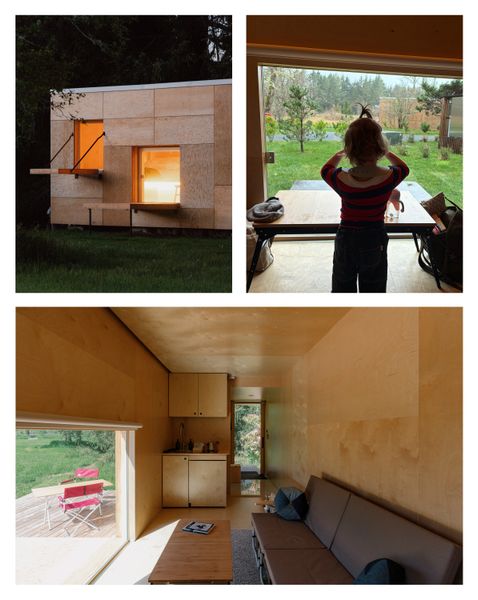
The 228-square-foot Jyubako Suites were designed by Japanese architect Kengo Kuma, and are stocked with Snow Peak products.
From top left (clockwise): Photo courtesy Snow Peak; by Kate Dries; courtesy Snow Peak
Coming from New York, I find my perspective on how small a town or city will be from afar a bit skewed, but even for the decided off season, Long Beach is a fully functioning town, even if the establishments have more limited hours than they might normally. Campfield Long Beach is a five-minute drive from the main drag, which means it’s quiet, and will only continue to get more so as the days go on. Despite its footprint, the cabin is almost so minimalist that in the dark it takes a second to get the lay of the land. Once you walk up the stairs, there’s a short hallway, with a small bench and hooks for your things; to the right is the bathroom, which is Europe-style, with the showerhead and the Toto toilet only separated by a curtain. The main space is a kitchen counter with an upper and lower cabinet, mini fridge, sink, and induction stovetop. There’s a Campfield Futon starter set (retails for $969.95)—which folds out into a bed for someone who is not under two—and a Renewed Single Action Low table ($249.95) that faces out the large picture window, which opens onto a small porch you can sit on in good weather. At the back wall is the bed, with a small nook next to it where you can charge and place devices and other small items.
While my partner quickly runs out to Sid’s, the local grocery store—the on-site Campstore closes at 5 p.m. during the week during the slow months—I attempt to unpack what we need and put as much stuff away as possible so we have some space to move around. For such a small space, I am pleasantly surprised by how easy it is to tuck things away. One genius move, if I do say so myself, is taking the suitcases and bringing them back to the car, allowing all of our packing cubes to be placed in the large drawer under the bed. My daughter looks on while eating grapes and cheddar bunnies as I try a few different rearrangements, finally settling on shifting the coffee table under the window, moving the futon closer to the bed, moving the Stacking Shelf container ($250.95) toward the window, and sliding her SlumberPod-covered Pack N Play next to the couch, leaving a small space to walk along the hallway into the main area.
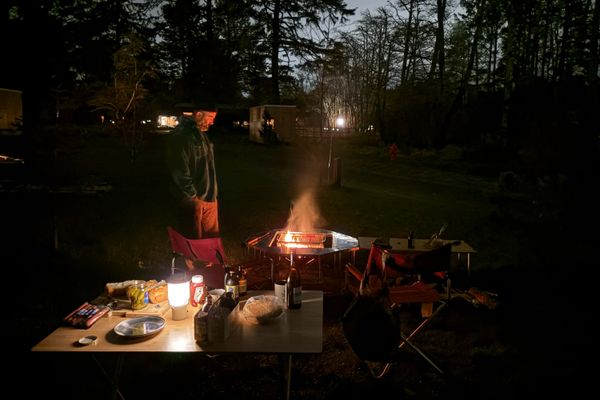
The Takibi Kit in action, one of several that can be rented at the site to make whatever meal you want to your specifications.
Photo by Kate Dries
See the full story on Dwell.com: One Night in Snow Peak’s First U.S. Campground—With a Toddler
Related stories:
- One Night in Vipp’s First U.S. Guesthouse—a Monolithic Upstate New York Cabin
- One Night in a 1919 Ship Turned Floating Hotel in Edinburgh
- One Night in a "Biotope" B&B in Bolivia’s Urban Jungle
Read More
By: Kate Dries
Title: One Night in Snow Peak’s First U.S. Campground—With a Toddler
Sourced From: www.dwell.com/article/one-night-in-snow-peak-campfield-long-beach-first-us-campground-with-a-toddler-e7bf576c-da52cae9-84f2f670-717a9df2
Published Date: Thu, 16 Apr 2026 13:59:44 GMT
Did you miss our previous article...
https://trendinginbusiness.business/real-estate/dark-matter-promotes-vikas-rao-to-ceo-announces-5-cut-to-workforce