.png)
The directors of a new show about real-life residential conflicts discuss the very American obsession with property at the heart of each episode.
Most nights in my Brooklyn apartment, I fall asleep to a garbled background symphony of creaking floors and footsteps, the sporadic sounds of the upstairs tenants’ bed-time routines audible through the old walls of our building (even with my fan on its loudest setting). Still, it’d take some serious, sustained stomping for me to actually feel I had the grounds to say something to them about it. That’s not the stance that most of the warring neighbors take in a new, six-episode docuseries from HBO and A24 about real-life residential disputes across the United States.
Each episode of the "explosive" unscripted series (as its logline describes it), directed and executive produced by Harrison Fishman and Dylan Redford, introduces new sets of neighbors embroiled in a heated disagreement. Some arguments concern ambiguous property lines: A newly installed fence in rural Montana sparks an IRL and TikTok feud between residents, while a long-standing spat over a fence in Southern California leads to a restraining order. In West Palm Beach, Florida, former friends fight over who owns a patch of grass between their houses. Cops get called, and plants get tossed across driveways. Along the state’s northwestern shoreline, a debate between beachgoers and private homeowners acquaints viewers with a property manager (who at one point proclaims, "I love protecting private property rights. I’d do it for free..."). He’s nicknamed the Sunburnt Scarecrow by one of his opponents, an anonymous "beach activist" called Shoreline Defender who wears a full-face mask during interviews.
Other debacles arise over perceived eyesores. A retired Indiana couple make it their mission to thwart their neighbor’s live-in grandson from raising livestock on her property. Her message for them? "They’re either going to accept it or move. It’s that simple." Meanwhile, a property assessor the couple hire to calculate the potential impact of the next-door view on their home’s value tells them: "Let’s forget about being neighborly, it’s worth $102,000 to you to figure out a solution." In San Diego, a man considers moving to a nudist community after constant scrutiny for exercising in front of his home and around the neighborhood in a thong bikini. (Warning: That episode, the sixth, is the series’s most NSFW.)
In one episode, former Texas senator Jeff Wentworth battles with his new(ish) San Antonio neighbor over the eight-foot concrete wall she’s building around her property that he says he’s "affronted" and "offended by" every day. She says it’s "going to be a mix of an Italian and a French villa." He calls it a "cartel-looking residence" and "the scar of the neighborhood," likening it to "the compound where Osama bin Laden hid out." Even in the conflicts in which the neighbors don’t make such overtly politicized references, larger ideological differences tend to be imbricated below the surface. An annual Halloween decoration competition in New Jersey doesn’t ruffle feathers between two fathers in the neighborhood on its own; the families are also trying to keep the parents’ differing politics from disrupting their kids’ friendships.
To find the real-life disputes in Neighbors, the casting team, led by coproducer Harleigh Shaw (whose prior docuseries casting credits include episodes of How To With John Wilson), scoured local newspapers and small claims court databases and posted flyers around the country, as well as online in neighborhood Facebook groups and on Craigslist. Fishman and Redford worked with a small team of family and friends (Fishman’s brother was a camera operator; Redford’s sister was a story producer and researcher), filming across the country for two years. They typically spent a few weeks to a month with each set of neighbors.
I recently spoke with Fishman and Redford about making the series, why neighbor disputes are so captivating, and the extremely American obsession with property that’s at the core of each story. Our conversation (which contains some spoilers for the show) has been lightly edited and condensed for clarity.
You started making this show after becoming obsessed with watching online videos of neighbors in conflict. What about that kind of content is so interesting?
Harrison Fishman: Initially you watch those kinds of videos and you’re just shocked by things people say. You’re like, Wow, this person is screaming. It’s like an explosive 30 seconds. I think the more that you watch them, the more we started to see them as these windows into these people’s lives. We were just interested in, obviously, who both people were, but also what led up to that moment where they started fighting and filming each other. Because you’re really seeing these people at a really vulnerable, crazy…maybe one of their worst moments, where maybe that isn’t, I mean, it is who they are, but it’s not all that they are.
Dylan Redford: Yeah. With a lot of other different types of internet confrontational videos, or Karen videos or whatever, it’s oftentimes two strangers yelling at each other engaged in something, and then they go their separate ways. At the very core of these videos is that they are stuck together. Like, you know that at the end of this video, they’re going to have to still keep living next to each other. And there’s these questions of, has it always been like this? What was their relationship like before? Because they are neighbor conflict videos, it implies an existing relationship before the conflict happened. That relationship could be minimal…it could just be saying hi to each other on the way to their cars or whatever, or their kids play. Or it could be really in-depth. But I think that part of what makes those types of confrontation videos so interesting to us is that there’s a relationship that exists before and after that video that has a lot of emotion attached to it.
HF: The stakes are high because they actually live next to each other. There’s so much baggage. When we were doing our casting, we really, really were striving for stories that the relationship felt deep.
Social media played into so many of the disputes in the series, whether it was Josh making TikToks about his feud with Seth, or the Shoreline Defender whose entire online footprint is dedicated to a property conflict. Did you come across any corners of the internet that surprised you where people were sharing their neighbor conflicts?
DR: What I was surprised by, and it actually doesn’t really end up in our show, but…my sister, Lena, who did research on the show and helped cast, found the world of HOA Facebook groups, and people talking about HOAs and venting about them. I didn’t know that much about HOAs before the show started. We had to kind of do a crash course about what they are and how they function. If we have the luxury of being able to make the show again, I think that’s something we’re really interested in.
HF: Once you start learning how to see these disputes online, when you’re out in the world, you start seeing infrastructure on people’s homes...even people having signs or notes when you’re walking around, and you start noticing, Oh, I think these people are in a dispute. Which is just a weird thing.
DR: Something I’ve noticed a lot, like a telltale sign, is the way people build their fences. Basically, if you build your fence so that the ugly side is facing the neighbor’s side, that is a number one ‘F U’ because what you’re supposed to do is have the kind of ugly side face inward. If you share a fence line, that’s a good indication of a neighbor relationship. A great way to get the temperature is like, How have they built their fence? You know, is the ugly side facing them?
HF: Figuring out neighbor disputes through less obvious ways started to become really exciting to us. When we did the pilot, we put out a bunch of Craigslist posts asking for neighbor disputes. The people that ended up doing our show weren’t actually the ones on Craigslist. A friend of a friend had seen the post, and then it got back to them and they were like, ‘You keep talking about this neighbor dispute. You know, there’s this show.’ A lot of the time we and our casting team just had to knock on the other neighbor’s door to ask them to do the show, which is both really exciting and really scary…in our world right now.
DR: [Laughs.] Really scary.
Were there any neighbor disputes that didn’t make it on the series that really stood out to you?
DR: I mean, the most important thing is that both neighbors have to do it. We constantly were coming upon a really compelling dispute that one neighbor would be willing to participate and the other one just wouldn’t do it. And it was over.
A dispute on top of a dispute…
DR: [Laughs.] Yeah, exactly.
HF: There was a community-wide dispute in a nudist community in Florida that, the main thing was that the rules around nudity in the community were changing. There was a group of nudists who wanted the rules to be very strict—you had to be nude everywhere—and then there were others who wanted to wear clothes sometimes. That one didn’t make it on. And there was an amazing guy who bred pigeons.
DR: Oh yeah, in Southern California, this guy was breeding really top of the line, gorgeous competition pigeons, and his neighbor, they were in dispute, ended up, like, poisoning and potentially stealing some and selling them for a ton of money? But that other neighbor that allegedly did that—who knows—wouldn’t participate. God, there are so many.
HF: It’s the hardest thing about the show, really. Just getting both parties to agree.
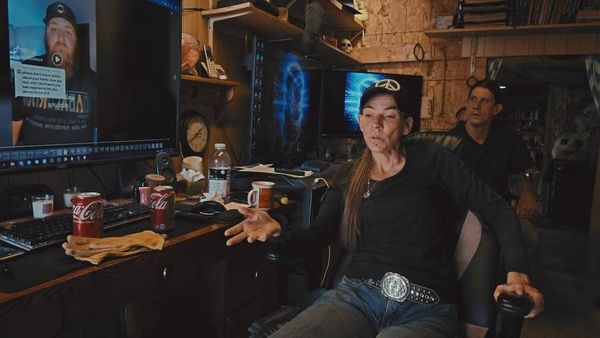
Starla and Seth Collins watch their neighbor Josh Alspaw’s TikTok about their feud over a gate he installed near both of their homes in rural Montana in the first episode of Neighbors.
Courtesy of HBO
What about the neighbor disputes we do see on the show—were there particular stories that really stuck with you?
HF: In the first episode, Josh and Seth, I think about often because they are really in the middle of nowhere, and they’re so far apart and they’re in a very heated neighbor dispute that takes place sort of online. That one feels really absurd, and there’s just something really sad and profound too about wanting to move away from society, basically. There’s, like, a fantasy of wanting to be in the middle of nowhere. But there’s an irony about, maybe if you do that, there’s still going to be someone there in the middle of nowhere, too.
DR: Yeah, there’s a desire to kind of escape society and any sort of responsibility that you have to deal with a fellow neighbor or a fellow person, and the reality is that that just doesn’t really exist. As long as you’re on this planet, you exist in proximity to someone and your actions in some way will affect them.
We were really overwhelmed by the generosity and openness with which we were greeted [by the people featured in the series]. Their openness and willingness to let us into their homes was incredible. I think partly what we hope the show does is show a real variety in what a lived American experience is right now. The way that people decorate their homes, the way that they think about their interior space, is also a reflection of who they are and what their values are. So for us, being inside of these people’s homes was also a way to understand who they are.
HF: As we went down the path of making the show, a lot of it started to feel that the dispute itself was kind of like, you had to eat your vegetables in order to get the dessert or something. We needed a dispute to enter these people’s lives. I mean, Seth built his home. It is just incredible, it’s made out of plywood and Tyvek, but it’s a functional house that he built.
DR: There’s a classic thing of, Well, why don’t you just move? You have a neighbor dispute? Just move. The common denominator, I would say, is that the stakes of having a neighbor dispute right now, just given the economics of being a homeowner and how difficult it is to afford and keep a home...that definitely is in the background of all of these disputes, regardless of where they are. That was one of the things I came away with. The stakes are high for owning a home right now.
The increasing inaccessibility of the American dream seeps into so many facets of American culture and influences so much beyond our living spaces. Many of the neighbors in the series say things like "this is what I’ve dreamed of" or "worked so hard for" about their homes. They also use words like "defend" and "protect" often, which says a lot about how they feel about their properties—and their lifestyles.
DR: With Darrell and Bruce, they’ve worked their entire lives and this is what they’ve been building toward, to have a retirement home. I think that you can’t fault any of our neighbors for caring as much as they do about their dispute. You have to take seriously how much these homes mean to them and how hard they worked to own the homes that they have. You can think about it like, Oh, I wish all these people were nicer to each other. But the second you get in there, you just see how complicated it is.
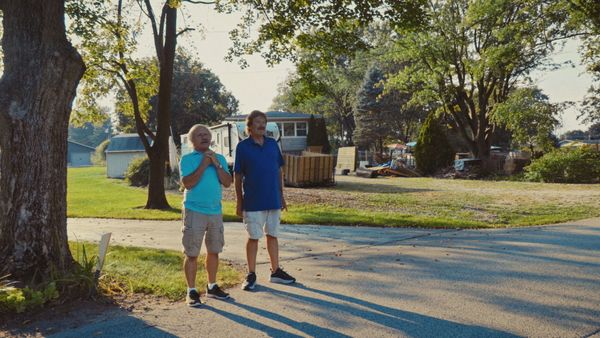
In the second episode of the series, Darrell and Bruce Blasius’s retirement bliss is disrupted when their neighbor’s grandson, Trever, starts raising livestock on her suburban Indiana property.
Courtesy of HBO
I loved Darrell and Bruce’s house so much—talk about seeing people’s lives on their walls. Which of the homes on the show was your favorite? Harrison, you mentioned Seth’s....
HF: I’ll say it’s my favorite. I think it is.
DR: I mean, Darrell and Bruce’s home is just incredible. Their vision, it’s so fully executed. And they’re also incredibly handy. They’re really resourceful. It didn’t make it in the cut, but Darrell and Bruce had a Christmas tree competition, or sort of a showing, every year where they covered their entire house in like 20 or 50 Christmas trees all decorated to different themes. They say it in the show, but they didn’t grow up having access to this type of home. And now that they have it, they really want to make the most of it.
Did you notice any commonalities in the types of things neighbors tend to fight over?
HF: A pattern that I think comes up is that people have very little recourse in ways that they can actually solve or deal with these situations. The police become no help because they’re civil matters. So the police give the advice that they have to document everything that’s happening so they could use it as evidence in court and all that. There’s no infrastructure to help neighbors deal with their disputes, so they sort of are forced to film it and document, and they’re forced to deal with it on their own and do our show. [Laughs.]
I feel like that’s a general pattern in the way people deal with these things, and why there’s so much evidence of them online.
DR: I think it’s an instinct that makes sense. They look for a virtual audience to tell their story to that helps them feel like they’re being listened to and that they’re right. [In the show] it’s less so much about similarities in the actual conflicts themselves, because we really wanted to try to keep it different to kind of make the point that it is about the dispute, but it’s also not about the dispute. Like, anyone can have a neighbor dispute. We’re all capable.
Have either of you ever had a neighbor dispute?
HF: I have never been in a neighbor dispute.
DR: Well, we dealt with an interesting neighbor situation while we were editing the show…
HF: Oh yeah! Right.
DR: So the production company that helped make the show is Gummy Films, and Rachel Walden, who’s our producer, kind of based the whole operation [from the company’s studio]. Next door, I think it’s a vinyl record store and also a place where two DJs produce music and practice DJing.
Perfect.
DR: It was just thumping. It was all different genres of music that are loud and have a high BPM, just blasting throughout our editing process. At first we were like, ‘This is a nightmare. We have to say something.’ But then, of course, we got to know the guy and we liked him a lot. And then we kind of got into it. It became kind of a soundtrack. It was like, ‘Okay, it’s time to lock in. The DJs have started their set, now we need to get back to the edit.’
It’s like you learned a lesson, and there was immediately a place to apply it.
DR: The irony was wild.
—
Neighbors debuts Friday, February 13, on HBO and will stream on HBO Max. The six-episode, half-hour show will air at 9 p.m. ET on a weekly basis.
Top photo courtesy HBO
—
Related Reading:
You Should Be Taking Reality TV Homes Way More Seriously
They Lived in a "Secret Mall Apartment" for Years. Now, They’re Telling the Story
Read More
By: Sarah Buder
Title: "That Is a Number One F U": A Conversation With the Creators of HBO’s "Neighbors" Docuseries
Sourced From: www.dwell.com/article/neighbors-hbo-a24-docuseries-interview-e7091c82-4a1e2fd3
Published Date: Wed, 11 Feb 2026 16:48:38 GMT