.png)
The owner architects and their parents kiln-fired clay sourced on-site to form the domes, which they use as bedrooms and workspaces.
Houses We Love: Every day we feature a remarkable space submitted by our community of architects, designers, builders, and homeowners. Have one to share? Post it here.
Project Details:
Location: Kanagawa, Japan
Architect: AATISMO / @aatismo
Footprint: 1,420 square feet
Builder: Yukari Kensetsu
Structural Engineer: Tectonica
Lighting Design: Daisuki Light
Table Production: Sasaki Research Institute
Plastering: Imajo Sakan
Photographer: Shinya Sato / @shinyasato_hello
From the Architect: "Haniyasu House is a two-family residence designed for our parents, who are ceramic artists, and for ourselves as architects. About 15 years ago, our parents moved to Kamakura in search of an environment where they could fully devote themselves to working with clay. The house is located at the edge of a valley called Yato, surrounded by steep cliffs into which horizontal cave tombs known as yagura are carved—an environment where the presence of the earth is strongly felt. In order to confront and respond to the way this land exists, we took earth, humanity ’s most ancient material, as our central theme and brought the architecture into being.
"As a place suited to all of us, whose lives revolve around making, we envisioned a primordial dwelling—one from a time when living and creating were not yet separated. We stripped away the walls and ceiling of the existing house to form a single large space connected to its surroundings, and added new rooms at its four corners, their forms evoking masses of earth emerging from the ground. Within the added volumes, each person works and sleeps in a cave-like, enclosed space, while gathering in a central, plaza-like area to converse and share meals. We imagined a way of life akin to that of a small settlement.
"The name Haniyasu House derives from a deity in Japanese mythology who governs earth, soil, and pottery; hani is an archaic Japanese word meaning clay. As if offered to this deity, the house seeks to unite with the land through earth as a medium, while transcending the frameworks of land, architecture, and pottery—becoming a vessel in which living and creating can remain inseparable.
"We crushed clay-rich soil from the land, fired it in my father’s kiln, applied glazes, and scorched it with burners—repeating numerous experiments in an attempt to use the colors of the earth itself as a material. In the final process, we bisque-fired discarded clay generated through my father’s making process, layered it over the soil from the site, and then poured a plaster mixed with iron and copper powder—byproducts from a metal workshop—over the exterior walls of the extensions in multiple layers, like glaze, allowing oxidation to produce color through rust."
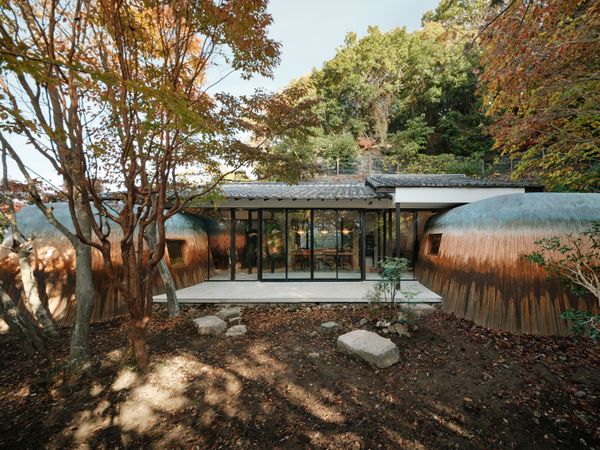
Photo: Shinya Sato
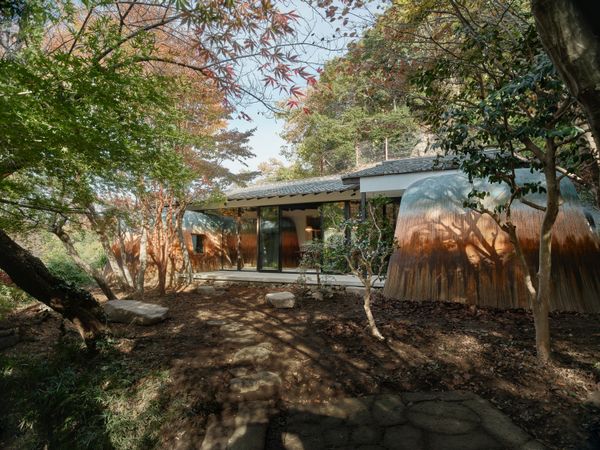
Photo: Shinya Sato
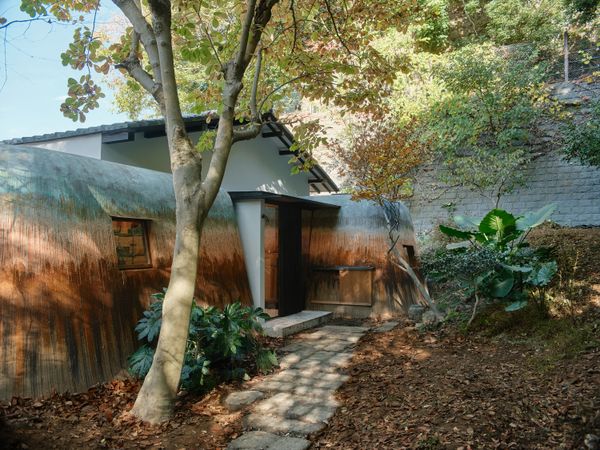
Photo: Shinya Sato
See the full story on Dwell.com: The Clay Domes Anchoring This Japanese Home Are Basically a Life-Size Ceramics Project
Related stories:
- You Enter This Brazil Retreat Through Its Mountain Bike Workshop
- Before & After: How Two Brothers Turned a Cavernous Candy Factory Loft Into a Sweet Pad
- Pink Slime Drips Around Windows at This Renovated Chicago Bungalow. And It Only Gets Weirder
Read More
By: Grace Bernard
Title: The Clay Domes Anchoring This Japanese Home Are Basically a Life-Size Ceramics Project
Sourced From: www.dwell.com/article/haniyasu-house-aatismo-clay-rooms-multigenerational-home-23eec56a
Published Date: Wed, 01 Apr 2026 18:51:10 GMT