.png)
Across the country, cities—big, small, and midsize—are attempting to remake their cores into livable neighborhoods, not just places of commerce. Will it work?
This story is part of Dwell’s yearlong 25th-anniversary celebration of the people, places, and ideas we’ve championed over the years.
Downtown Orlando will soon look a lot different. The one-way streets designed to make car travel more efficient are changing back to pedestrian-friendly two-way traffic, and there will soon be wider sidewalks, more bike lanes, dog parks, plazas, and street trees around. These changes are part of an action plan, one that calls for downtown to become a daisy chain of public spaces that entices more foot traffic.
"One of the reasons we’re so focused on the public realm is that it is the thing that’s most important to our cities," says Cassie Branum, the Atlanta-based urban design practice leader at Perkins & Will who is helping Orlando reinvent its core. "Those are the backbones of our cities and what brings humanity to life in these places."
The American downtown has always been a site of reinvention and experimentation, making visible the social, economic, and political priorities of the time. Until the middle of the 20th century, downtowns across the country thrived. Then suburbanization, white flight, and deindustrialization pulled people away in the postwar era. As their cores emptied, cities relied on raze-and-rebuild urban renewal projects—think Interstate highways, new sports stadiums, and state-of-the-art office towers often built over neighborhoods of color—to improve their fortunes. It’s a strategy that continued into the early 21st century, with various cities vying to become the next tech hub or home base for large companies (remember Amazon’s HQ2 competition?).
But the missing element, cities came to understand, was a robust public life. People want to be around people. Think bustling sidewalks, cultural attractions, buzzing restaurants that are open beyond office hours, and parks and playgrounds. Detroit, the poster child for downtown depopulation, experienced two consecutive years of growth in 2023 and 2024, which Mayor Mike Duggan attributed to new residential development that has attracted families, young professionals, and seniors; more entertainment and cultural attractions; and crime reduction.
Downtowns now are contending with a new set of challenges. Even college-educated workers are priced out of expensive coastal cities, and these same places—like New York, San Francisco, Boston, and Seattle—have had lower return-to-office rates. Since the pandemic, the country’s 12 largest cities have lost eight percent of their population. Meanwhile, fast-growing Sun Belt cities, which rapidly developed during the car-centric postwar era, are figuring out how best to accommodate and encourage the right kind of growth and do it sustainably.
Across the country, cities are remaking their downtowns into livable neighborhoods, layering housing, humane streetscapes, and vibrant public spaces into areas that have primarily served as central business districts. In some cases, bringing more people downtown has been an ongoing desire for decades, but the affordability crisis, the shuttering of offices due to the pandemic, and people seeking out lower costs of living has prompted cities to rethink the role of the urban core. There’s growing consensus that these places should be walkable, mixed-use neighborhoods that are vibrant 24 hours of the day—or as close to that as possible. It’s not just about bringing people downtown with projects like new stadiums and entertainment or innovation districts; it’s about keeping them there.
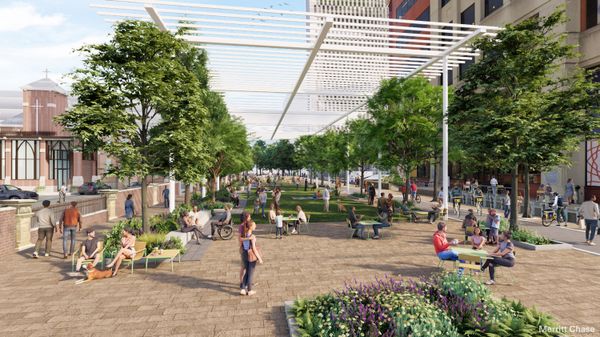
A rendering of Georgia Street in downtown Indianapolis, which is being remade by landscape and design firm Merritt Chase.
Courtesy of Merritt Chase
A return to livability
The heart of downtown Indianapolis is a 285-foot-tall limestone obelisk dedicated to soldiers and sailors from the state of Indiana. A bronze of Lady Victory alights its peak and at its base are cascading fountains adorned with statues depicting battle scenes and a reflecting pool. Despite the monument’s somber subject matter, it is a pleasant place to be—save for the traffic circle that disconnects it from the rest of downtown. But a couple years ago, amid a bid for more livability downtown, the city transformed a quadrant of the roundabout into a temporary park. Designed by the landscape and urban design firm Merritt Chase, it featured a beer garden, a bright blue Imagination Playground, wood picnic tables, movable bistro and Adirondack chairs, lime-green umbrellas for shade, and turf circles. Over 5,000 people visited on opening weekend in 2023. The pop-up was so successful that Merritt Chase and the city are exploring a permanent design.
Monument Circle Park, as it’s now called, is part of a larger plan to revitalize the urban core of Indianapolis and draw more people to it by focusing on new housing, upgrading infrastructure, and economic development programs. It’s working: Over the past 10 years, the number of families living downtown has increased over 66 percent. What stitches it all together is an improved public realm, including new parks and more pleasant, beautiful streets. Instead of serving as primarily a place to work, downtown Indianapolis has the ambition to become a highly desirable neighborhood.
"People really want to live in downtowns," says Nina Chase, a founding principal of Merritt Chase, which is also working on a street connectivity plan in the area. "The pitch is: bring people downtown, not just for big sports events or big tourism draws, but for people to have a good quality of life."
Indianapolis wants to turbocharge the momentum and increase the downtown population by 20,000 people—roughly 65 percent—in the next decade. "If we invest in better livability, everything else will benefit," says Chase’s fellow founding principal Chris Merritt. "People are really mobile and flexible and so they can choose where they want to be. You have to invest in better quality of life in cities to get the kind of talent cities want."
In addition to Monument Circle, the firm is remaking Georgia Street—a European-style promenade built for the 2010 Superbowl—into a park-like setting. Three blocks away, it’s updating the plazas and open space around City Market, a 19th-century market hall that is being renovated into a mixed-use campus. The firm is uncovering part of an old foundation that still remains in the plaza, which is a nod to the architectural heritage of the city and adding more greenery. The hope is that instead of getting into your car and driving to your next destination, people downtown will walk from place to place instead. "Especially post Covid, we’re trying to build better social cohesion and not just have isolation," says Merritt. "We think public spaces do that, and that can improve our lives and strengthen community."
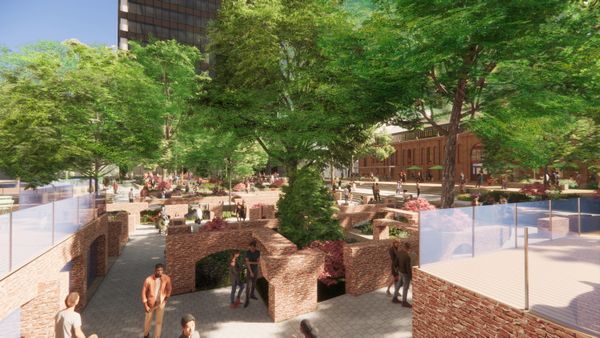
The firm is also taking on nearby City Market.
Courtesy of Merritt Chase
Revitalization for sustainability’s sake
The revitalization work happening downtown is also a play at long-term social resiliency to cities. The pandemic cratered downtowns, laying bare just how dependent central business districts are on nine-to-five office workers for economic vitality in these areas. Nearly six years later, recovery has been slow and uneven. It took Manhattan until August for foot traffic to surpass pre-pandemic levels, a shift attributed to return to office mandates and safety perceptions. San Francisco, once a poster child for the so-called urban doom loop, is still experiencing significant office vacancies and lower foot traffic than before the pandemic. However, cities with lower rates of hybrid work, which includes midsize and small cities and those in the Sun Belt, recovered faster. There’s a sense among planners that diversifying the reasons why people come downtown is crucial for reducing the potential impact of future crises.
Houston is one Sun Belt city that has been remaking its central business district into a more sustainable and resilient place. While downtown Houston was mixed-use until the early 20th century, midcentury suburbanization and sprawl led it to become a place that people mostly drove in and out of to go to work. Since the 1980s, Houston has been adding hotels, convention centers, stadiums, and an arts and culture district. "We’ve been on a multidecade journey around this question of diversification," says Kris Larson, the president and CEO of Downtown Houston+, a nonprofit organization that has been shaping the growth strategy of the area since its founding in 1983.
In recent years, the organization has been advocating for more residents in the area. Since Downtown Houston+ launched its downtown living initiative in 2013, developers have constructed over 15,600 units of housing with more on the way. Thanks to a number of state and local subsidies, office-to-residential conversions have become a new avenue to add these units.
Brooks Howell, a principal in the Houston office at Gensler who specializes in residential and mixed-use developments, notes that office buildings constructed since 2010 are in high demand and fully leased while those that are older than 1990 are struggling. However, offices built before 1975, which have come to the end of their useful lives as workplaces, since they are too expensive to retrofit, are in demand for adaptive reuse. These buildings qualify for historic tax credits that make them financially appealing to redevelop as residential buildings. Howell also sees opportunities for other cities with older office buildings to employ a similar strategy, especially mid-size cities that have experienced depopulation. "In some of these downtowns, every building is more than fifty years old. Every single one," he says. "We could take this downtown and essentially plan it into one giant mixed-use project."
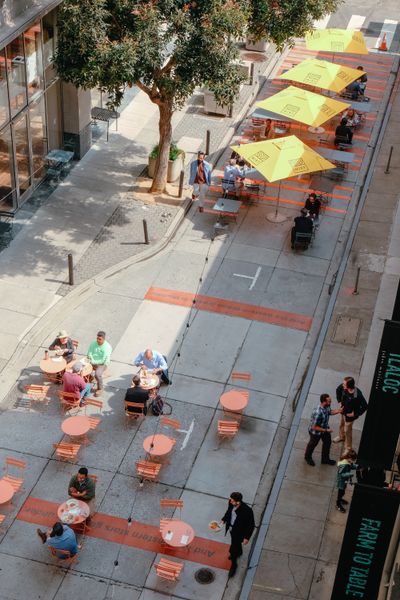
Landing at Leidesdorff in San Francisco, which was redesigned to create a new public space.
Courtesy of SITELAB urban studio
See the full story on Dwell.com: The Great Downtown Renaissance
Related stories:
- The Garage Was in Bad Shape, So She Swapped It Out for a Crisp Art Studio
- The Millennials Who Ditched Cities During the Pandemic Would Like a Word
- This Metallic Office Space in Munich Is an Underground Party Waiting to Happen
Read More
By: Diana Budds
Title: The Great Downtown Renaissance
Sourced From: www.dwell.com/article/the-great-downtown-renaissance-de451e82
Published Date: Tue, 16 Dec 2025 19:28:01 GMT
Did you miss our previous article...
https://trendinginbusiness.business/real-estate/how-frank-gehry-became-a-household-name