.png)
Open Architecture Design used fiber cement panels that match the original concrete, and made a custom metal frame to support the roof structure atop the glass.
Houses We Love: Every day we feature a remarkable space submitted by our community of architects, designers, builders, and homeowners. Have one to share? Post it here.
Project Details:
Location: Saraiki, Latvia
Architect: Open Architecture Design
Footprint: 780 square feet
Builder: Arnhome
Civil Engineer: Arberg
Landscape Design: Landshape
Cabinetry: Baltfuru
Photographer: Alvis Rozenbergs
From the Architect: "Constructed on foundations of Soviet-era military units built to safeguard the Baltic coastal dunes, this seaside residence introduces an adaptive approach to sustainable architecture. The site was discovered with four grass-covered and timeworn military bunkers, now transformed into one main home and two guesthouses for a family of three generations. Located on the Latvian coastline, where northern winds are strong enough to bend century-old pines, the home was created as a sacred heaven for a multigenerational family.
"The essence of the main family house lies within its pronounced dual-sloped roof. While compliant with the local regulations, it is redefined through a contemporary expression of fiber cement panels, drawing a link to the Soviet-era architecture. Faced with the technical challenge of anchoring the massive roof over a glass facade, OAD developed a tailored metal frame that serves as both a structural and design element.
"Life in the main residence begins on the second floor, with the entrance tucked below the structure. Elevated above the horizon, the house forms a bridge over two bunker foundations—an innovative solution for increasing the living area with minimal impact on the surrounding environment. Drawing inspiration from original bunkers in shape and form, the guest houses with their grass-covered roofs expand the habitats of local fauna, seamlessly blending with the untamed wilderness. This contrast between levitation and grounding becomes the defining quality of the spatial experience.
"Inside, the architectural language is restrained, ascetic, and raw. The interior design embraces minimalistic detailing, defined by wooden finishes, concrete floors, and tactile materials that embrace texture over color. The layout is designed to encourage residents to follow natural rhythms of life: the main living area is filled with morning light, while windows in the primary bedroom capture sunset views. Transparent glass facade reinforces the connection to the land below, dissolving the boundary between the natural environment and man-made space."
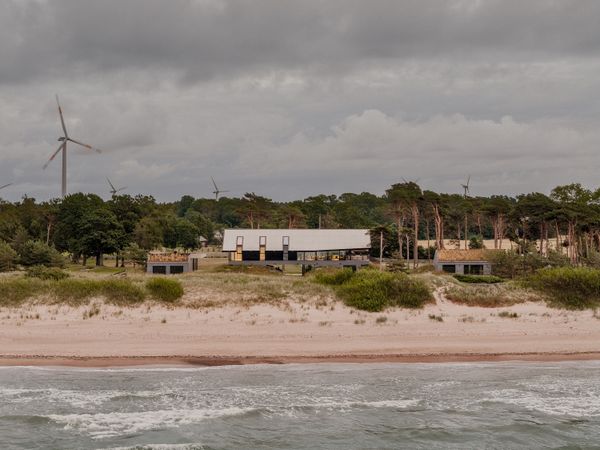
Photo by Alvis Rozenbergs
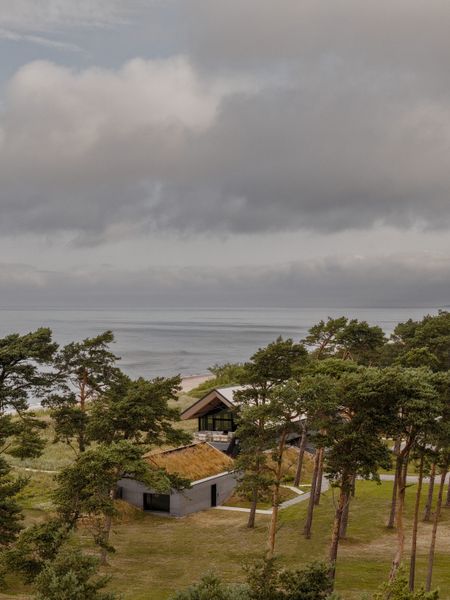
Photo by Alvis Rozenbergs
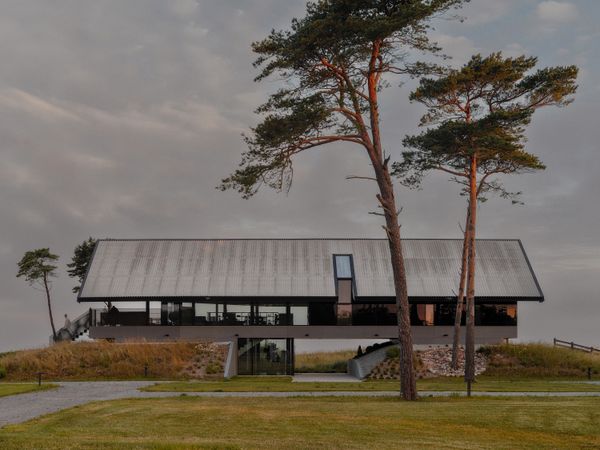
Photo by Alvis Rozenbergs
See the full story on Dwell.com: They Turned Soviet-Era Military Bunkers Into a Glass-Walled Multigenerational Home
Related stories:
- Australian Designer Claire Perini’s Renovated Midcentury Is Soaked in ’70s Soul
- They Built a Unique Barrel-Vaulted Home—and a New Life in Oaxaca—at 86 Years Old
- A Soaring Library in This Boulder Home Makes the "Bookshelf Wealth" Trend Look Like Small Potatoes
Read More
By: Grace Bernard
Title: They Turned Soviet-Era Military Bunkers Into a Glass-Walled Multigenerational Home
Sourced From: www.dwell.com/article/sar-residence-oad-adaptive-reuse-bunker-home-multigenerational-living-7ca3b995
Published Date: Wed, 15 Apr 2026 17:43:41 GMT
Did you miss our previous article...
https://trendinginbusiness.business/real-estate/homebuilder-confidence-ticks-down-amid-economic-uncertainty