.png)
Another wave of companies is emphasizing returning to the office—but that doesn’t mean they’re addressing workers’ needs in meaningful ways.
In 2023, John (a pseudonym) was called back to the office. As an engineer in Chicago, he was one of thousands of workers across the country who left a desk to work from home in the wake of Covid’s shelter-in-place orders. In the two-bedroom apartment that he shared with his wife, he set up his workstation at the kitchen table each morning and put it away for dinnertime, every day for two and a half years. Though he liked waking up later, spared from a transit commute, he longed for his old office, where he had multiple monitors and camaraderie with his team. The initial mandate to return, which required two days per week minimum in their downtown office, was soon expanded to three days. John seems ambivalent about the new policy—and his office.
"They only have two microwaves on the floor that I’m on, and that fills up very quickly. And they also have a fridge policy where you can’t leave anything overnight, and they will throw anything left away," he says. There’s no free coffee or silverware for his lunches. This is no different from his office life before the pandemic, but like many workplaces that reduced their footprints to save money during Covid, returning to work has meant that more people are using the reduced facilities. Sure, he enjoys the comfort of multiple monitors, but these details have become daily frustrations. Five years since the pandemic first began, many companies like John’s are mandating that employees come back to an office, including more than half of Fortune 100 desk workers—up from five percent in 2023. As work-from-home employees are getting back to their desks, the question of what role the physical office can play in bringing workers back remains prominent. After years of working from home, can an office makeover be tantalizing enough to draw even the most adamant remote workers back?
Covid’s onset today feels like a haze: Early on, many office workers moved remote with the understanding that it would be temporary. From variant to variant, offices pushed their reopening. A Gartner survey of CEOs conducted in August 2021 found that two thirds of companies postponed reopening plans, per the New York Times. Building managers and employers rightly turned their attention to small-scale interior updates, making swift changes to keep people distanced and improve hygiene: circles drawn on linoleum floors, and hand sanitizing podiums went up in front of doors. Social distancing in the office, however, prompted many company leaders to begin rethinking how their office might look. Gensler, the world’s largest architecture practice, developed an algorithmic tool in 2020 that applied Center for Disease Control guidelines for social distancing to spatial design.
Eric Gannon, a project director at Gensler, says that the tool helped generate a lot of new conversations about what those guidelines might mean for post-Covid offices. For potential clients, the prospect of changing an office from 100 people to 30 to accommodate a six-foot radius seemed daunting. As states issued stay-at-home orders, the Covid interior safeguards proved irrelevant; remote work seemed to become a permanent future: The U.S. Census reports that the number of remote-only workers tripled between 2019 and 2021, a possible death knell to the office (and to business districts) as we know it. But Gannon feels the office had already been in decline for years prior to the pandemic.
"Everything from how the work environment supports people doing solo work to group work, to socializing and learning, all of it was on a pretty steady decline and heading up to the pandemic—it was, honestly, starting to tank," he says. "The pandemic drew a lot of emphasis on it, but we were aware that workplaces were starting to shift in terms of needs."
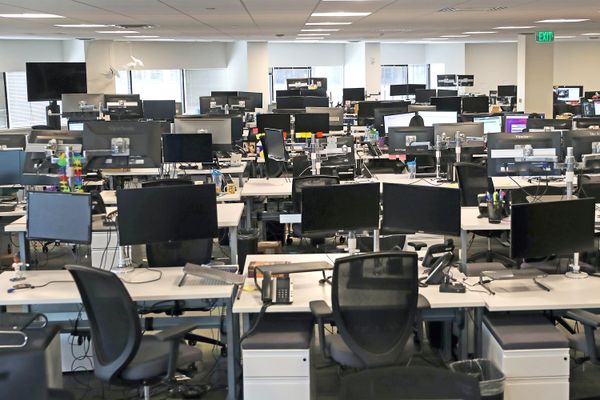
Empty desks at the Fuze office in Boston on March 10, 2020, one of many that became ghost towns during the work-from-home era of the pandemic.
Photo by David L. Ryan/The Boston Globe/Getty Images
Open offices, popularized in the late 1990s, had been especially fading into irrelevance. The scheme supposedly ‘broke down barriers’ of cubicle walls to encourage a more socialized and collaborative workplace, but a 2021 New Yorker article documenting the office’s evolution notes that, by the early aughts, the ‘open plan office’ became more of a grift than a gift, a ploy to cram more people into less space. In 2010, reads the story, "the average North American employer allocated two hundred square feet to each worker; by 2017, that number had shrunk to about a hundred and thirty square feet." As anyone who works in an office can attest, noisy distractions abounded, forcing employees to hide away in their headphones.
These problems persist, according to Gensler’s 2025 Global Workplace Survey, a study of more than 16,000 full-time office workers across 15 countries and 10 industries. They found that space-effectiveness for all activities including working solo, collaborating in person, socializing, or learning, haven’t improved since 2008; the majority of respondents report that their biggest distractions—overhearing phone and in-person conversations, as well as foot traffic—remain inherent to open offices. These open office plans "fail to accomplish one of their major stated goals—increasing collaboration. Instead, researchers have found, they drive workers into more isolation," reports Scientific American.
It’s no wonder that working from home makes people happier, yet employers still want their workers back. A 2024 study by KPMG shows that 79 percent of American CEOs envision "corporate employees whose roles were traditionally based in-office to be back in the physical workplace in the next three years." That’s up 34 percent from the year prior. JPMorgan Chase concurs: Their recently completed Foster + Partners office building, a 2.5-million-square-foot "supertall" in Manhattan that cost $3 billion (with interior workspaces designed by Gensler), is "a bet on the idea that working from an office is a competitive advantage in a business landscape that is rapidly changing," designed with a goal "to make workers healthier in mind, body, and spirit—and therefore equipped to do their best work efficiently and effectively," writes Dwell contributor Diana Budds in Fast Company. Communal spaces on each floor, ample light, and clustered workstations all contribute to making workers "feel like they have more personal space."
Time will tell if a fancy HQ will be enough to attract workers back or just a post to which disaffected employees will be chained, and CEOs around the country might be taking note. But among those employers who chose to up their workplace game, JPMorgan’s CEO Jamie Dimon is an outlier. Many CEOs (or architects) aren’t billing their new builds or rehabs as a means to get butts back in seats, framing them instead as recommitments to attracting and retaining talent by providing more holistic workspaces. Still, 59 percent of organizations plan to increase investment in office renovations that "support return-to-office" efforts, reads an op-ed in Constructive Dive by the Americas market lead for project and development services at global real estate investment firm JLL. Despite that excitement, Gensler’s research found that only 30 percent of offices have been renovated post-pandemic, and "that’s sixty-plus percent that have been untouched where [workers are] trying to live a new life in the same environment," says Gannon.
Realistically, few corporations have the capital to build entire new buildings, and renovations aren’t cheap (and as the JLL piece notes, becoming even pricier under labor shortages and material costs). Some employers have instead retooled workplaces, using strategies like "hoteling," where workers ‘book’ a desk daily or weekly, a means to cheaply provide the type of flexibility and change of scenery that employees crave. Redditors have taken to the forum to discuss the practice, calling hoteled workplaces "cesspits." One tech employee in Chicago described how "flexibility" and "collaboration" are undermined when employees who refuse to use the booking system and instead "make their own rules and take the desks closest to the windows."
If there’s budgeted capital, employers might renovate their space, or, says Gannon, depending on when their lease is up, may choose to relocate and begin anew. But it’s not just about adding a cafe or letting employees book the desk of their choosing that may make these spaces desirable to workers wearily returning from their homes. Gannon sees the glitzy, "almost laughable" amenities of the past, popularized by start-ups—like ping pong tables—as a big turnoff; those employers who might now be trying to entice their employees out of their houses by making the office into a home-like environment, like creating ‘living rooms’ with residential seating, are also missing the mark. "At some point you want your nest at home, and you think of your personal space differently than trying to personalize your office space," he says.
"It’s like the consumer mindset," Gannon adds. "Workers aren’t people you just push things on. They have opinions, and that’s, I think, a reality for us now." Instead, Gannon emphasizes the need for more authentic or purposeful interior redesigns that can be adapted or reconfigured over time and rooted in data sourced from employees. (Though he warns, "don’t ask if you’re not going to do something with it.") Workers, it seems, know when the carrot is just a stick in disguise: It could explain why, according to Pew Research, 46 percent of remote workers say they would rather quit than return to the office.
Instead of trying to convince employees that the office is perfect for them individually, then using policy to force it on them, Gannon explains that employers would be better off investing in spaces that genuinely enable them to work better by focusing on what employees need to perform their best—technology, flexibility, and meaningful amenities. Building managers and owners also have a stake—and responsibility—in the equation; a paper by the Chicago Fed reported by The Hill in July 2025 shows that massive amenities like gyms have little effect on overall office vacancy rates. However, "meaningful amenities" might look like free parking, which, writes The Hill, "eliminates a major logistical headache and financial burden, especially when downtown parking prices are high or public transit is unreliable." Relieving daily frictions is the way to go.
It echoes John’s experience: workers see optimism in returning because of the technology tools and relationships they’ve built with their team; the day-to-day frustrations of commuting, sitting for long periods in one place, being unable to collaborate effectively, and being exposed to nuisances can all be detrimental to the back-to-work project. Luring people with shiny objects or novelty spaces simply isn’t an effective strategy. For some it may require more complex renovations. For others, it might mean smaller interventions like ensuring that workers don’t return to half-hearted offices where even the mistake of forgetting a spoon can lead to a headache.
Top photo of JPMorgan Chase’s new office in Manhattan by Angela Weiss/AFP/Getty Images.
Related Reading:
When the Office Starts to Look Like Home
How Adaptive Reuse Can Help Solve the Affordability Crisis
Read More
By: Anjulie Rao
Title: What Have We Learned About the Design of Attracting Employees?
Sourced From: www.dwell.com/article/what-have-we-learned-about-the-design-of-attracting-employees-back-to-office-9bbf3849-8fc16122
Published Date: Thu, 01 Jan 2026 13:02:18 GMT
Did you miss our previous article...
https://trendinginbusiness.business/real-estate/go-modern-or-traditional-my-familys-adirondack-cabin-proves-you-dont-have-to-pick