.png)
These unexpected exterior renovations have a surprisingly high return on investment—and can drastically increase the resale value of your home.
The garage is arguably one of the most overlooked spaces of the home, but in recent years, there’s been a change. Once catchalls for storage of all kinds (as well as being used for their intended purpose), the garage is experiencing a renaissance, and this sea change isn’t just limited to making them more functional.
According to a recent New York Times article, the garage has become the home’s newest "third space"—part mini living room, part workspace—but altogether a flexible extension of a house. Hence, more homeowners are asking designers and architects to pay more attention to their garages—and not just the inside, but the outside, too.
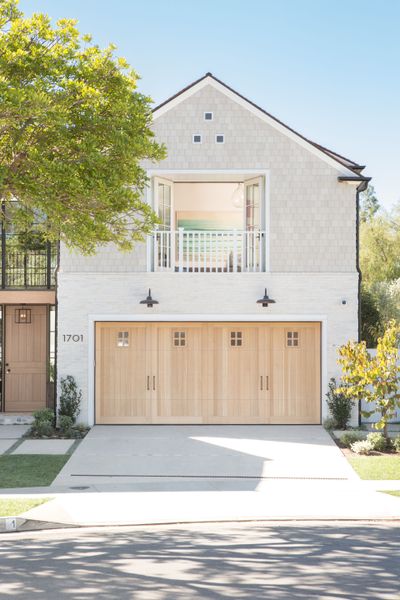
Light stained wood works well on a more farmhouse or traditional-style home, as seen in this project in Newport Beach, California.
Photo by David Tosti
Garage Living, a company focused on renovating garage interiors, completes several thousand full scope garage projects across North America and Australia each year. "And that number continues to rise as homeowners rethink what this space can be," says Aaron Cash, president of Garage Living. What used to be a general storage zone is now evolving into workshops, fitness areas, hobby rooms, bonus living rooms, and more, as homeowners seek to customize their garage interiors.
However, it’s hard to quantify just how much custom interior garage renovations actually increase the overall value of a home. The true merit of customization lies in the eye of a homeowner. For some, a private gym in the garage is worth its weight in dumbbells; for others, it’s one decked out in solar panels. Garage door replacements, on the other hand, are known to deliver significant value boosts with an impressive 194 percent ROI, according to the Journal of Light Construction’s 2024 Cost vs. Value Report. In 2025, Zillow ranked garage door renos as the best ROI home improvement project. A new garage door can cost on average $4,317, but the resale value can be worth upward of $15,081—a whole 349.3 percent return on investment.
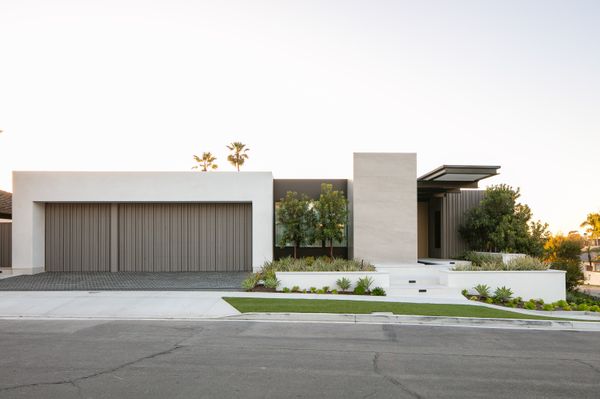
This Corona del Mar project, dubbed Serena Terrace by Brandon Architects, featured Azek TimberTech for the garage door.
Photo by Ryan Garvin
It’s this surprisingly high profitability that’s driving more homeowners to revamp their garage doors, integrating them into architectural design. "Of course, homeowners want to improve their property and make it fit their taste and offer curb appeal," says Ryan McDaniel, partner and director of design at Brandon Architects. "But also, in a competitive housing market, I’ve seen new, stylish garage doors make homes sell easier."
Over the last few years, the company has designed wood and faux wood garage doors in a wide range of styles, from ultramodern garage doors to those that fit a more transitional style. "For traditional looks, we try to draw from carriage doors—which were attached to old coach houses, the original standalone garage designed to store horse-drawn carriages—in terms of hinges, hardware, and decorative pulls we use," McDaniel says. With modern garage designs, the company might try to conceal the doors entirely. "Ultimately, it’s the style of the home that dictates what we do with the garage doors," he says.
Sure, purchasing simple aluminum garage doors online is the easy way out. But according to McDaniel, his clients don’t want a garage door that could fit just any home. "Clients realize that wood and faux wood garage doors are another way to make a design statement, especially for a higher end home."
Is real wood or faux the way to go?
A lot of the wood garages McDaniel has helped design use real wood, usually hemlock or red cedar. A significant benefit to both is that they can be stained to suit personal preference and can even be made to match the rest of a house. Red cedar especially looks great in darker hues, McDaniel points out, and it’s known for its natural decay and insect resistance.
Other woods typically used include Douglas fir, an adaptable wood that is easy to paint, stain, and maintain; redwood, known for its durability and appearance; and pine, a more economical choice due to its price point but requires regular maintenance to prevent rotting and warping over time.
However, all these options require re-staining and upkeep, and, like all real wood, they naturally patina and weather. "The number one reason people choose fake wood is to avoid all this maintenance," McDaniel says. "With real wood, someone would have to come by and touch up the doors, re-staining the wood to maintain the look and keep the colors consistent. Which is why we’ve seen a rise in composite materials that can achieve the natural look of wood without the maintenance."
A recent example is the company’s Sabrina Terrace project, which is a modern design that implemented AZEK TimberTech as a primary wall material. "With the help of our build team, we mitered the product to create a vertical batten detail throughout the home which was also used in the garage to reduce the visual impact of the garage doors," he says. This added a rich texture to the home’s exterior while addressing the client’s concerns for maintenance.
TimberTech’s intended use is for residential decks, says Patrick Barnds, senior vice president and general manager of TimberTech Deck and Accessories. Still, one of the most enjoyable things about Barnds’s role, he says, is watching creative designers, architects, and talented fabricators use the products in ways that they never imagined.
"I have seen some amazing benches, planters, privacy walls, fences, and other architectural elements fabricated from our materials," he says. Initially, TimberTech’s product was never marketed as anything other than decking. But Barnds noticed that homeowners and the like were using it in different and exciting ways. "After a few years, we ultimately did the work to test our products for cladding applications. We then developed proper installation guidelines, fasteners, and fastener schedules and now warranty the product in this application," he says.
The benefit of synthetic materials is durability. But longevity often comes with aesthetic sacrifices. "The drawback is that the materials won’t have that natural grain to them, and the closer you stand next to them, the more the material shows itself," McDaniel says. With the aforementioned Sabrina Terrace project, the architects played with the material’s shadow lines and created depth out of the material as opposed to allowing the wood to speak for itself through its graining. Yet, despite whatever they may lack in beauty, these composite or synthetic materials can still achieve a more natural wood look without the upkeep challenges of wood: staining, sanding, rot, or decay.
Faux wood also isn’t as heavy. Wood doors weigh more than aluminum ones, so homeowners need to upgrade their garage door motor. "All the extra weight may mean the motor could be serviced every two years or so," says McDaniel, instead of the usual five to six years that comes with the average garage door motor.
The future of garage renovations
Modern, sleek wood garage doors are an enduring trend. "On the exterior, garage doors are becoming an architectural statement," Cash says. "We’re seeing interest in minimalist door styles, upgraded materials, and smart technology that pairs with the overall design [of the home]." Inside a garage, homeowners are gravitating toward cleaner lines, integrated lighting, and cabinetry that feels more in line with the house’s interior design. "We expect to see strong demand for flexible storage systems that adapt to changing needs," Cash says.
Still, the garage door is the largest visual element facing the street, so homeowners are going to continue investing in doors that elevate their home’s overall curb appeal. For many, houses are also their greatest financial investment, and so, boosting a house’s perceived monetary worth will always take precedence. This is especially true looking ahead to 2026, as housing market analysts have already predicted a 50 percent price drop in the real estate market as it shifts into a more "buyer-friendly" one.
And the future of garage aesthetics might soon change even further. As homeowners attempt to keep up with the proverbial Joneses, embracing the use of smarter technology—greater security systems, new EV charging stations, energy-efficient insulation systems, and solar panels becoming standard practice in the garage—they’re further enabling a once neglected area of the home to become not only functional but valuable, too.
Top photo by Chad Mellon
Related Reading:
15 Modern Garage Doors That Demand a Second Look
How to Upgrade the Curb Appeal of Your Home for Less Than $500
Read More
By: Michelle Mastro
Title: Why Homeowners Are Focusing on the Garage Door
Sourced From: www.dwell.com/article/why-homeowners-are-focusing-on-the-garage-door-ac032385
Published Date: Tue, 16 Dec 2025 17:50:16 GMT
Did you miss our previous article...
https://trendinginbusiness.business/real-estate/the-staircase-in-this-small-spanish-apartment-hides-a-secret-toilet