.png)
In "Dream Facades," Dwell managing editor Jack Balderrama Morley unpacks the deeper meaning of the architecture on your favorite unscripted shows.
What does Lauren Berlant have to do with The Hills? What connects the Kardashians and white flight? What can RuPaul’s Drag Race and Fire Island teach us about the colonial mentality? Dwell managing editor Jack Balderrama Morley’s upcoming book, Dream Facades: The Cruel Architecture of Reality TV, holds the answers. Building from their long-held obsession with reality television, Jack connects the genre’s shows and the architectural styles that populate them to the broader political issues that shape life in the United States.
Throughout there are personalities big enough that they’d make Andy Cohen’s ears perk up. Take Joseph Pell Lombardi, one of the main architects behind the New York loft renovations from The Real World, who declares his renovation for the loft seen in the show’s first season was "the best loft in New York City or in the world." Or Addison Mizner, an architect who traveled with two chow chows and several monkeys in tow at all times, inspired a Stephen Sondheim musical, and helped give Florida its Mediterranean Revival flavor. Grandstanding is not limited to career reality stars, needless to say.
Ahead of the release of Dream Facades on March 3, I spoke with Jack to hear more about what’s so compelling to them about the homes and spaces we see in reality TV. We touch on the long-term effects of home renovation shows like Trading Spaces, get to the bottom of where, exactly, Jack would live if they had to live somewhere in the Bravoverse, and why reality television and everyday architecture finally deserve to be taken seriously.
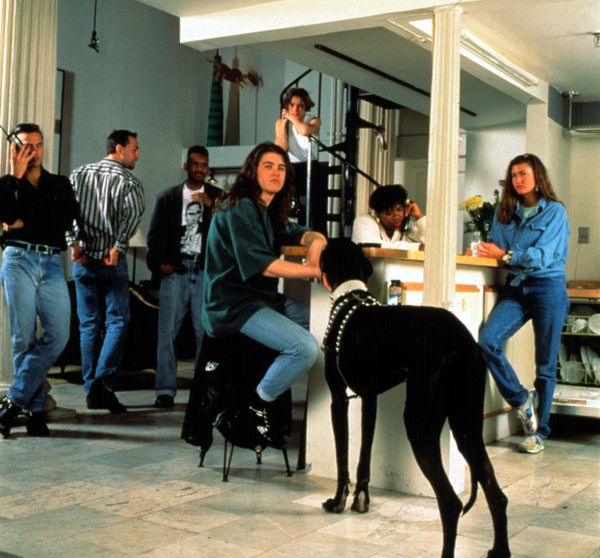
The cast of Season 1 of MTV’s The Real World pose inside their New York loft, renovated for the show by architect Joseph Pell Lombardi.
Photo © MTV / Courtesy Everett Collection
You’re obviously a big fan of reality television. Was there a definitive moment when you began to think critically about the homes in these shows?
I think the Selling Sunset story that I wrote for Dwell really did kick it off. I remember we were chatting about it in a pitch discussion in 2022, if anybody wanted to write about it. I was like, "Oh, maybe there is something that I could say," because I was a big fan of the show. Obviously the homes are so weird on that show, and it was really a big part of the zeitgeist at that time. But I sort of surprised myself at how much I felt like there was to dig into. It wasn’t like I had this master plan of what the book would be and the arc. It really just unfolded on its own as I went along, which is amazing. It’s really cool.
Yeah, I’ve written a little bit about reality TV design and I had the same experience of being surprised by how much there was to write about it. You use reality TV in this book as a lens to get into so much, like colonialism in America, for instance. What do you think we gain from taking reality television seriously?
I feel like it’s one of those things where it’s not considered a heroic art form that historically has been studied, like art history, as a significant cultural text that can really tell us about how culture works and operates. But I mean, the theorist Sianne Ngai, who I cite a bunch in the book, writes a lot about minor aesthetic categories. Like things that are just interesting, or things that are cute, or these things that are really not heroic. I feel like that sort of analysis of quotidian, almost banal stuff, like reality TV, can say just as much, if not maybe more than more exceptional, heroic artworks. Like just looking at the slop that we’re all wallowing through every day I think can tell us more than the sacred pearls that we come across.
I feel like that was done really well, especially in The Bachelor section and how you link it to other narratives throughout time.
Totally, thank you. On the architecture side, it was really interesting just looking at some of these architectural styles. Like in The Bachelor section, the Mediterranean Revival style, or whatever you want to call it, is a nonheroic architecture style, but it’s so common. It’s around so much of the country, like so much of the country is coated in it. There’s not that much really that’s written about it critically. There are good historians who have studied it, but in terms of cool contemporary architecture theory, it’s not up there, even though it’s a style that more people interact with than heroic modernism, or capital A architecture of any time. So thanks, I was really trying to do something that was relevant to a lot of people.
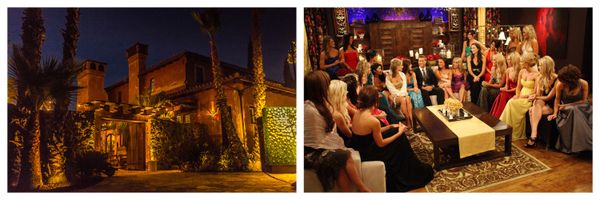
Bachelor Jake Pavelca is surrounded by bachelorettes at The Bachelor mansion in Season 14.
Left photo by Greg Doherty via Getty Images. Right photo © ABC / Craig Sjodin / Courtesy Everett Collection
Totally, everyday architecture is to capital A architecture what reality TV is to scripted television.
Yeah, it’s like more of the slop, basically. It’s all the stuff that we didn’t choose but is around us and I guess on some level, sometimes we choose it. But I don’t know if, in an ideal world, we would be choosing any of this stuff.
I feel like with architecture, the thinking is like, Well, this is the thing I can afford, this is the thing that’s readily available to me. And with reality TV, it’s a similar dynamic of like, this is the thing that at the end of a long day, I have room for in my brain.
I was amazed when I was writing the book, interviewing professors who are like chairs of departments at Ivy League universities, and, like, off the record, before the interview, they’d be like, "Well, I do watch this one show." It’s like, you’re the high standard of intellectual discourse and you’re watching this stuff. Most of us are consuming it, so let’s think about it differently.
Silly question for you: after looking at all of these reality TV show houses so closely, if you had to choose one to live in, which would you choose?
Oh, my goodness. Chateau Shereé [from Real Housewives of Atlanta], just because then I could live with Shereé. I think that’s just the first one that comes to mind that was actually like a real home in a real neighborhood. It’s so strange in its own way, but that would be my choice.

The Real Housewives of Atlanta stars from Season 2 gather around a sectional.
Photo © Bravo / Wilford Harewood / Courtesy Everett Collection
See the full story on Dwell.com: You Should Be Taking Reality TV Homes Way More Seriously
Read More
By: Rachel Davies
Title: You Should Be Taking Reality TV Homes Way More Seriously
Sourced From: www.dwell.com/article/reality-tv-architecture-dream-facades-jack-balderrama-morley-255698cf
Published Date: Tue, 27 Jan 2026 16:16:15 GMT
Did you miss our previous article...
https://trendinginbusiness.business/real-estate/where-neighbors-saw-a-jumble-of-blocks-they-saw-tetris-pieces-with-potential