.png)
The rules of online visibility are changing fast. Millions of people who once typed queries into Google are now asking AI chatbots for answers, and those AI systems don’t return a list of blue links. Instead, they generate a single, confident response, and if your brand isn’t part of that response, you’re basically invisible.
That shift is exactly why Generative Engine Optimization has become one of the most urgent topics in digital marketing. According to Search Engine Land, optimizing for AI-generated answers requires a fundamentally different approach than traditional SEO, which is something brands will have to be aware of moving forward.
Understanding what GEO actually means, and how to act on it, starts with a clear definition and a full understanding of what it means for online visibility. From there, you can develop a strategy to take full advantage of GEO and its benefits.
Quick Takeaways
- Generative Engine Optimization focuses on getting your content included in AI-generated answers, not just ranked in search results.
- Traditional SEO is no longer enough, as visibility now depends on how well your content can be understood and cited by AI.
- Search behavior is shifting toward conversational, question-based queries with fewer clicks to websites.
- High-quality, structured, and authoritative content is critical for GEO success.
What Is Generative Engine Optimization (GEO)?
Generative Engine Optimization is the practice of structuring and optimizing your content so that AI-powered tools, like ChatGPT, Perplexity, Google’s AI Overviews, and similar platforms, are more likely to cite or summarize your brand in their responses.
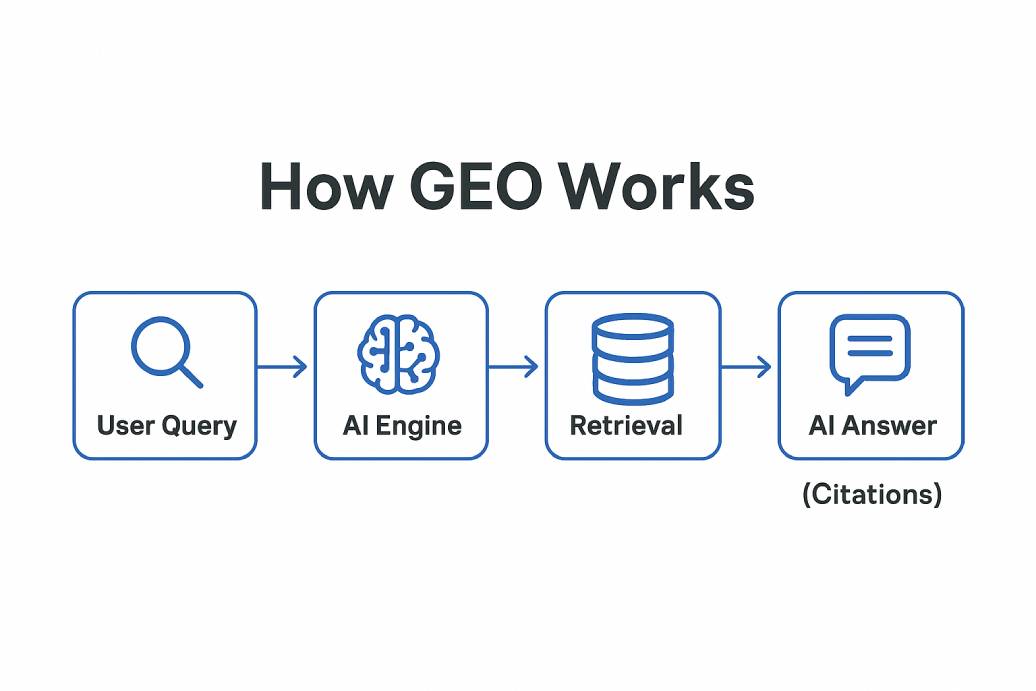
Image Source
Think of it as SEO’s forward-looking counterpart. Where traditional SEO targets search engine rankings, GEO targets AI-generated answers directly. The goal isn’t a blue link on page one, but becoming the source an AI confidently references when a user asks a question relevant to your business.
How Generative Engines Are Changing Search Behavior
Generative AI isn’t just a new interface, but a fundamentally different way people get answers. Traditional search hands users a list of links and lets them do the digging. Generative engines do the digging for them, synthesizing information from multiple sources into a single, conversational response.
The behavioral shift is significant. Users are increasingly asking longer, more complex questions and expecting direct answers rather than ten blue links. What typically happens is that AI-generated responses absorb the click, meaning your content may inform an answer without ever earning a visit.
Why Generative Engine Optimization Matters for Businesses
The shift in search behavior isn’t just a technical curiosity, as it has real consequences for visibility and revenue. As Large Language Models (LLMs) become the default answer engines for millions of users, businesses that aren’t optimized for these systems risk becoming invisible online.
In practice, AI-generated responses act like a shortlist. If your brand isn’t cited, you simply don’t exist in that conversation. According to Coursera, GEO directly influences whether your content gets noticed as a trusted source in AI outputs, making it a business priority.
The brands that earn AI citations build authority that compounds over time. That kind of positioning is increasingly difficult to replicate once competitors establish it first.
How GEO Differs from Traditional SEO
SEO and GEO share the same ultimate goal, but the rules of the game are different. Understanding where they diverge is necessary for any business trying to figure out how search actually works now.
Traditional SEO is built around ranking signals like backlinks, keyword density, page authority, and technical performance. However, Search Generative Experience (SGE) and AI-powered answer engines mean those factors no longer guarantee visibility. GEO shifts the focus toward citation-worthiness, which is how likely an AI model is to reference your content as a trusted source when synthesizing an answer.
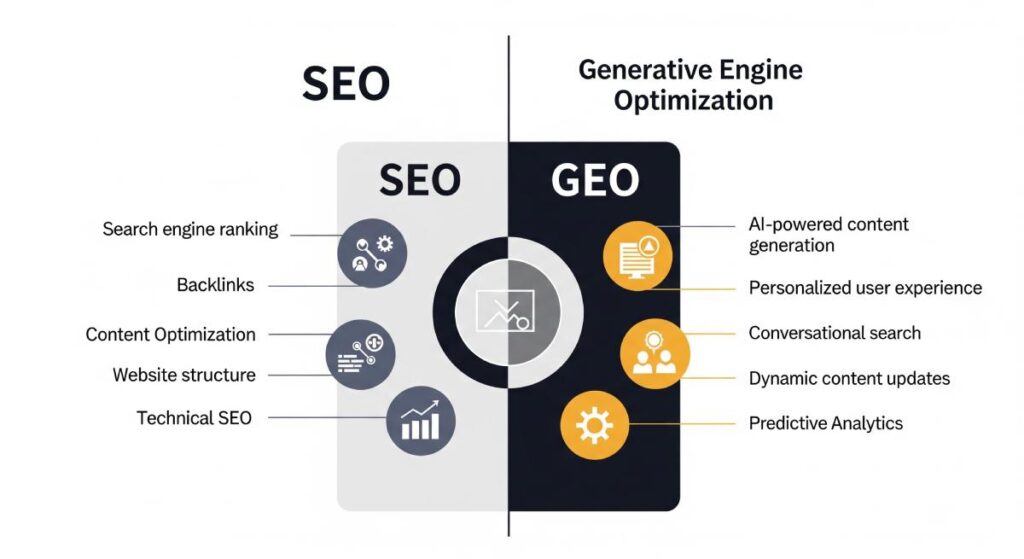
Image Source
In practice, SEO asks, “Can search engines find and rank this page?” GEO asks, “Will an AI confidently quote or recommend this content?” That’s a meaningful distinction. Where SEO rewards optimization for algorithms, GEO rewards depth, clarity, and genuine authority, making content strategy more closely tied to demonstrable expertise than ever before.
Key Elements of a GEO Strategy
Building a presence in AI search engines requires a deliberate, structured approach, not just recycled SEO tactics. A strong GEO strategy rests on a few core pillars that work together:
- Authority and credibility signals: AI models favor content from recognized experts. Citing reputable data and earning mentions from trusted sources reinforces your standing.
- Direct, structured answers: Conversational AI rewards content that answers questions clearly and concisely, which could include definitions and step-by-step explanations.
- Comprehensive topic coverage: Thin content gets skipped. Covering a subject in meaningful depth shows that your content is a reliable reference worth surfacing.
Content that shows expertise and provides value is more likely to show up in generative AI results. That principle drives every tactical decision in GEO. Even small improvements like adding statistics and tightening structure can meaningfully increase how often AI systems pull from your content.
Common Mistakes to Avoid with GEO
Even with a solid strategy in place, there are several pitfalls that can quietly undermine your GEO efforts. Avoiding these missteps is just as important as implementing the right tactics.
Treating GEO like traditional SEO is the most common error. Keyword stuffing and backlink chasing don’t move the needle when AI engines are scanning for authoritative, well-structured answers. Similarly, confusing Answer Engine Optimization (AEO) with GEO leads to a narrow focus, as AEO targets direct question-answering, while GEO casts a broader net across AI-generated responses.
Other frequent mistakes include:
- Ignoring content structure: AI models favor clearly organized, scannable content
- Neglecting citations and sources: Unverified claims get deprioritized by AI engines
- Publishing thin content: Depth and specificity signal genuine expertise
The brands that struggle most with GEO are those waiting for a perfect playbook before acting. In practice, consistent iteration beats delayed perfection every time. With these pitfalls in mind, you’re well-positioned to take practical, confident first steps.
How to Get Started with Generative Engine Optimization
Avoiding common mistakes is one thing, but where do you actually begin? The good news is that getting started with GEO doesn’t require rebuilding your entire content strategy from scratch.
You’ll start by auditing your existing content through the lens of semantic search. AI engines prioritize content that answers questions thoroughly and contextually, not just content stuffed with keywords.
From there, focus on a few practical steps:
- Structure content clearly with defined questions and direct answers
- Add authoritative citations to reinforce credibility
- Use natural, conversational language that mirrors how people actually ask questions
GEO-ready content is less about gaming algorithms and more about serving the reader, which is a shift that positions your brand well for whatever comes next in AI-driven search.
The Bottom Line on Generative Engine Optimization
Generative Engine Optimization isn’t a future trend, as it’s already reshaping how your audience finds and trusts information. The brands that succeed will be the ones creating authoritative, AI-friendly content today.
If you’re ready to make your content work harder, Marketing Insider Group can help. From strategy to execution, our team specializes in creating high-quality, GEO-optimized content that drives authority and real business results.
Get in touch with Marketing Insider Group to start building content that shows up where your audience is already looking.
FAQ: Generative Engine Optimization
What is Generative Engine Optimization?
Generative Engine Optimization (GEO) is the process of optimizing content so it can be understood and included in AI-generated answers from tools like chatbots and AI-powered search engines.
How is GEO different from traditional SEO?
While SEO focuses on ranking web pages in search engine results, GEO focuses on getting your content included directly in AI-generated responses. It prioritizes context and authority over just keywords and backlinks.
Why is GEO important for businesses?
As more users rely on AI for answers, fewer people click on traditional search results. GEO helps ensure your brand remains visible and influential in these AI-driven experiences.
What types of content perform best for GEO?
Content that is well-structured, authoritative, and written in a clear, conversational tone tends to perform best. Answering specific questions and covering topics in depth also improves visibility.
How can I start optimizing for GEO?
Start by updating your existing content to be more structured and easier to understand. Focus on answering real user questions, improving content depth, and organizing information with clear headings and formatting.
Read More
By: MIG Admin
Title: What Is Generative Engine Optimization (GEO) and Why It Matters
Sourced From: marketinginsidergroup.com/artificial-intelligence/what-is-generative-engine-optimization-geo-and-why-it-matters/
Published Date: Thu, 23 Apr 2026 10:00:17 +0000