.png)
Mainstream media would have people believe that there is no support for the U.S.-Iran conflict and that the world would not be safer with the IRGC removed from power. However, NATO Secretary General Mark Rutte told Jake Tapper on CNN that the world is safer because of U.S. military action in Iran.
He added that, under President Trump’s leadership, U.S. strikes have significantly weakened Iran’s nuclear and ballistic missile programs, stating, “Degrading these capabilities is really, really very important for your and my safety here in the U.S., in Europe, in the Middle East.”
Across the world, protests in favor of regime change have been taking place, but mainstream media have largely ignored them. The Nieman Journalism Lab at Harvard University noted in a March 9, 2026, analysis that VOA Persian was accused by its own staff of censoring coverage of Pahlavi. This suggested that President Trump was correct in his characterization of VOA and other government-funded media as having been co-opted by the left and no longer reporting objectively.
Three VOA staff members told The Hill that the adviser overseeing VOA’s Persian-language service, Ali Javanmardi, was excluding video and audio of protesters chanting Pahlavi’s name, silencing guests from discussing Pahlavi, and skewing coverage of Trump’s position toward the crown prince. One staffer said, “This is the kind of censorship that you would expect to see in authoritarian countries run by dictatorships.”
In March 2026, VOA journalist Ahmad Batebi, a prominent Iranian dissident, said he was fired after confronting Javanmardi about censorship. He stated that he was repeatedly told verbally that he was not allowed to include eyewitness statements supporting Pahlavi or pro-Pahlavi slogans in his reports.
Iranian diaspora media outlets, operating outside Iran and broadcasting in Persian, have been among the most consistent voices opposing the Islamic Republic and its security apparatus. Iran International, a London-based network and the most-watched Persian-language satellite channel globally, documented the IRGC’s massacre of thousands of protesters since January 2026.
In response, the regime summoned the families of exiled journalists, threatening them to pressure their family members to stop reporting negatively on the regime.
Tehran’s prosecutor ordered the seizure of assets and bank accounts of Iran International staff, alongside those of other diaspora outlets and protesters. According to Tehran regime state media, the Iranian Attorney General’s Office issued a warning to “those Iranians living abroad who in different ways sympathize, support, or cooperate with the American-Zionist (Israeli) enemy.”
In addition to framing the U.S. conflict as an attack on the Iranian people rather than on the IRGC, mainstream media have downplayed the popular support for former prince Reza Pahlavi, whom many Iranians would like to serve as an interim leader until elections can be held.
On January 9, 2026, when Reza Pahlavi issued a call for protests at a specific hour, millions of Iranians responded simultaneously and on schedule, describing it not as mere popularity but as “a successful act of political command,” marking a qualitative shift in Iran’s political dynamics.
When U.S.-Israeli strikes began on February 28, the network documented Iranians inside the country pleading directly with President Trump for protection, with rooftop chants calling for the death of the IRGC echoing across residential neighborhoods despite armed regime enforcers firing on buildings to silence them.
IranWire, a Washington, D.C.-based investigative outlet founded by Iranian journalists in exile, reported in March 2026 that the prospect of strikes on IRGC infrastructure was welcomed by those inside Iran who had watched the Islamic Revolutionary Guard Corps (IRGC) massacre their compatriots in January.
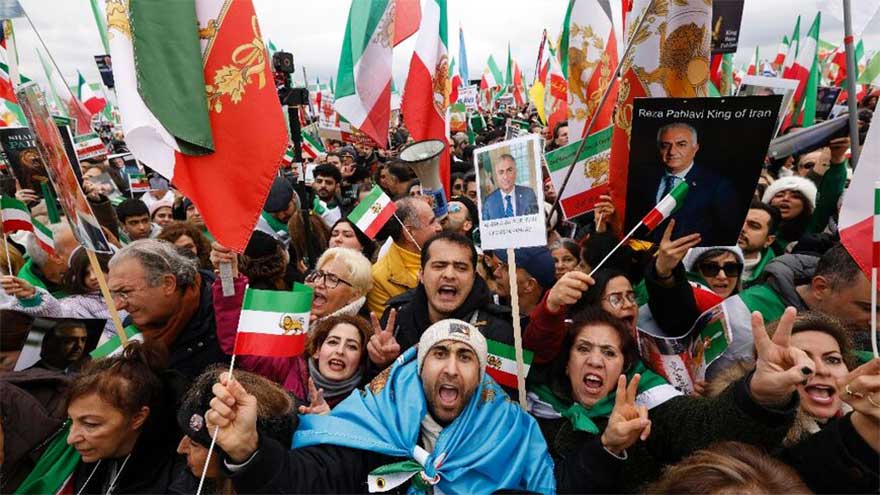
Large Iranian diaspora protests have been ongoing in London since January 2026, consistently linked to Pahlavi’s calls to action. Demonstrations on January 11 drew several thousand people, first outside the Iranian embassy and then in front of Downing Street. The February 14 London rally drew 50,000. On April 4, the Jerusalem Post reported coordinated diaspora rallies outside U.S. embassies and consulates in more than 20 countries, spanning at least 34 cities across Europe, Asia, and North America, including Paris, Berlin, Rome, Stockholm, Seoul, Toronto, Los Angeles, and Washington, D.C. Pahlavi stated: “The message from hundreds of thousands of Iranians around the world is loud and clear: this is a decisive moment for our nation and the struggle for freedom.”
In Washington, D.C., Iranian Americans took to the streets supporting U.S. and Israeli strikes. Women marched with uncovered hair in defiance of Islamic Republic rules, and protesters walked dogs, both banned under the regime. A rally and march from the U.S. Congress toward the White House was held March 29, called for by Pahlavi. In London, counter-protesters facing a pro-regime march told each other “Soon in Tehran” as Iranians and Israelis danced together, with crowds shouting “Go IDF” and “Down with the Islamic Republic.” One journalist noted: “They are mainly pro-Shah, and even though Israel is bombing their country, they feel it’s bombing only the IRGC.”
On March 31, rooftop chants across Iranian residential neighborhoods called for the death of the IRGC and the Basij militia. Footage from Tehran’s Chitgar district showed a plainclothes enforcer pointing a rifle at a residential building as anti-IRGC chants rang from the upper floors, followed by gunfire. The Center for Human Rights in Iran wrote in the Washington Post: “The bombs are still falling, and the Islamic Republic’s future is uncertain, but one thing is already clear: The Iranian regime is preparing for its next war against its own citizens.”
Gratitude toward President Trump has been a recurring theme. Diaspora news media documented Iranians sending him direct appeals for intervention during the January crackdown. France 24 reported on April 9, 2026, that many Iranians who opposed the Islamic Republic had hoped U.S. attacks would lead to regime change and therefore opposed the ceasefire. One Tehran resident stated, “I am personally willing to pay any price, as long as the regime ceases to exist,” while others asked, “Why? Why did they not finish it off?”
Many Iranians described the ceasefire as a betrayal, with one writing directly to President Trump, “We asked you for help to free Iran, but not only did you not free it, you handed us a much worse country and trampled the blood of 45,000 martyrs.” Kako Aliyar, a member of the leadership committee of the Kurdish Iranian opposition party Komala, said there was “no viable alternative” to removing the Islamic regime and that the ceasefire had left the IRGC intact while executions continued.
The Iranian diaspora, including Prince Reza Pahlavi, have called for the U.S. to pursue regime change rather than a deal.
At CPAC on March 28, Pahlavi urged Trump to “stay the course,” telling the crowd: “Do not throw this crumbling regime a lifeline. Pave the way for the Iranian people to finish the job,” adding: “Millions of Iranians have called on me to lead the transition to democracy.” Iranian diaspora supporters carrying Lion and Sun flags filled the audience, chanting “Long live the king.”
The post Media Downplays NATO Endorsement and Iranian Popular Support for U.S. Strikes appeared first on The Gateway Pundit.
------------Read More
By: Antonio Graceffo
Title: Media Downplays NATO Endorsement and Iranian Popular Support for U.S. Strikes
Sourced From: www.thegatewaypundit.com/2026/04/media-downplays-nato-endorsement-iranian-popular-support-u/
Published Date: Sun, 12 Apr 2026 15:40:33 +0000
Did you miss our previous article...
https://trendinginbusiness.business/politcal/update-farleft-antiice-extremist-now-plays-victim-after-brutal-assault-on-tpusa-reporter-savanah-hernandez-boyfriend-also-arrested-and-in-custody