.png)
In the Swiss Alps, the distinctive low-impact, multiunit dwelling was actually built using traditional chalet techniques by in-the-know locals.
As a part of our 25th-anniversary celebration, we’re republishing formative magazine stories from before our website launched. This story previously appeared in Dwell’s November/December 2003 issue.
It may have been designed with custom software, but Chesa Futura owes just as much to the kind of chalets conjured up by our mind’s eye when we hear the word "Switzerland" as it does to cutting-edge computer technology. Set on the slopes of the Engadin Valley, overlooking the town of St. Moritz and its lake, the shimmering ovoid structure looks every inch a piece of pure 21st-century design. But it turns out that both the inspiration for and execution of this unique project are rooted firmly in Swiss tradition, from the pilotis that raise it from the ground to the wooden shingles that coat its exterior.
Serendipity played a part in the design process as well: When the project’s developer, Sisa AG, approached prestigious English practice Foster and Partners, they couldn’t have known that they would end up with a project director who knew the Engadin Valley like the back of his hand. In fact, Milan-born Matteo Fantoni had even more insight than some locals into the exact nature of the site, having stayed in the apartment building that would make way for Chesa Futura during some of his numerous visits to the area in his youth. "We had friends who had flats in the building that was there before Chesa Futura," he explains. "So I knew the view, I knew the orientation, I knew the mountains."
Proceeding with an open brief and a blank piece of paper, Fantoni realized that the elevated, curved shape of Chesa Futura would be ideal for the site, and the more he explored this approach, the more practical it became. The steel legs that raise the wooden shell 11 and a half feet from the ground reference a Swiss mountain-home tradition that prolongs the life of timber structures by minimizing contact with the chilling and dampening snow. It also takes the structure clear of the houses in front of it, meaning that each floor is afforded a much sought-after view of the lake.
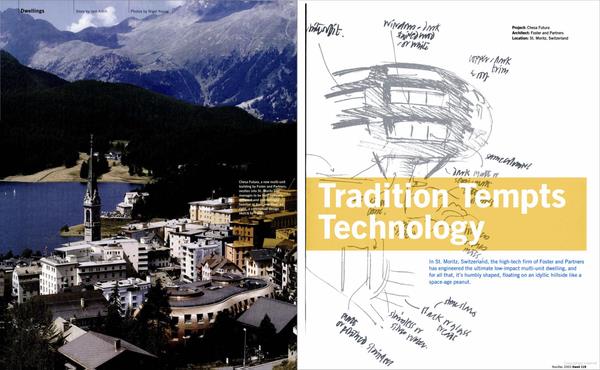
Conceptual design sketch by Norman Foster (right)
The five-story building that Fantoni vacationed in as a teenager had two lower levels that suffered from views restricted by the houses in front of them and the resultant lack of light. That’s something Chesa Futura’s residents will never need to worry about, as the building’s convex southerly aspect contains 10-foot-wide windows that look out onto a terrace and offer panoramic views of St. Moritz. The north-facing rear of the building is radically different—concave to afford maximum insulation from the mountain winds, it is dotted with small windows set at an angle so as to allow the maximum sunlight in while protecting the building from the often extreme conditions.
Despite its elevated position, Chesa Futura intrudes no further into the skyline than its predecessor. Just over 50 feet tall at its apex, the building has been constructed with a slight downward tilt as the valley rises to ensure that it fits snugly into the envelope left by the old building. This was vital to comply with local planning regulations and make sure that neighbors would not lose their views of the lake. Such a radical design in this idyllic location was bound to bring some objections, but by meticulously keeping within local codes, Foster and Partners minimized disruption to the project. Getting the local mayor on board helped, too, even though he wasn’t so sure about things when he first saw the plans.
"He was silent for 20 minutes," says Fantoni. "He then eventually said, ‘You can have my full support on it, because it is going to be great for our valley, Switzerland, and St. Moritz.’" This seems to have been an astute judgment, as the building has already become something of a tourist attraction, with locals and visitors alike stopping to take snapshots or simply stand and stare.
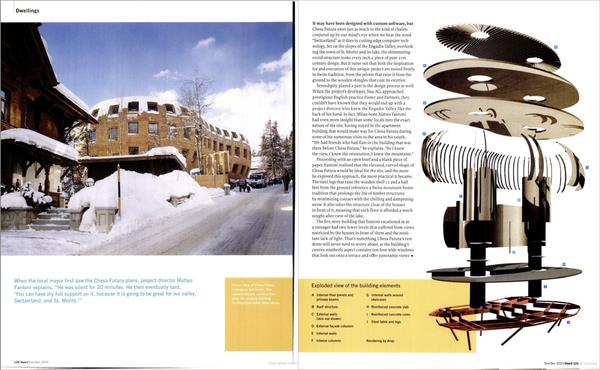
Rendering by Arup (right)
From a distance, Chesa Futura almost appears to hover above the side of the valley like a wood-clad mother ship, the sun illuminating its larch shingles. These hand-cut wooden tiles, which cover the entire surface of the building, are another piece of Swiss tradition that Foster and Partners sought out in their travels across the Alpine region looking for inspiration and materials. One great discovery was 82-year-old Lorenz Kraettli, who has been making shingles all his life.
"He selected 80 trees, took them home, and with his family chopped all the pieces," says Fantoni. "They produced 250,000 pieces out of 80 trees and then put them on the structure of the building over the batons for a period of five or six months. We learned a lot from him about how to cut trees. You can have better structural performance if you cut radial to the log. It creates a much stronger scheme that will last as long as possible."
The structure is topped off with a copper roof, another Swiss material used for practicality as much as tradition. Its malleability at low temperatures (which can reach below zero Fahrenheit in the valley) meant that it could be fabricated onsite, rather than having to be awkwardly transported through the tiny side streets of St.Moritz. It is this ability to adapt and think ahead that Fantoni believes has made the project such a success, in terms of both construction and in building relationships in the local area.
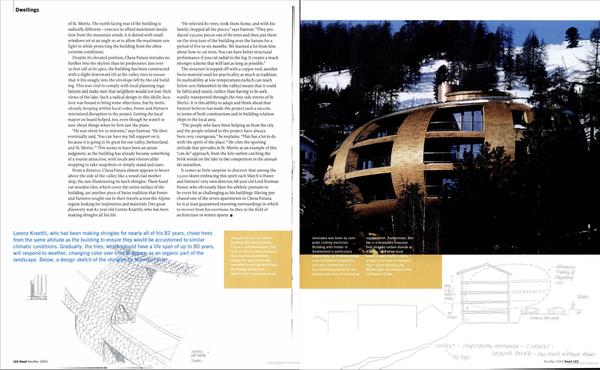
Design sketch of the shingles by Norman Foster (left), Elevation view by Norman Foster (right)
See the full story on Dwell.com: From the Archive: How Norman Foster’s "Space-Age Peanut" Chesa Futura Came to Be
Related stories:
- Before & After: How a Couple Brought Mediterranean Vibes to Their London Terrace House
- Lloyd Wright’s Usonian Ideas Inspired This ’60s Italian Villa, Now Refreshed for a Family of Five
- A Half-Arch Motif Merges an L.A. Renovation With Its New ADU
Read More
By: Iain Aitch
Title: From the Archive: How Norman Foster’s "Space-Age Peanut" Chesa Futura Came to Be
Sourced From: www.dwell.com/article/from-the-archive-chesa-futura-norman-foster-9cff4f1e-60d32898
Published Date: Thu, 11 Dec 2025 13:52:02 GMT
Did you miss our previous article...
https://trendinginbusiness.business/real-estate/walters-plaxen-group-joins-sothebys-international-realty