.png)
The Atelier de Recherche et de Création (ARC) fostered a virtual Who’s Who of France’s postwar style by giving designers like Pierre Paulin and Olivier Mourgue financial support paired with complete creative freedom.
Welcome to From the Archive, a look back at stories from Dwell’s past. This story previously appeared in the July/August 2006 issue.
It was 1964, and André Malraux, the French minister of culture, had an idea.
Jean Coural, director of the Mobilier National—the institution that conserves and commissions furniture for some 6o0 public buildings in France and abroad—had just led the nation to a grand prize at the Milan Triennale, where he’d presented strikingly modern design work. In that heady moment, Malraux proposed that Coural create a special workshop that would infuse the Mobilier National’s historic mission with new vitality by bringing in France’s most innovative designers and encouraging them to experiment freely. He also suggested that these creations be made available to furniture companies, which could market them commercially.
Such a workshop, Malraux believed, would reinvigorate both French style and the country’s design industry, which, according to Paris furniture dealer Stephane Danant, had been in the doldrums since the end of World War II. "Mostly, we were importing a lot of Scandinavian and American furniture," he says. "We didn’t have big companies like Herman Miller or Knoll, and there was no policy for export."
So Malraux’s proposal was smart—and not a little audacious. The Mobilier National was begun by Jean-Baptiste Colbert, Louis XIV’s finance minister, and in many ways is about preserving the past. It holds roughly 200,000 furnishings, all meticulously maintained in seven restoration studios and, although available for use by government officials, the exclusive property of the state. The notion of placing this august institution at the service of the avant-garde—and mass-producing the results—was, at the least, counterintuitive.
Yet Malraux was simply updating what Colbert had done, which was to bestow royal patronage on the state’s design houses, thereby increasing their business and establishing France at the center of international style. Coural embraced the idea, and the Atelier de Recherche et de Création (ARC)—the workshop of research and creation—was born.
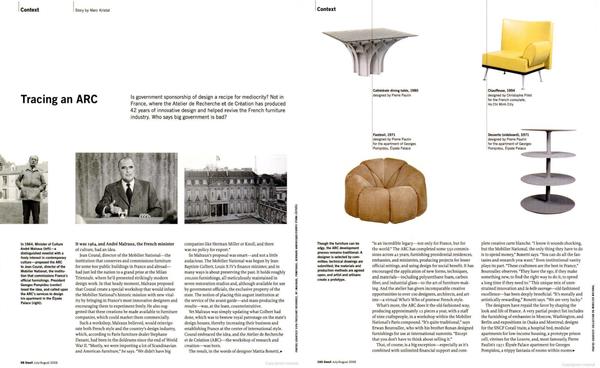
Photos courtesy Sipa Press / Art Resource, NY / Bernard Annebicque / Corbis Sygma / Collection du Mobilier National
The result, in the words of designer Mattia Bonetti, "is an incredible legacy—not only for France, but for the world." The ARC has completed some 550 commissions across 42 years, furnishing presidential residences, embassies, and ministries, producing projects for lesser official settings, and using design for social benefit. It has encouraged the application of new forms, techniques, and materials—including polyurethane foam, carbon fiber, and industrial glass—to the art of furniture-making. And the atelier has given incomparable creative opportunities to over 1oo designers, architects, and artists—a virtual Who’s Who of postwar French style.
What’s more, the ARC does it the old-fashioned way, producing approximately 12 pieces a year, with a staff of nine craftspeople, in a workshop within the Mobilier National’s Paris compound. "It’s quite traditional," says Erwan Bouroullec, who with his brother Ronan designed furnishings for use at international summits. "Except that you don’t have to think about selling it."
That, of course, is a big exception—especially as it’s combined with unlimited financial support and complete creative carte blanche. "I know it sounds shocking, but the Mobilier National, the only thing they have to do is to spend money," Bonetti says. "You can do all the fantasies and research you want." Even institutional vanity plays its part. "These craftsmen are the best in France," Bouroullec observes. "They have the ego, if they make something new, to find the right way to do it, to spend a long time if they need to." This unique mix of unrestrained innovation and la belle ouvrage—old-fashioned excellence—has been deeply beneficial. "It’s morally and artistically rewarding," Bonetti says. "We are very lucky."
The designers have repaid the favor by shaping the look and life of France. A very partial project list includes the furnishing of embassies in Moscow, Washington, and Berlin and expositions in Osaka and Montreal; designs for the SNCF Corail train; a hospital bed, modular apartments for low-income housing, a prototype prison cell, vitrines for the Louvre, and, most famously, Pierre Paulin’s 1971 Élysée Palace apartment for Georges Pompidou, a trippy fantasia of rooms within rooms furnished with Paulin’s high-style take on the beanbag chair, which the president commissioned by saying, "There is no reason to allow the Italians a monopoly on innovation."
To be sure, the insouciant, revolutionary ARC of the ’6os—wherein designers like Paulin and Olivier Mourgue investigated new materials, production techniques, and modes of living—has passed. "That was the most creative period," Danant says. "It was about creating models for people and industry, not furnishing an embassy’s living room." Later, he believes, "the utopian goal of the atelier was lost"—a point reinforced by Bonetti when he says, of the elegant pieces he designed with Elizabeth Garouste in the ’8os, "Our furniture was meant to represent power." Nor did the industry connection really take hold. Some ARC designs, notably by Paulin, Mourgue, Étienne Fermigier, and Joseph-André Motte, were issued commercially, but—no surprise—they were too costly to produce in quantity. And, says Danant, "The group of people who wanted modern, expensive design was very limited."
But popular taste caught up—and that is due, in some measure, to the influence of the ARC oeuvre. "You can’t go directly from the Mobilier National to Ikea," observes New York furniture dealer Charles Fuller. "It takes two generations before these concepts become viable. But the seed is there, and ultimately new ideas and forms get incorporated into life." Indeed they do: Forty-two years after Milan, French design is once again preeminent, and its influence is comprehensive. Malraux—and Colbert—would be pleased.
Could an ARC happen here? It’s unlikely, given that the arts in the U.S. are largely supported by private money. As for official taste, well, Frank Gehry won’t be lining the Oval Office with titanium anytime soon. Still, one dreams of what an alliance between a home-grown atelier and American industry might produce. After all, observes Danant, "the Mobilier National helped two generations of designers move forward, to do things they wouldn’t have been able to do. And," he adds reasonably, "these are not utopian projects—you can sit on them!"
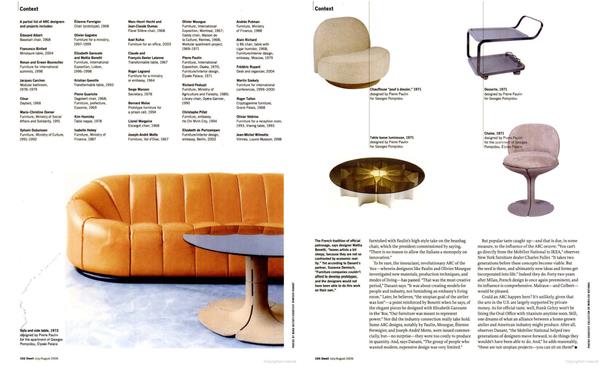
Photos courtesy Demisch Danant (by Mark Heitoff) / Collection du Mobilier National
See more from the Dwell archive on US Modernist.
Related Reading:
From the Archive: Nights and Weekends Spent Working, Plus $55K, Revitalized This L.A. Fixer Upper
From the Archive: Inside London’s Pioneering Prefab Housing Complex
Read More
By: Marc Kristal
Title: From the Archive: The 1960s Government Project That Helped Revive French Furniture Design
Sourced From: www.dwell.com/article/archive-1960s-french-furniture-b732ce2d-63e5a889
Published Date: Thu, 02 Apr 2026 15:19:02 GMT