.png)
In the mid-aughts, a first-of-its-kind modular project in Manchester tried to reverse decades of distaste for factory-built housing that had held strong in England since the postwar period.
Welcome to From the Archive, a look back at stories from Dwell’s past. This story previously appeared in the April/May 2005 issue.
Prefabricated housing has long been the bastard child of British architecture. Born out of a postwar desperation to shelter thousands of people left homeless by bombing raids, over 150,000 prefab houses were erected in the five years immediately following World War II. Built for speed rather than aesthetics, their temporality, lack of attention to design, and shoddy construction standards became evident in the decades to follow. Though their owners often came to love them as symbols of renewed hope and modernity, the reality of deteriorating asbestos concrete, leaky window seams, and poor insulation resulted in a recent government-led demolition crusade.
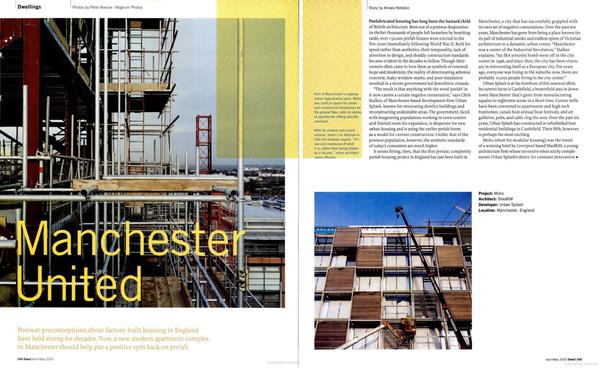
Photo by Peter Marlow/Magnum Photos
"The result is that anything with the word ‘prefab’ in it now carries a certain negative connotation," says Chris Stalker, of Manchester-based development firm Urban Splash, known for renovating derelict buildings and reconstructing undesirable areas. The government, faced with burgeoning populations working in town centers and limited room for expansion, is desperate for new urban housing and is using the earlier prefab boom as a model for current construction. Unlike that of the postwar population, however, the aesthetic standards of today’s consumers are much higher.
It seems fitting, then, that the first private, completely prefab housing project in England has just been built in Manchester, a city that has successfully grappled with its own set of negative connotations. Over the past 10 years, Manchester has gone from being a place known for its pall of industrial smoke and endless spires of Victorian architecture to a dynamic urban center. "Manchester was a center of the Industrial Revolution," Stalker explains. "An IRA terrorist bomb went off in the city center in 1996, and since then, the city has been visionary in reinventing itself as a European city. Ten years ago, everyone was living in the suburbs; now, there are probably 10,000 people living in the city center."
Urban Splash is at the forefront of this renewal effort. Its current focus is Castlefield, a brownfield area in downtown Manchester that’s gone from manufacturing squalor to nighttime scene in a short time. Cotton mills have been converted to apartments and high-tech businesses, canals host annual boat festivals, and art galleries, pubs, and cafes clog the area. Over the past six years, Urban Splash has constructed or refurbished four residential buildings in Castlefield. Their fifth, however, is perhaps the most exciting.
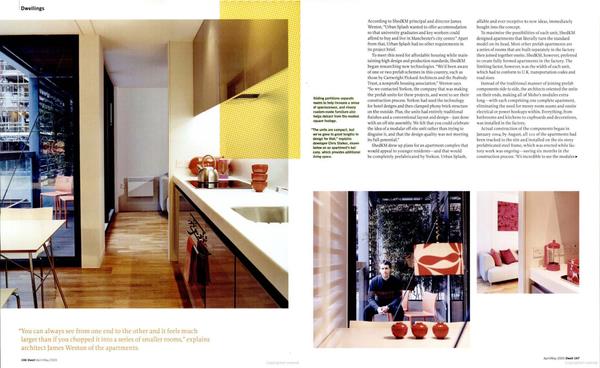
Photo by Peter Marlow/Magnum Photos
Moho (short for modular housing) was the result of a winning brief by Liverpool-based ShedKM, a young architecture firm whose inventive ethos nicely complements Urban Splash’s desire for constant innovation. According to ShedKM principal and director James Weston, "Urban Splash wanted to offer accommodation so that university graduates and key workers could afford to buy and live in Manchester’s city center." Apart from that, Urban Splash had no other requirements in its project brief.
To meet this need for affordable housing while maintaining high design and production standards, ShedKM began researching new technologies. "We’d been aware of one or two prefab schemes in this country, such as those by Cartwright Pickard Architects and the Peabody Trust, a nonprofit housing association," Weston says. "So we contacted Yorkon, the company that was making the prefab units for these projects, and went to see their construction process. Yorkon had used the technology for hotel designs and then clamped phony brick structure on the outside. Plus, the units had entirely traditional finishes and a conventional layout and design—just done with an off-site assembly. We felt that you could celebrate the idea of a modular off-site unit rather than trying to disguise it, and that the design quality was not meeting its full potential."
ShedKM drew up plans for an apartment complex that would appeal to younger residents—and that would be completely prefabricated by Yorkon. Urban Splash, affable and ever receptive to new ideas, immediately bought into the concept.
To maximize the possibilities of each unit, ShedKM designed apartments that literally turn the standard model on its head. Most other prefab apartments are a series of rooms that are built separately in the factory then joined together onsite. ShedKM, however, preferred to create fully formed apartments in the factory. The limiting factor, however, was the width of each unit, which had to conform to U.K. transportation codes and road sizes.
Instead of the traditional manner of joining prefab components side to side, the architects oriented the units on their ends, making all of Moho’s modules extra-long—with each comprising one complete apartment, eliminating the need for messy room seams and onsite electrical or power hookups within. Everything, from bathrooms and kitchens to cupboards and decorations, was installed in the factory.
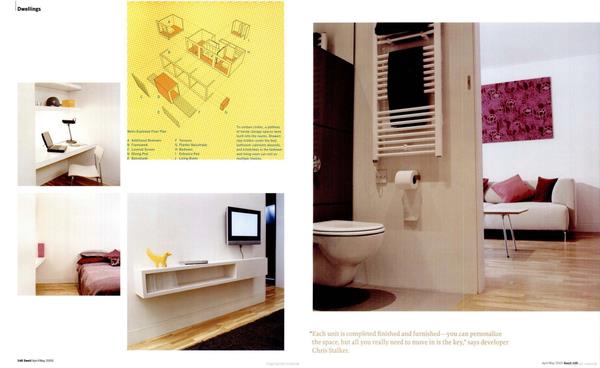
Photo by Peter Marlow/Magnum Photos
See the full story on Dwell.com: From the Archive: The British Apartment Complex That Aimed to Rehab Prefab’s Poor Reputation
Related stories:
- From the Archive: Two Architects, One Very DIY Duplex Reno
- From the Archive: For $145K, Architect William Massie Built a Curvy Concrete Home From the Ground Up
- From the Archive: With Just $50 a Month, These Renters DIY’d Their Way to an Ultra Funky Pad
Read More
By: Amara Holstein
Title: From the Archive: The British Apartment Complex That Aimed to Rehab Prefab’s Poor Reputation
Sourced From: www.dwell.com/article/from-the-archive-british-prefab-apartments-744a358d
Published Date: Thu, 30 Apr 2026 18:43:21 GMT
Did you miss our previous article...
https://trendinginbusiness.business/real-estate/in-portland-a-matteblack-midcentury-with-minimalist-interiors-seeks-11m