.png)
Architect Eddie Jones worked in ample unconventional design elements that make the Arizona heat more livable, while sneaking in details like a hidden room and a glass-floored bridge.
Welcome to From the Archive, a look back at stories from Dwell’s past. This story previously appeared in the June 2001 issue.
It doesn’t rain very often in Phoenix. But when it does, the residents of Kachina Drive often head over to Eddie Jones and Lisa Johnson’s house to watch the show.
Rainwater rushes from a steel scupper—it’s sort of like a spout—which projects from the top of the house’s cylindrical entrance. Water pours down a set of suspended silvery chains, into an open 18-foot semicircular cistern at ground level. The rushing water sounds like a muted waterfall. Most houses shoo away rainwater the way a host hustles a misbehaved guest out the back door of a dinner party: quietly and with as little fanfare as possible. Rain is routed to a set of gutters and, ultimately, down to the sewer. But through the scupper and cistern, the house on Kachina Drive slowly releases rainwater onto the property. Rainy days become special events and displays in sustainability.
"When we moved in, it rained and we ran out to see the waterfall," says architect Eddie Jones, who designed the home and owns it with his wife, Lisa Johnson, whose company, Corporate Interior Systems, Inc., helps businesses plan and furnish their offices. "Suddenly, people started coming out of their homes and applauding."
"When you’re in this desert, it hardly ever rains," Jones says. "So when it does and you get your architecture to celebrate it, I think that’s meaningful."
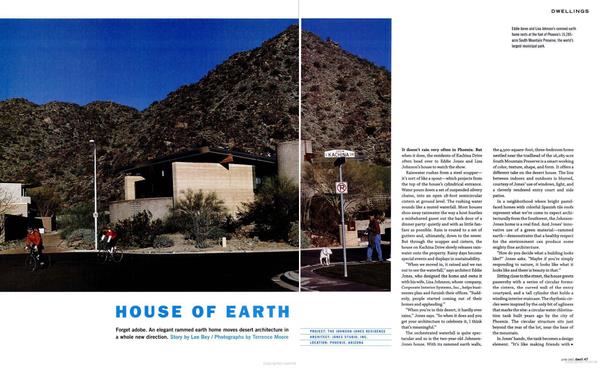
The orchestrated waterfall is quite spectacular and so is the two-year-old Johnson-Jones house. With its rammed earth walls, the 4,500-square-foot, three-bedroom home nestled near the trailhead of the 16,285-acre South Mountain Preserve is a smart working of color, texture, shape, and form. It offers a different take on the desert house. The line between indoors and outdoors is blurred, courtesy of Jones’ use of windows, light, and a cleverly rendered entry court and side patios.
In a neighborhood where bright pastel-faced homes with colorful Spanish tile roofs represent what we’ve come to expect architecturally from the Southwest, the Johnson-Jones home is a real find. And Jones’ innovative use of a green material—rammed earth—demonstrates that a healthy respect for the environment can produce some mighty fine architecture.
"How do you decide what a building looks like?" Jones asks. "Maybe if you’re simply responding to nature, it looks like what it looks like and there is beauty in that."
Sitting close to the street, the house greets passersby with a series of circular forms: the cistern, the curved wall of the entry courtyard, and a tall cylinder that holds a winding interior staircase. The rhythmic circles were inspired by the only bit of ugliness that marks the site: a circular water chlorination tank built years ago by the city of Phoenix. The circular structure sits just beyond the rear of the lot, near the base of the mountain.
In Jones’ hands, the tank becomes a design element. "It’s like making friends with something that could be easily construed as a negative," Jones explains.
When it built the tank the city of Phoenix raked the site clean. Tempe landscape architect Bill Tonnesen surveyed the rock patterns, flora, and vegetation of a 15-square-foot area of South Mountain, then recreated his findings on the land around the Johnson-Jones house. The result is a convincing approximation of a natural desert landscape.
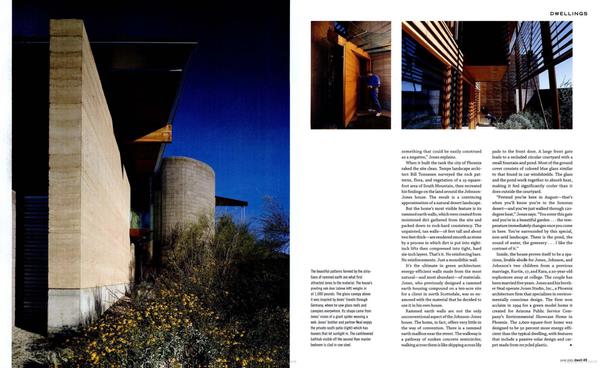
But the home’s most visible feature is its rammed earth walls, which were created from moistened dirt gathered from the site and packed down to rock-hard consistency. The unpainted, tan walls—18 feet tall and about two feet thick—are rendered smooth as stone by a process in which dirt is put into eight-inch lifts then compressed into tight, hard six-inch layers. That’s it. No reinforcing bars. No reinforcements. Just a monolithic wall.
It’s the ultimate in green architecture: energy-efficient walls made from the most natural—and most abundant—of materials. Jones, who previously designed a rammed earth housing compound on a ten-acre site for a client in north Scottsdale, was so enamored with the material that he decided to use it in his own house.
Rammed earth walls are not the only unconventional aspect of the Johnson-Jones house. The home, in fact, offers very little in the way of convention. There is a rammed earth mailbox near the street. The walkway is a pathway of sunken concrete semicircles; walking across them is like skipping across lily pads to the front door. A large front gate leads to a secluded circular courtyard with a small fountain and pond. Most of the ground cover consists of colored blue glass similar to that found in car windshields. The glass and the pond work together to absorb heat, making it feel significantly cooler than it does outside the courtyard.
"Pretend you’re here in August—that’s when you’ll know you’re in the Sonoran desert—and you’ve just walked through 120-degree heat," Jones says. "You enter this gate and you’re in a beautiful garden...the temperature immediately changes once you come in here. You’re surrounded by this special, non-arid landscape. There is the pond, the sound of water, the greenery... I like the contrast of it."
Inside, the house proves itself to be a spacious, livable abode for Jones, Johnson, and Johnson’s two children from a previous marriage, Kurtie, 17, and Kara, a 20-year-old sophomore away at college. The couple has been married five years. Jones and his brother Neal operate Jones Studio, Inc., a Phoenix architecture firm that specializes in environmentally conscious design. The firm won acclaim in 1994 for a green model home it created for Arizona Public Service Company’s Environmental Showcase Home in Phoenix. The 2,6oo-square-foot home was designed to be 50 percent more energy efficient than the typical dwelling, with features that include a passive solar design and carpet made from recycled plastic.
The Johnson-Jones family lives in Phoenix’s Ahwatukee community. It’s a comfortable area where in recent months homes have sold for sums ranging from $250,000 to over $1 million. Johnson, who has lived in Ahwatukee for 20 years, sold her last home, a stone’s throw from the couple’s current residence, to Arizona Cardinals defensive end Simeon Rice. The Cardinals’ quarterback, Jake Plummer, lives down the street.
Jones, on the other hand, comes from Cave Creek, an enclave notable for its delightfully rough edges, full of "old hippies and all the old cowboys," he says.
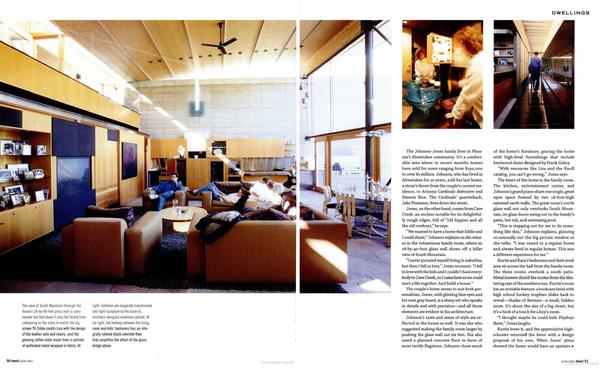
"We wanted to have a home that Eddie and I could share," Johnson explains as she relaxes in the voluminous family room, where an 18-by-4o-foot glass wall shows off a killer view of South Mountain.
"I never pictured myself living in suburbia, but then I fell in love," Jones recounts. "I fell in love with the kids and I couldn’t haul everybody to Cave Creek, so I came here so we could start a life together. And build a house."
The couple’s home seems to suit both personalities. Jones, with glinting blue eyes and his neat gray beard, is a sharp wit who speaks in details and with precision—and all those elements are evident in his architecture.
Johnson’s taste and sense of style are reflected in the house as well. It was she who suggested making the family room larger by pushing the glass wall out six feet. She also nixed a planned concrete floor in favor of more tactile flagstone. Johnson chose much of the home’s furniture, gracing the home with high-level furnishings that include bentwood chairs designed by Frank Gehry.
"With resources like Lisa and the Knoll catalog, you can’t go wrong," Jones says.
See the full story on Dwell.com: From the Archive: With Rammed Earth Walls and Flagstone Flooring, This Desert Home Matched Its Site
Related stories:
- A Monumental Hearth Anchors This Agricultural Building Turned Home in Brazil
- Budget Breakdown: With $288K, Two Architects Opened Up Their Brick House and Filled It With Surprise
- You Couldn’t Begin to Count the Perforations in the Facade of This Bangkok Home
Read More
By: Lee Bey
Title: From the Archive: With Rammed Earth Walls and Flagstone Flooring, This Desert Home Matched Its Site
Sourced From: www.dwell.com/article/from-the-archive-rammed-earth-desert-home-e4380d44
Published Date: Thu, 21 May 2026 17:52:25 GMT