.png)
Culture of Bathe-ing’s first event, in Brooklyn, brought in DJs, poetry readings, and performance art to shift how we collectively sweat it out.
About a month ago I was sweating in a thirty-year old concrete temazcal, built into the bathroom of a house in Oaxaca—an ancient sweat lodge ritual led by a temazcalero named Larissa. Today I’m sitting in an Airstream trailer that’s been converted into a sauna, parked on the shore of the Hudson River in Williamsburg’s Domino Park. Steeping in 180-degree heat can be transformative, and at the very least, zen. But despite the slight head high, there’s something about this sauna event I’m attending that feels very New York. Maybe it’s the throng of helpful festival volunteers, or the locals walking their dogs along the waterfront, peering into the saunas as they pass. Maybe it’s the pop-up American Eagle–sponsored ice rink across the street?
Or, maybe it’s that I’m in one of 16 individual saunas plopped on the waterfront, each offering a slightly different sweat: from wood-fired steams in a barrel sauna with a woodburning stove to the "AirSteam" I’m sitting in (ha!), cleverly retrofitted with black waxed cladding, long wooden benches, and a small window that looks out at the remaining ice floe making its way down the Hudson, passing slowly beneath the Williamsburg Bridge.
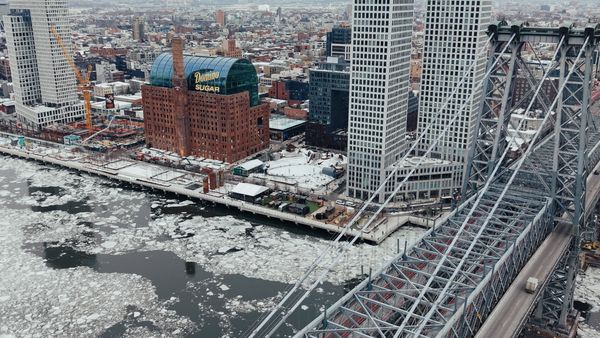
Culture of Bathe-ing and Therme Group, a developer in the wellness space, hosted a pop-up sauna festival in Domino Park in Brooklyn.
Photo courtesy of Culture of Bathe-ing
New York is home to some great bathhouses: the East Village’s Russian & Turkish (now co-run by the family of its longtime owner-operators, Boris Tuberman and David Shapiro, who still have alternating weeks of operation) was opened in 1892; Spa Castle in College Point has Korean scrubs and rooftop hot tubs; Mermaid Spa in Seagate offers a traditional "platza service", which involves being massaged by a birch venik (a bundle of birch, eucalyptus, or oak tree twigs tied together). But the tide seemed to turn when Bathhouse—meant to be a more refined take on bathing, with low lighting, streamlined cement, and pools of various temperatures heated by Bitcoin mining—opened in 2019, first in Williamsburg and then in Flatiron. Then came a slew of modern bathing spaces: Othership, World Spa, and Akari, to name a few. There’s even an abbreviated bathhouse experience for the typically busy New Yorker: a "temperature contrast session" at Elahni in Flatiron, where you can "reset your nervous system" by rotating through a circuit of sauna, shower, and ice bath three times and be on your way in just an hour.
It’s almost surprising, then, that it took this long for a sauna festival to occur. Amid the chill of winter (and between two snow storms), from February 12 through March 1, Domino Park was home to the largest sauna village ever staged in the United States, or so claims the Culture of Bathe-ing—an event series that started as a WhatsApp group of bathhouse operators, which led to an NYC meet up and now has its own Substack. It’s being put on by Therme Group—big developers of wellness destinations that often involve thermal bathing and spa in hot spots like Dubai and Bucharest—and aside from pushing the already-bustling bathhouse agenda, it wants to show New Yorkers that bathing can be first (and even foremost) a social experience. Sweaty, definitely, but also collective.
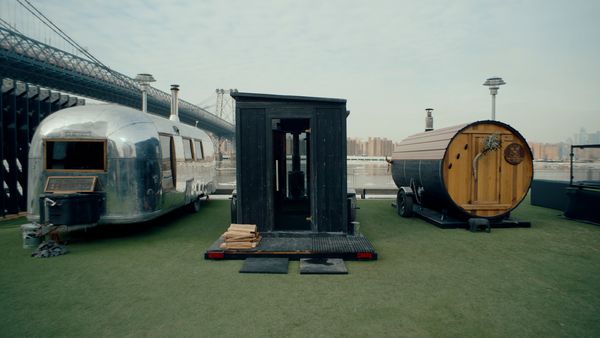
The festival offered a mix of mobile sauna experiences, from a converted Airstream to a barrel sauna.
Photo courtesy of Culture of Bathe-ing
"I would like to see sauna culture in the U.S. move out of gym and spa spaces and beyond the optimization cycle," says Robert Hammond, Therme Group’s president, who sees connection as a way of embracing "ritual, performance, and culture, not just recovery." It’s a heartening message from an investor in big bathing spaces, as so much conversation about sauna has recently revolved around how long you should be in super hot or super cold environments—not necessarily what you should do while you’re in there. If Hammond’s way out of optimization is by way of embracing sauna as a potential "third space" (to use the old phrase recently embraced by Gen Z as an inspiration to disconnect from devices, and meet people the old fashioned way), he’s found something that’d be worth paying extra for. "[The festival] echoes how bathhouses once functioned as civic infrastructure and still do in many parts of the world," Hammond adds, pointing toward cities like Helsinki and Seoul, where people gather to bathe weekly, not just on special occasions. "We wanted to place bathing back in the public imagination, not tucked behind a spa door."
One of his problems (and the problem of any other modern bathhouse operator) lies in the pricing. Tickets for the festival were $60 to $125 (depending on time and day, granting you access to all of the saunas for a two-hour window), which is a price range that has already become standard practice in New York. The city’s bathhouse culture is tragically stunted by inaccessibility, something even a festival with multiple sponsors (Therme, but also Athletic Brewing Co. and Vital Proteins) hasn’t been able to avoid. But unlike other city bathhouses, the festival proudly boasts a wider variety of saunas for those with the means to attend—like a cedar-walled mobile unit by Rhode Island company Altaer, an Estonian-made Leil, or the traditional Finnish löyly—a treat for those who love bathing, but perhaps haven’t been able to experience all it offers across the globe.
"I think what a lot of people are used to is a hot box and they don’t know how they’re supposed to feel in that space," says Courtney Wittich, a self described thermal journalist, sauna sommelier, and bathing connoisseur who writes S.P.A., a Substack covering what has recently become a billion dollar industry. (Full disclosure, Wittich has appeared in a few Instagram Reels promoting the festival.) "If you enjoyed a specific type of steam [at the festival], you can seek that out more authentically on your travels or whatever or wherever else you go. I’ve been calling it the post-iPhone leisure world," says Wittich with a laugh. "These are not trends, they’ve been here forever. But I do think that we’ll have people reverting back to a more nostalgic way of living to feel more human again."
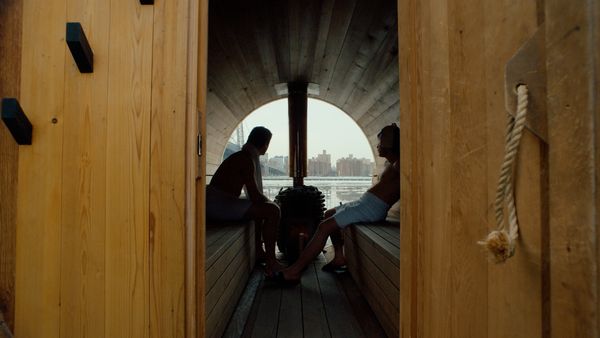
Festival goers try a barrel sauna by Tatanka, a Wyoming company.
Photo courtesy of Culture of Bathe-ing
See the full story on Dwell.com: How Social Can Sauna Culture Get? This Steamy Festival Tested the Limits
Related stories:
- L.A.’s Graffiti Towers Might Have a Buyer—and Everything Else You Need to Know About This Week
- Bobby Berk’s New Show May Be About Decluttering, but It Left Me Wanting More
- An I.M. Pei Building in Texas Faces Demolition—and Everything Else You Need to Know About This Week
Read More
By: Lindsey Weber
Title: How Social Can Sauna Culture Get? This Steamy Festival Tested the Limits
Sourced From: www.dwell.com/article/culture-of-bathe-ing-brooklyn-sauna-festival-84a4ae42
Published Date: Fri, 27 Feb 2026 19:36:28 GMT
Did you miss our previous article...
https://trendinginbusiness.business/real-estate/will-war-with-iran-send-mortgage-rates-higher-or-lower