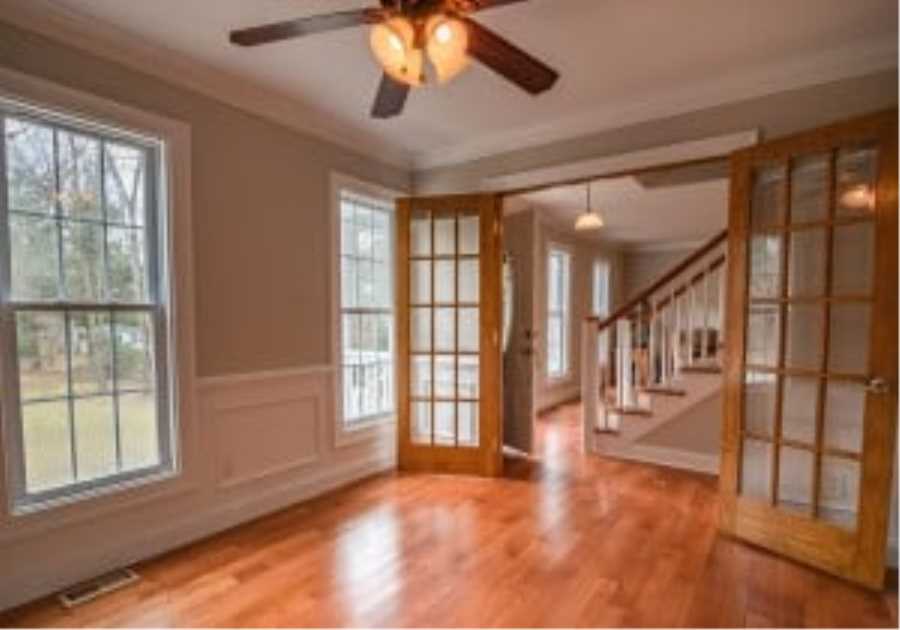
.png)
Developers are packing as many as three into townhomes and cottages as small as 850 square feet, under the belief that they’re what the market wants. They might be right.
Last fall Julia Humphreville purchased a two-bedroom, two-story condo in Portland, Oregon’s Richmond neighborhood, around the corner from the original Stumptown Coffee and within walking distance of Mt. Tabor Park. The 900-square-foot unit is part of a new sixplex developed under the city’s residential infill zoning codes, which opened up single-family home neighborhoods to more diverse and affordable housing types. Humphreville, a clinical social worker, loves the condo’s open kitchen, high ceilings, and tiny backyard. Crucially, the $349,000 price tag allowed her to buy into a neighborhood that otherwise was too expensive for her budget. "It felt like a gem," she says.
One design feature does leave her a bit befuddled—the fact that the condo has two full bathrooms upstairs and one half bath downstairs. "Did the unit really need three bathrooms?" asks Humphreville, who shares the home with her partner. "Probably not." The dwelling has only two closets, both upstairs. "Ideally, the first floor bathroom could have been a storage closet," she says.
Over the past few years Portland has become a leader in the development of middle housing—townhomes, cottage clusters, and other dwellings that fall somewhere between single-family homes and apartment buildings—in residential neighborhoods. Lauded for their relative affordability and modern aesthetic, many of them are also drawing attention for their seemingly high bathroom counts. According to the city of Portland and local realtors, the most commonly permitted middle housing type is a two-bedroom unit with anywhere from 850 to 1,000 square feet; roughly 85 percent of them have two full bathrooms and one half bath, according to realtors, builders, and a review of Zillow listings.
The myriad bathrooms have surprised many—but not all—buyers and housing experts in part because bathrooms are among the most expensive parts of a house to build. Incorporating three bathrooms into a small home can also leave some units feeling like a warehouse for bathrooms. "They are hard not to notice," observes Lori Rissetto, a Portland realtor who has toured the units with prospective buyers. "The homes are wonderful," adds Rissetto. "But a house that is under 1,000 square feet does not need three bathrooms and three toilets to clean, especially when there is a better way to utilize the space."
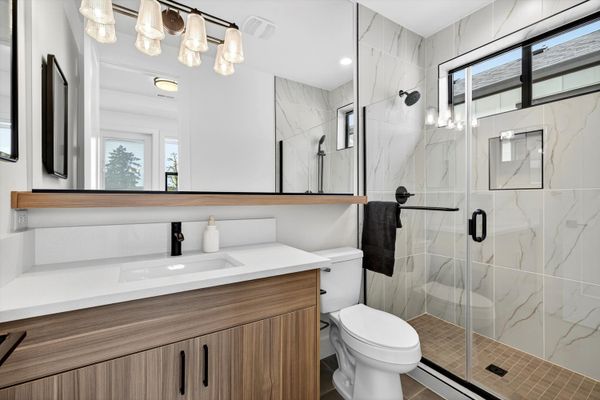
Portland-area developer Kehoe Northwest Properties recently built several 1,000-square-foot plans in Lake Oswego that include two bedrooms and two and a half baths.
Photo by Justin Jones
Other cities including Sacramento, Spokane, and Minneapolis have changed zoning rules to allow middle housing in single family neighborhoods. But construction has been relatively sluggish and in some cases has taken a different form than the new building in Portland—for example, larger units or rental apartments.
Driving Portland’s success are the city’s "floor area ratio" requirements, which give developers a financial incentive to build more units on a single lot, according to Morgan Tracy, a senior planner with the Bureau of Planning and Sustainability. "It’s the secret sauce," he says, adding that a thriving ecosystem of local developers and an abundance of infill lots also give Portland an advantage.
On the leading edge, Portland is a window into a changing housing market. All these bathrooms, it turns out, are at the heart of an interregnum. Amid skyrocketing housing prices and shifting household demographics—more people are living alone or without kids—the old ways of building and buying homes are fading, says Scott Dergance, a principal at KGA Studio Architects in Denver. But new ones have yet to fully develop. "The first-time buyer is willing to have fewer bathrooms, and maybe get to an older model of how we used to build homes 60 to 70 years ago, when you would have a two-bedroom house that had one bathroom," says Dergance, who works on projects around the country. "But we’re not quite there yet. We’re in a transition period."
For their part, Portland developers who favor the two-and-a-half bathroom model say the middle market wants what it wants. "Based on our experience folks want the additional bathroom counts," says Vlad Kovtun, partner at Aker Development, a Portland-area builder that has constructed more than 350 middle housing units over the past few years. "They want the privacy."
Housing affordability and changing buyer dynamics also play a role. Many buyers are renting out rooms to offset the cost of a home. Others are purchasing homes as roommates, says Martin Kehoe, a developer who recently completed an eight-unit cottage cluster in Lake Oswego, an affluent Portland suburb. The 1,000-square-foot homes feature two bedrooms and two and a half baths, a configuration that Kehoe plans to incorporate on 300 additional middle housing lots over the next two years. "You meet some degree of market resistance when you have two bedrooms upstairs sharing the same bathroom," says Kehoe. "If you’re roommates, you’re going to have to share a bathroom, which limits the buying pool."
In some ways the abundance of bathrooms in Portland's middle housing is merely another manifestation of the bathroom inflation that has long shaped the history of home building in this country. In 1950, the typical home had only one bathroom, regardless of household size. In 1975, 20 percent of homes had two or more bathrooms—between 2009 and 2013, 80 percent of all new construction fell into that category. Today a standard market rate townhome is a two-bed, two-and-a-half-bath.
In Portland proper, city code does play a small role in middle housing bathroom design. One-third of the homes in a cottage cluster are required to include "visitability features," including a half bathroom on the ground floor. The goal is to increase accessibility for visitors with mobility challenges, says Tracy.
"You meet some degree of market resistance when you have two bedrooms upstairs sharing the same bathroom."
—Martin Kehoe, developer
The high bathroom count does come at a financial cost—adding roughly $15,000 to $25,000 per bathroom. It also leads to design and functionality challenges, typically in the areas of closet space and bedroom size. "It will shrink room size so you have to get as creative as possible," Kehoe says.
Rita Blake is dealing with some of the trade-offs. In December the financial services worker purchased a 900-square-foot, two-bed, two-and-a-half bath townhome in an East Portland neighborhood for $330,000. But in lieu of sufficient storage, she says, one and a half of those bathrooms are functioning instead as storage for kitchenware, tools, linens, and more. A single homeowner, Blake is currently pricing storage solutions that will free up the downstairs powder room for visitors and the second full bathroom upstairs for her 13-year-old niece, "who currently wrecks all my Lancôme products having makeup parties using my bathroom." Despite the headaches, Blake likes having two and a half bathrooms, at least in dwellings like hers, where the upstairs bathrooms are accessible only through the bedrooms. Plus, of all the homes she’s visited or lived in, "I don’t think there has ever been a time when I’ve thought to myself: ‘There are too many bathrooms in this home.’"
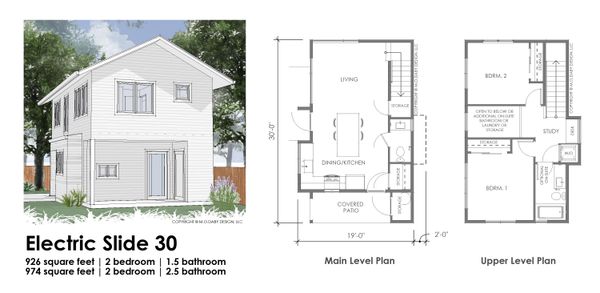
Portland architecture firm M.O.Daby Design is offering an alternative to the two-bed, two-and-a-half bath plan with an upstairs room that can serve as storage or laundry.
Courtesy of M.O.Daby Design
On the industry side, developers can be reluctant to build homes with fewer bathrooms, says Matt Daby, a Portland architect whose one-and-a-half and two-bath middle housing designs push back against the standard. "Sometimes they try to check boxes based on what the real estate market is perceiving people want, when they may not actually want that," he says, adding: "If I’m only allowed 800 or 900 or even 1,000 square feet, I would sacrifice that third bathroom in a heartbeat for more storage."
Creative design can help accelerate the middle market transition, according to architects like Daby and KGA’s Dergance, yielding better living through fewer bathrooms. Developer Eric Thompson of Snug Homes, for one, has worked with Daby on three-bedroom layouts that don’t necessarily come with an extra full bathroom. One option is to separate the shower and toilet areas so different people can use the functions of a bathroom at the same time. "You don’t use as much square footage," Thompson observes, "but get the flexibility if you’re going to have multiple roommates within the context of middle housing." New Oregon state regulations tied to accessibility and affordability are also expected to catalyze new forms of middle housing—and bathroom designs.
Whether Portland’s middle housing bathroom counts are a flash in the evolutionary pan or an enduring design feature remains to be seen. For now, long-standing champions of Portland’s residential infill programs are keeping their eyes on the prize. Michael Andersen, director of cities and towns at the Seattle-based Sightline Institute, lives in Northeast Portland, where the three-bathroom layout in a nearby cottage cluster did not escape his attention. "Seems bizarre. Seems like a waste of space," Andersen said in an email. "But if this is what it takes to get freestanding homes built and sold at what would have been unthinkably low prices a few years ago—great."
Top photo by Justin Jones
—
Related Reading:
In Portland, Oregon, the Paths to Homeownership Are Multiplying
Read More
By: Linda Baker
Title: Portland Housing Has a Bathroom Problem
Sourced From: www.dwell.com/article/portland-middle-housing-bathroom-problem-03652e5b
Published Date: Thu, 09 Apr 2026 12:02:18 GMT