.png)
Anyone staying in one of the $77K units won’t have to go far for a wood-fired sweat session.
Welcome to Tiny Home Profiles, an interview series with people pushing the limits of living small. From space-saving hacks to flexible floor plans, here’s what they say makes for the best tiny homes on the planet. Know of a builder we should talk to? Reach out.
Japanese architects Kazumasa Takada and Yuriko Yagi took an unconventional approach to developing their practice. After meeting in Copenhagen in 2017 and soon after establishing their studio, PAN-PROJECTS, they spent the first few years designing experiments like a pavilion built from upcycled paper and a series of floating public installations. But these seemingly offbeat ideas held a greater significance, shares Takada, who says they were "early attempts to test how modest architecture could frame collective experiences and connect directly to its context." Recognizing a kindred spirit in PAN-PROJECTS and the ideas they stood for, Earthboat, a Japanese hospitality developer specializing in nature retreats, asked them to design something small that could be easily set up on remote sites.
The result was a new tiny home, itself named Earthboat, "a small, self-contained wooden accommodation designed for simple stays in nature," says Takada. Later, he and Yagi got the green light to design a second mobile retreat for the developer—what would become Earthboat Cave. Here, we talk to Takada about what sets this iteration apart, as well as what’s next for their partnership.
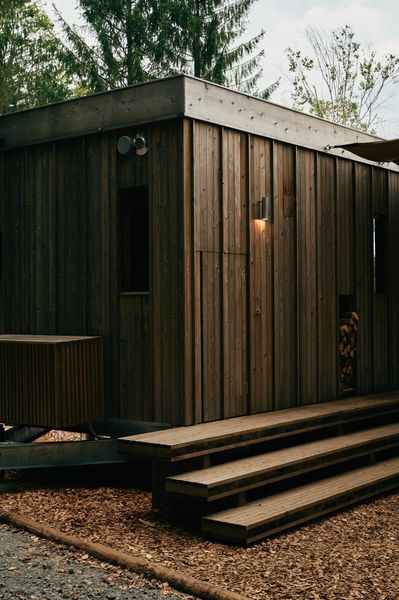
Earthboat operates accommodations in eight locations across Japan. Their latest cabin, the Earthboat Cave, is set on the shore of Lake Shirakaba, a few hours west of Tokyo.
Yuta Sawamura Photography
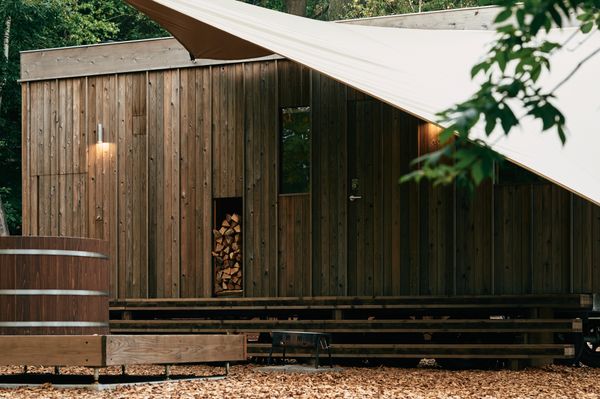
The structure and its furniture are built with CLT made of Japanese cedar.
Yuta Sawamura Photography
What exactly is the Earthboat Cave?
It’s a small movable accommodation made of Japanese cedar, and the first one is located in the lakeside forest of Shirakabako, Japan. The project offers a quiet retreat where people can pause, rest, and reconnect with nature. It proposes a calm form of hospitality rooted in simplicity and proximity to nature, reflecting the broader Earthboat vision of a nature escape.
What qualities set the cabin apart?
It’s designed to support life outdoors rather than pull people inside a compact cabin. Its layout, outdoor access, and sauna encourage guests to stay close to the landscape. The building sits on adjustable jacks without typical foundations, so the ground remains undamaged. Natural thermal comfort is achieved through solid Japanese cedar CLT rather than synthetic insulation. Chemical-based materials are minimized.
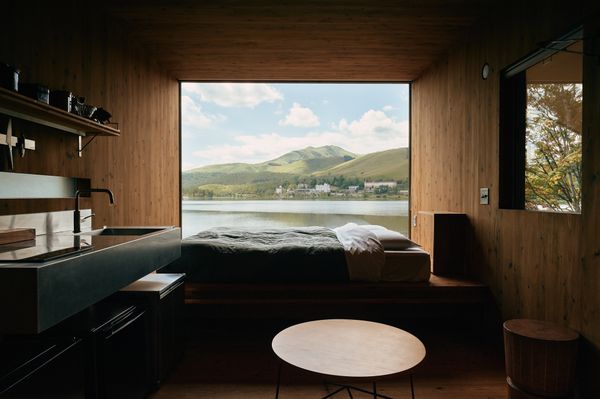
The 275-square-foot home has a queen-size bed positioned against a window looking out over Lake Shirakaba.
Yuta Sawamura Photography
See the full story on Dwell.com: Saunas Are Squeezed Into These 275-Square-Foot Japanese Tiny Homes
Related stories:
- The Best Part of Trump’s Ballroom Might Be the Public Feedback
- Other Cities Could Learn a Thing or Two From Charleston’s Affordable Housing Plan
- Mexico City Landlords Are Evicting En Masse—and Everything Else You Need to Know About This Week
Read More
By: John Trujillo
Title: Saunas Are Squeezed Into These 275-Square-Foot Japanese Tiny Homes
Sourced From: www.dwell.com/article/sauna-tiny-home-japanese-cedar-pan-projects-earthboat-cave-3705720e
Published Date: Wed, 08 Apr 2026 16:43:24 GMT