.png)
Cities turning beloved stadiums into mixed-use housing developments are grappling with how much of the past to hold onto.
In March, when 31-year-old David Trusty moved into an apartment in Stadium Lofts in Indianapolis, he didn’t know the new digs just a short bike ride from work also came with a window onto his family’s baseball past. His great-grandfather played first base for the city’s minor league team just before the franchise began playing in what was a then-new ballpark in 1931; and afterward, he played in the stadium for a community league. "When my grandparents heard I was living here, they were elated and told me about how he played with the Indianapolis Indians for a short while, and later played ball right here," says Trusty.
Trusty lives in a section of the building that once offered premier seating behind home plate in Bush Stadium, originally named Perry Stadium. His apartment features lofty 21-foot ceilings, exposed ductwork, and large picture windows that overlook the old diamond and the field beyond—a fan-shaped expanse of green that now includes pickleball courts and grilling stations. He keeps his bike in a designated storage room in what had been a dugout.
The apartment complex opened in 2013 and, while Trusty’s past connection to the place is remarkable, the idea of living in an old ballpark may be less unusual in short order. In fact, a proposed development in Columbus, Ohio, may likewise add housing as it retains the historic character of another 1930s-era ballpark, Cooper Stadium. And as it turns out, as cities fund new stadiums elsewhere, defunct ones are being eyed more frequently as prime real estate for redevelopment and a greater focus of urban planning.
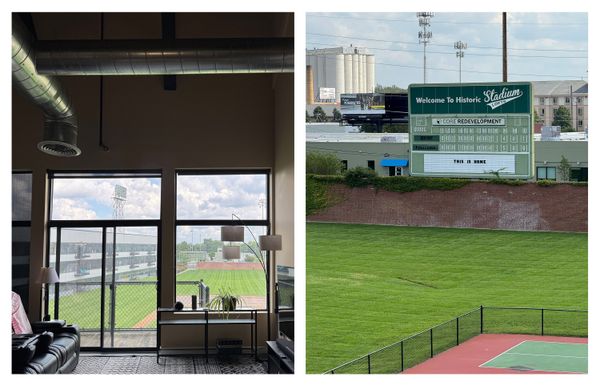
Indianapolis resident David Trusty’s apartment at Stadium Lofts, formerly Bush Stadium, has a view over the baseball diamond.
Photos by David Trusty
Extra innings
In San Francisco, a long-awaited and well-reported on redevelopment of Candlestick Park, where the Giants and 49ers once played, finally broke ground in September after years of revisions (not to mention scandal and controversy). Plans now include nearly three million square feet of commercial space and 7,200 housing units, with roughly a third designated as affordable. Across the bay, similar plans are underway at the 112-acre Oakland Coliseum site, which was home to the Athletics from 1968 to 2024. And in Southern California, the recent demolition of Qualcomm Stadium, where the Padres and the Chargers played for several decades, will make space for a mixed-use development anchored around San Diego State University’s new Snapdragon Stadium, opened in 2022.
In Salt Lake City, a minor league stadium where the triple-A Salt Lake Bees had played since it opened in 1994 is being turned into Ballpark NEXT, a mixed-use development with affordable housing and on-site amenities. (The team had in fact been playing here since 1928, in another stadium on the same site that was razed in 1993 to make way for the new venue; ahead of last year’s season, the franchise moved from their century-old home turf to a brand-new stadium 20 miles away.) To create a proposal, which was approved in December of 2025, architecture firm Perkins & Will considered three key questions with which the city was faced: Can another team take over? Should the stadium be preserved or partially preserved and repurposed? Or should it be razed altogether to clear the 14-acre site for something new? "Smith’s Ballpark is just over three decades old, it’s no Fenway Park or Wrigley Field," says the project’s lead designer, Marc Asnis. "But it is an iconic local landmark. I mean, the neighborhood itself is literally called Ballpark."
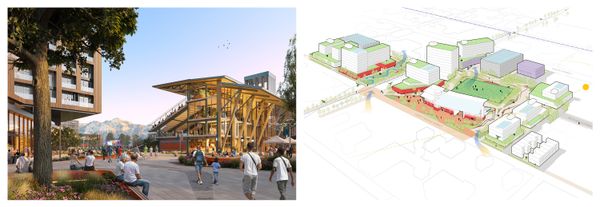
Architecture firm Perkins & Will created a plan to turn a minor league stadium in Salt Lake City into a mixed-use housing development that will partly preserve the original structure.
Courtesy Perkins & Will
Community input helped point to preservation and reuse, and early stakeholder discussions raised the idea of turning it into an entertainment venue. Market assessments for the greater Salt Lake region suggested a need for a 9,000-seat venue, about 6,000 seats fewer than the old stadium had. The designers want to preserve the structure enough and still accommodate the smaller crowd, retain the unobstructed views of the Wasatch Mountains, and design a whole new building scheme with a cantilevered roof plane extending outward from the front and a glass curtain wall in place of the concrete masonry facade.
The designers are also planning development into the surrounding neighborhood, supported by $100 million in public-private investment. Given that the stadium will only be used at certain times and could impede pedestrian movement, the plan features platting with more porosity to improve walkability and neighborhood connection. "You have to think about the spectator experience, and everyday life," Asnis says. "So, we wanted to open up the site’s edges and create public spaces and pedestrian paths, for event days but also for kids to play youth soccer, for people to drink coffee outdoors."
Weighing the odds
The idea of repurposing stadiums and their sites is cropping up in many other communities too, says Toccarra Nicole Thomas, an urban planning expert with nonprofit Smart Growth America. "Attendance is declining at old stadiums, and teams and fans always want the shiny new thing and there’s always money for that," she says. "But there’s very little money for redevelopment or maintenance or refurbishing, and a lot of times, it’s just easier and cheaper to tear down and rebuild."
Bush Stadium, in Indianapolis, barely escaped the wrecking ball itself thanks to its cherished local history. For a few decades, the venue had hosted Negro League Baseball—in fact, Hank Aaron played shortstop for the Indianapolis Clowns for three months there in 1952, before his debut in the major leagues two years later. Until 1996, it was home to the Triple-A Indians, which moved to the brand-new Victory Stadium downtown, a few miles away. The rest of the story follows a somewhat familiar pattern of decline with older stadiums that outlive their original purposes: the old ballpark was used briefly as a dirt racetrack and, later, from 2008 to 2011, a storage site for cars amassed through the federal "Cash for Clunkers" program.
By then, the city was already weighing the possibility of tearing it down and selling the 15-acre site because the ballpark had become a financial liability and an eyesore. Preservationists advocated to save it and, as part of a compromise, the city transferred the deed to Indiana Landmarks. Subject to several conditions, the nonprofit then sold it for one dollar to Core Redevelopment, which specializes in repurposing historic buildings into market-ready rental housing, and then managing them. The developer oversaw the $14 million transformation, which was largely subsidized by the city.
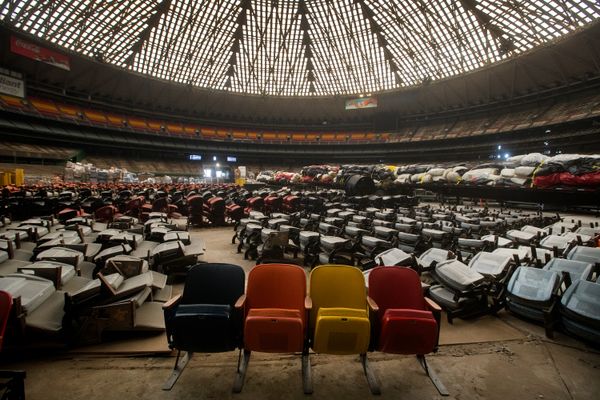
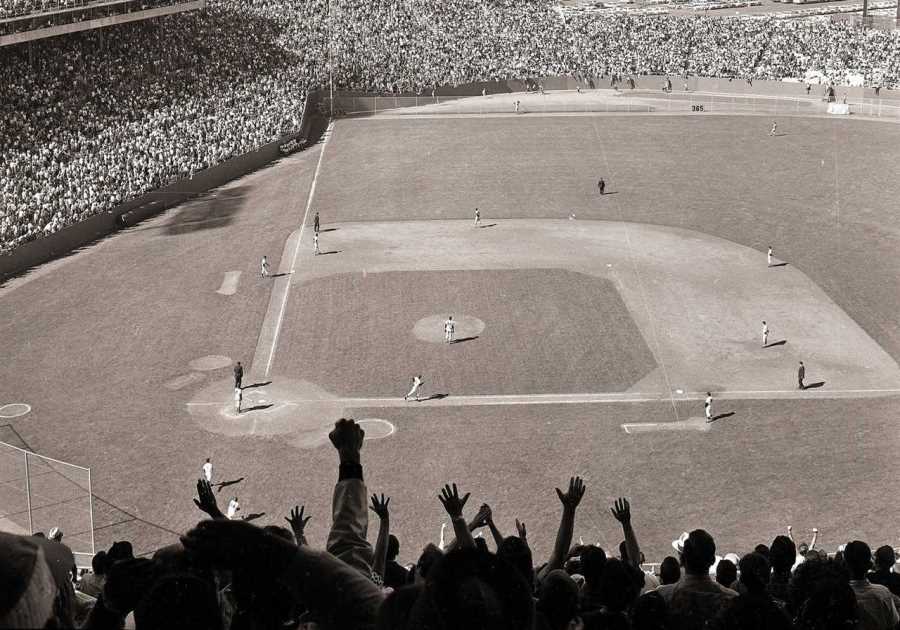
The Houston Astrodome, where the Astros played from 1965 to 1999, is sitting unused. Harris County, Texas, has plans to turn it into a housing development.
Photos by Stan Grossfeld/The Boston Globe/Getty Images
See the full story on Dwell.com: Take Me Home to the Old Ballgame
Related stories:
- Design Brands Are Now Duping Themselves—Sort Of
- LA Design Week/end Was the Comeback the City Needs Right Now
- What the Obama Center Actually Cost—and Everything Else You Need to Know About This Week
Read More
By: Ben Ikenson
Title: Take Me Home to the Old Ballgame
Sourced From: www.dwell.com/article/ballpark-housing-developments-candlestick-park-a17164e0
Published Date: Tue, 13 Oct 2026 15:57:21 GMT
Did you miss our previous article...
https://trendinginbusiness.business/real-estate/in-mongolia-a-traditional-housing-type-meets-the-changing-realities-of-its-residents