.png)
In the age of value-engineered structure, corporate-funded street art has become the architectural detailing that some of the public has been craving—and criticizing.
It was during a July drive down Interstate 25 through Denver that I noticed new midrise residences and bulky multifamilies beginning to color the city. By "color" I mean taupify: All shades of brown, beige, and sandstone blurred together, with some grays and burnt siennas to provide visual interest—like a sunburn might add depth to a bare thigh. My partner joked that all these new apartments look like Swedish prisons; I’d never seen a Swedish prison before, but I got what he was saying. The buildings appear desiccated in the high desert sunshine, but they are humane enough for residents seeking an apartment to occupy during a national housing shortage. From a distance, each looks like a comfortable punishment.
Though the view is grim from the freeway, driving and walking through the city paints a different picture—literally. Denver has become a mecca for muralists, with government initiatives for capital improvement projects yielding funding for public art. As the city has grown in population, new tax revenues have helped fund infrastructure improvements, new and renovated libraries and shelters, and expanded transit lines. A municipal program requires that 1 percent of city-funded capital projects with budgets greater than $1 million go toward public art. But developers, too, have taken to the idea. As multifamily buildings are constructed or renovated, massive murals are adorning what would otherwise be blank walls or eyesore parking garages. It’s a many-pronged strategy—marketing, branding, ornamentation, real estate returns, and public art rolled into one.
This isn’t just happening in Denver. Around the country, murals have been proliferating at new housing developments. The trend has caused a debate among communities that see new development as a threat to their property taxes, a way of "artwashing"—the use of cultural projects like public art to obfuscate gentrification. But some artists and arts organizations disagree. As developers add much-needed housing to urban areas, commissioning a piece of public art has become a way to add visual interest to a boring extruded box. In the age of value-engineered development that has flattened not just architecture but local culture, public art has become an avenue for civic identity-making that has been diminished by a sea of brown boxes.
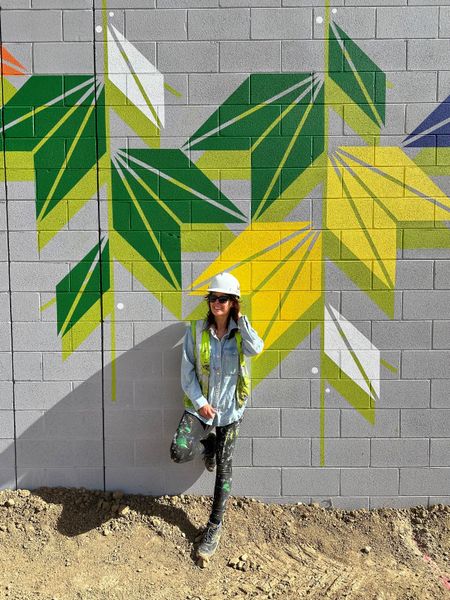
Artist Sandra Fettingis installing a mural at Sprouts Market in Aurora, Colorado.
Photo courtesy Sandra Fettingis
Artist Sandra Fettingis resides in Denver. Unlike much of her newly built bland surroundings, her murals feature brightly colored patterns that, while angular and sharp, seem to embody a natural geometry. I’ve admired Fettingis’s work since 2011, when we both worked at the front desk of the Museum of Contemporary Art Denver, a job that sustained her until her reputation took off after she won a commission to create a massive installation in the Colorado Convention Center’s atrium as a part of the city’s public arts program.
Since then, Fettingis’s work has appeared everywhere: windscreens for railway stations, a suspended installation in a college atrium, and murals in private homes. She’s completed more than 90 murals and installations at sites across the Denver area, including 22 new rental apartment and condo projects. One of her most recent projects was a commission by Mill Creek, a major U.S. developer known for upscale apartments. Mill Creek approached her in 2024, she says, to design a mural on a new building near the University of Denver. It’s a normal "developer special": studios and one- and two-bedroom units in a five-story structure located in an otherwise single-family neighborhood; a charcoal gray amenity tower with a deck meets burnt sienna and tan cladding the exterior. Fettingis’s mural is on a wall near the entryway, visible from the amenity deck and some balconies.
She wasn’t given any art direction—a great relief for a creative person who sometimes gets commissions based on work she completed years prior—and created a 60-by-25-foot mural whose umber tones complement the building’s muted color schemes. It also features her signature geometric botanicals cascading down the wall, transforming an otherwise ordinary building into a landmark for residents and passersby.
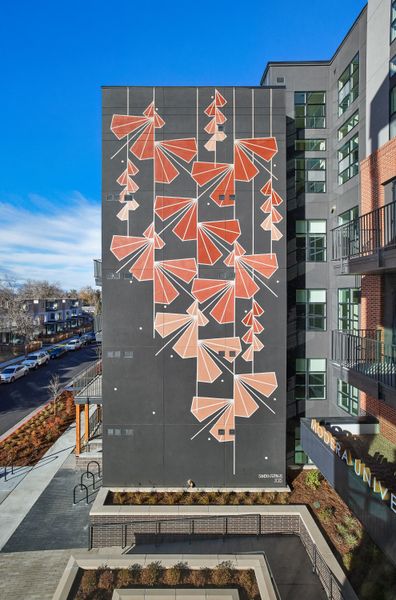
In 2025, Fettingis installed a mural of her characteristic geometric botanicals down the side of the Modera University Park building built by developer Mill Creek in Denver. She says residents talk to her while she’s working on her pieces and have shared "how much life and joy" they bring.
Photo by Third Dune Productions
"I think there’s a lot of things that take place even on a subconscious level," she says of the experience of being a resident. "I think there’s a level of pride if your building has something rad on it." On a community level, she continues, it shows that a developer actually cares about the neighborhood it’s building in. "They are offering this unique character to a place that’s thoughtful, versus just dumping a building and leaving and going on to the next one." Gina Harris, regional design manager at Mill Creek (who hired Fettingis for the project) agrees and says the company has worked with local artists on projects across a national portfolio. "We believe art adds lasting value by giving a building personality and emotional resonance. It helps residents feel proud of where they live and signals that we care deeply about the communities we develop," she told Dwell via email. "Those details matter."
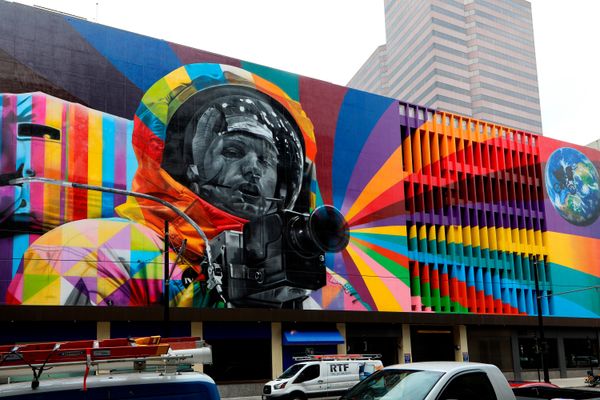
Eduardo Kobra’s "Armstrong" mural in Cincinnati, Ohio.
Photo by Raymond Boyd via Getty Images
See the full story on Dwell.com: The Case for the Developer Mural
Related stories:
- Could the Listening Bar Boom Help Solve Our Need for More Third Spaces?
- Paris’s Ugliest Building Is Getting a Glow Up—and Everything Else You Need to Know About This Week
- How Far Into the Wild Can Hay’s Outdoors Gear Actually Take You?
Read More
By: Anjulie Rao
Title: The Case for the Developer Mural
Sourced From: www.dwell.com/article/the-case-for-the-developer-mural-4d16e5f2
Published Date: Tue, 10 Mar 2026 12:02:19 GMT
Did you miss our previous article...
https://trendinginbusiness.business/real-estate/before-amp-after-how-a-twobedroom-craftsman-grew-to-fit-a-family-of-six-for-605k