.png)
Architect Pamela Jerome shares the challenges of undertaking a three-year renovation remedying decades of damage at Fallingwater: "Over ninety years of water have passed through its stone walls."
"I want you to live with the waterfall, not just to look at it, but for it to become an integral part of your lives." So wrote architect Frank Lloyd Wright to the Kaufmann family in 1935, just before construction would start on Fallingwater, which famously cantilevers over a cascading stretch of the Bear Run stream in rural southwestern Pennsylvania. Wright’s ingenious fusion of nature and architecture, completed in 1937 and honored as a UNESCO World Heritage site in 2019, owes its existence to the power and presence of water. He even utilized river pebbles in some of the building’s concrete mix.
That same element has, over the decades of the home’s storied existence, conspired to degrade it, seeping into walls and even on occasion flooding the living space. In 1956, a roaring Bear Run ran into the living room during a severe storm while owner Edgar Kaufmann and his family were inside, leaving everyone unscathed but significantly damaging precious artwork. And it’s not just the nature of the site. Wright’s insistence on certain materials and design choices, across his entire body of work, have famously created maintenance challenges and water intrusion issues for owners for decades.
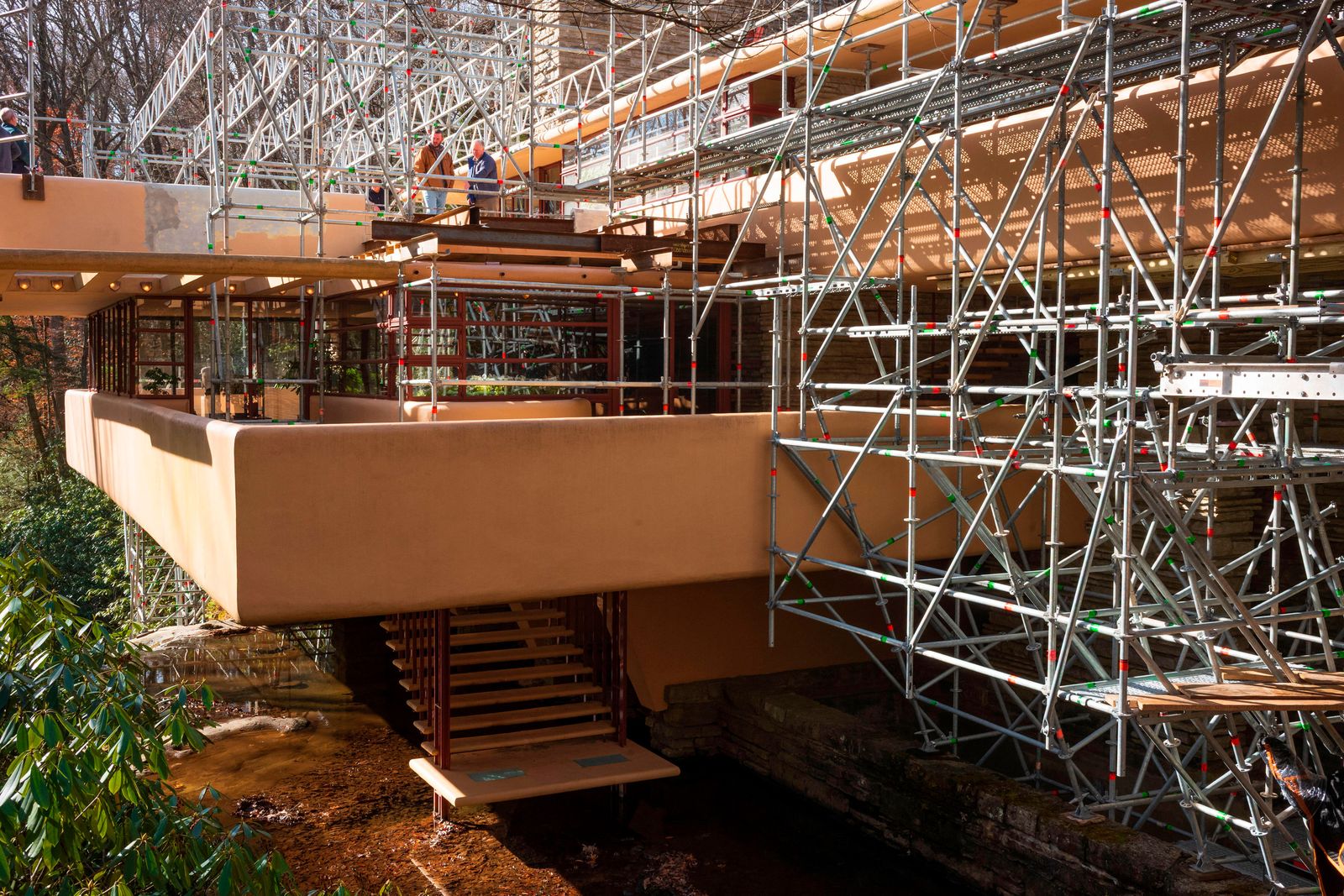
Maintenance and restoration projects have tried to strengthen Fallingwater’s defense, attempting the tricky balance of defending it from environmental challenges while adhering to increasingly stringent preservation edicts. One of the most exhaustive, a $7.5 million, three-year effort that put scaffolding around the entire home for the first time in 20 years, is now at the finish line. Here, lead restoration architect Pamela Jerome, the president of New York–based firm Architectural Preservation Studio, shares the challenges of restoring what might be the most famous home in existence.
Fallingwater, designed by Frank Lloyd Wright and completed in 1937, is undergoing an extensive $7.5 million renovation.
Courtesy Western Pennsylvania Conservancy
What exactly is the scale of damage at Fallingwater?
Pamela Jerome: Fallingwater is in great condition for a modern house of its age, the result of cyclical maintenance and ongoing careful stewardship. However, the greatest area of concern were the leaks on the third floor of the main house. In addition, warranties on existing roofing had lapsed, necessitating replacement of all roofing and terrace waterproofing. There were visible places of water damage that required attention, and grouting and waterproofing replacement allowed us to resolve these areas of concern.
Where is the water damage mostly happening?
Since ancient times, stone walls have been constructed in a similar fashion [to Fallingwater], with an inboard and outboard wythe, and bits of stone and mortar packed as infill into the middle. At Fallingwater, periodic through-wall tie stones hold the two wythes together. Over 90 years of water have passed through Fallingwater’s stone walls due to a lack of original flashing. This has caused a lot of the infill materials to settle and/or wash out of defective joints.
Buildings are normally constructed with metal counterflashing wherever exterior walls meet a roof or terrace. It’s located a minimum of eight inches above the finished roof or terrace so it is visible. Presumably, Wright did not like the look of what would have been copper counterflashing. But without it, any moisture entering the stone walls can penetrate the interiors. In Fallingwater’s case, because the walls also have projecting ledges that accumulate snow and rain, this tendency is exacerbated, allowing moisture to seep through hairline separations in the mortar joints. As a result, most of the chronic leaks were associated with water coming through stone walls.
How much damage is done to the home from precipitation versus Bear Run?
Bear Run can flood. There was a well-known event in 1956 that brought water up to the level of the living room, overwhelming the east and west living-room terraces. There has been debris brought down by Bear Run that knocked out part of the stairs to the stream. However, the main damage within the buildings comes from precipitation entering through the ledges projecting from the stone walls, whether that be rain or melting snow.
Did Wright leave any instructions, advice, or suggestions on maintenance and upkeep of Fallingwater?
No, Wright left no advice that the Western Pennsylvania Conservancy [which owns and operates the home] is aware of. In fact, he reassured the Kaufmanns that the house was sound. The Kaufmanns had a caretaker, as they did not live at Fallingwater year-round, who was responsible for the grounds as well as the maintenance of the buildings. Considering the size of Fallingwater’s team today (110 total, 11 maintenance staff), it would have been a challenging site to care for even when it was newly constructed.
How did you locate the water damage, compared to the last time the home was updated?
Laser-scanning has been a game changer in terms of producing accurate AutoCAD background plans, elevations, and sections. For the first restoration, our CAD drawings were developed from hand measurements. For this one, we used surface-penetrating radar along with videoscopes to locate and calculate the size of voids in the stone walls as well as to determine how continuous the voids were. Additionally, smartphone apps that perform laser-scanning were used to quickly understand thicknesses of stone walls.
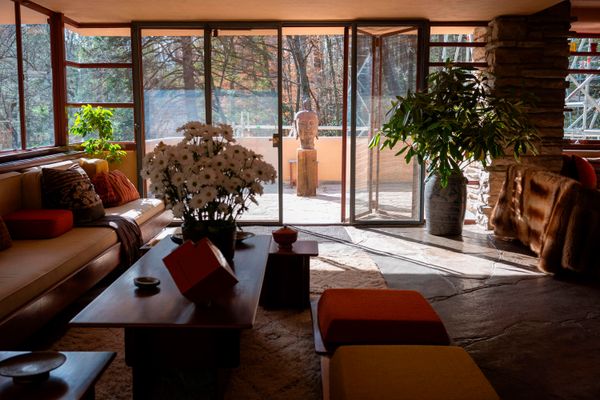
The river over which Fallingwater sits, Bear Run, flooded the living room in 1956 while the owners, the Kaufmanns, were inside. Nobody was hurt, but artwork was damaged.
Photo by Jonathan Cohen/Alamy
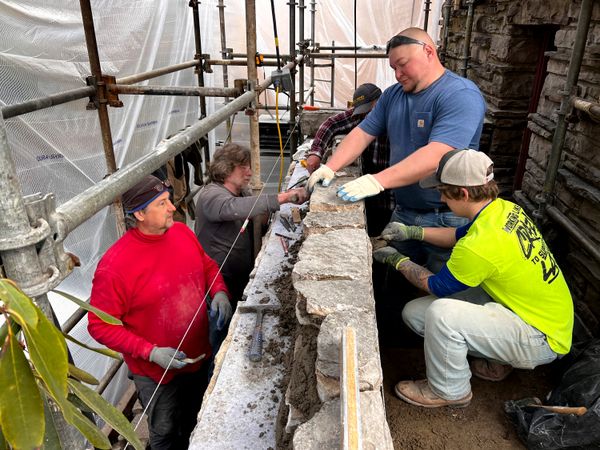
Much of the home’s water damage is due to a lack of flashing where the walls meet roofs and terraces; some say Frank Lloyd Wright omitted it for aesthetic reasons. Here, stone masons place new stones atop newly installed flashing.
Courtesy Western Pennsylvania Conservancy
See the full story on Dwell.com: Where Exactly $7.5 Million Is Going to Preserve Frank Lloyd Wright’s Most Famous Home
Related stories:
- Before & After: How a Two-Bedroom Craftsman Grew to Fit a Family of Six for $605K
- You’d Never Believe This Angular Glass Facade Stands Among Former Military Barracks
- Going Back to Brutalist Was the Plan for This Concrete Croatian Flat
Read More
By: Patrick Sisson
Title: Where Exactly $7.5 Million Is Going to Preserve Frank Lloyd Wright’s Most Famous Home
Sourced From: www.dwell.com/article/frank-lloyd-wright-fallingwater-preservation-plan-pamela-jerome-84b76806
Published Date: Thu, 12 Mar 2026 12:02:18 GMT