.png)
A recent twist in the Walser House saga illuminates the undesirable outcome that can await architecturally significant buildings without stewards.
In Chicagoland, Frank Lloyd Wright’s Prairie-style homes draw tourists and architecture enthusiasts from around the world. Many of his buildings across the city have been meticulously cared for and preserved. Fans could head to Oak Park, where they can visit the Frank Lloyd Wright Home & Studio, built as the architect’s own residence in 1889; or stop by the Robie House in Hyde Park, for a tour of the 1910 structure. Located in Chicago’s west side neighborhood of Austin, the Walser House is another significant Wright-designed property: Built in 1903 for printing executive Joseph Jacob Walser, it is one of only seven surviving homes in the city limits. It’s an example of Wright’s more modest work designed to fit on a narrow city-sized lot—though streamlined for a smaller footprint, its deep roof eaves, band of windows, and floor plan are indicative of Wright’s style. While it was built during the area’s heyday, today, Austin is rebuilding after decades of disinvestment—and the Walser House, one of its most cherished cultural landmarks, is also in need of revitalization.
Despite its heritage and its significance to the neighborhood, the Walser House is in bad shape. The building’s most recent steady owner held the property for nearly five decades, beginning in 1970. After her death in 2019, it entered a long, hazy legal limbo and was left vacant for five years. Despite having local and national historic designations, it ended up on Preservation Chicago’s and Landmarks Illinois’s Most Endangered Buildings lists. The property has moved slowly through the foreclosure process, all the while sitting boarded up and quiet. That is until earlier this month, when the Frank Lloyd Wright Conservancy, which has been diligently advocating for the Walser House for years, received a Google alert about it. To their surprise, someone had listed the property on Zillow. The listing kicked off what would become a short-lived mystery, one whose resolution reveals one of the many unfortunate outcomes when a building is left to decay.
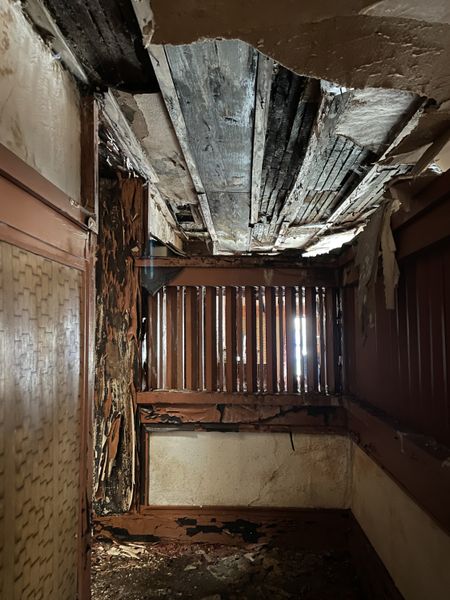
The home’s interior is in desperate need of repair.
Courtesy Frank Lloyd Wright Building Conservancy
The Walser House’s story echoes that of many estates that are located in disinvested neighborhoods: After a longtime owner passes away, the financial challenges inherent to keeping an aging house up can lead to a real struggle for their heirs, especially those who lack the resources to do so. Wright homes are no ordinary brick-and-mortar two flats, either; many haven’t aged gracefully, necessitating major, expensive renovations and repairs. Though the house was well-maintained over the past four decades, Barb Gordon, executive director of the Conservancy, says that after the owner’s death it was discovered that they had taken out a reverse mortgage in the 1990s to redo the roof. "Somehow it got converted to a line of credit, and then it really became financially unsustainable for her heirs when she died," she explains. The house entered the foreclosure process in 2023.
Since 2019, the house has deteriorated far beyond the usual wear that can happen when an owner is aging. "Clearly, any owner who is in their nineties is not focused on major house projects. There were issues, but it did not look at all like it does today," says Gordon. While the building was moving through the foreclosure process, the Conservancy worked with local nonprofit redevelopment and community group Austin Coming Together to keep tabs on its state. By 2024, the condition was dire.
"Any building that is left vacant for five years is going to just continue to deteriorate," Gordon explains. She says that visits to the house found doors wide open, suggesting that squatters were going inside; at one point they found a space heater running unattended. They submitted building violations in order to get it boarded up, hired landscapers to remove overgrown trees, and laid tarps to stop water seepage, all while attending various court hearings related to the foreclosure process. Finally, in December last year, the building went up for judicial sale.
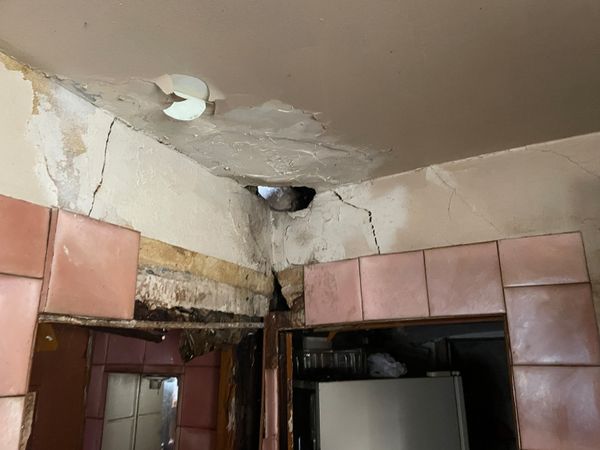
In the kitchen, pink tiles have been ripped out and a hole is seen in one corner.
Courtesy Frank Lloyd Wright Building Conservancy
"Austin Coming Together was trying to buy it before it went for judicial sale, but the lender did not take them up on that," Gordon says. The lender wanted to see what they could get for it, she continues, and they set the opening bid price at $240,000. "When this property came up , it was like a 30-second nope. Nobody was ready to buy it because everyone knows how much work is going to be needed, and that the comps just didn’t support what they were asking." The county chancery court formally transferred the home to Fannie Mae on January 9.
A week later, the home appeared on Zillow as "For Sale By Owner" at a price of $350,000. The Conservancy team thought something felt off when they saw it listed. Still, they went ahead and added it to their website’s "Wright on the Marketplace" page where other FLW-designed homes for sale are featured. Their partners at Austin Coming Together also noticed the listing and, together, they began reaching out to the owner using the phone number listed on Zillow. It went to voicemail.
"It was this very unprofessional, incoherent mailbox," Gordon says, and recalls thinking, "Hmm, this doesn’t sound like a person that I want to do business with." The listing itself was equally confusing, filled with misspellings, unusual acronyms, and text that seemed to be pulled from various internet sources using AI. They scoured other listing sites like Trulia and Redfin—often listings are syndicated across platforms—and found nothing; they contacted a realtor and found no MLS listing. After Martin Luther King Jr. holiday weekend, they were able to confirm with Fannie Mae that the listing was, indeed, fake; they removed the listing from their website stating that whomever listed the home was "possibly aiming to defraud a well-intentioned potential purchaser."
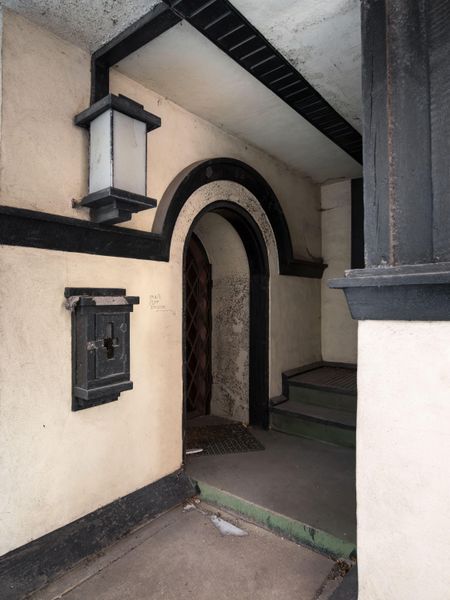
The home’s entryway is deteoriating, too.
Photo by Serhii Chrucky/Alamy
See the full story on Dwell.com: Who Faked the Zillow Listing for This Endangered Frank Lloyd Wright Home?
Related stories:
- The Aspirational Pantry Is a Scam
- You Should Be Taking Reality TV Homes Way More Seriously
- It’s a 20th-Century Log Cabin—and Now the Living Room of Their Lake House
Read More
By: Anjulie Rao
Title: Who Faked the Zillow Listing for This Endangered Frank Lloyd Wright Home?
Sourced From: www.dwell.com/article/walser-house-frank-lloyd-wright-zillow-listing-6e5d2942
Published Date: Thu, 29 Jan 2026 20:33:49 GMT