.png)
A viral LinkedIn video showing bulldozers covering forests-worth of timber being sold as carbon credits has been cause for controversy.
Recently, footage of bulldozers heaving felled trees into football-field-sized pits in southern Colorado went viral on LinkedIn. As of this writing it has garnered no fewer than 145 comments, with one person calling it absolutely absurd. Another said that he really enjoyed the post and comments thread, being able to go from not knowing about the concept, to being outraged, to then realizing it’s actually a great idea. Many just wanted to know why diesel-hungry machinery was piling up and burying in the ground a mountain-top’s-worth of lumber.
The company who posted the video, DuraVault, is in the business of wood vaulting, which is part of a growing industry known as biomass carbon and removal storage, or BiCRS, where timber deemed unusable is buried in the ground and sold as carbon credits. Burying timber dramatically slows decay and sequesters the carbon it would release over time. (Left to rot naturally, one Douglas fir can release 10 metric tons of carbon dioxide, roughly equivalent to driving a car 25,000 miles.) DuraVault and more U.S. companies then sell off what they store as carbon credits to companies looking to offset their emissions.
Those in the BiCRS business claim they are only burying unmarketable timber, such as wildfire-charred, beetle-killed, or "slash" timber, which is often chemically or physically compromised. Sometimes it comes from forest thinning or fire remediation projects, and a yield is too small for sawmills to use and too expensive to transport. In terms of construction, companies in the sector say the wood can’t be used for beams because it has too many knots, cracks, or rot, and for furniture, it is too warped.
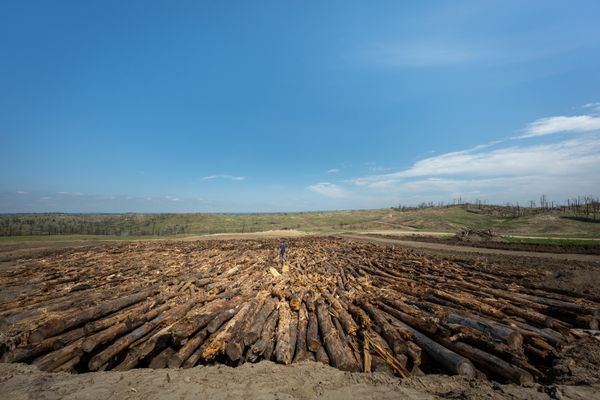
Washington biomass storage company Mast Reforestation positions itself as a forest management solution in the wake of wildfire events.
Photo courtesy of Mast Reforestation
And yet the practice, as made apparent by the LinkedIn post, is causing an uproar, with many skeptics claiming this is an absurd waste of wood. From sustainability architects, to climate activists, and others working in the built environment, many believe that adding a financial incentive such as carbon credits to burying wood is a shame and essentially unethical. British architectural historian Barnabas Calder says there is also a significant risk that healthy trees and useful wood will be buried in large quantities, even if specific operators are absolutely scrupulous about burying only wood that has to be removed for pressing forestry reasons. Calder also calls carbon capture "a nightmare," and says that isn’t a solution to the climate emergency. "The aim of reducing carbon in the atmosphere feels like an extreme instrumentalization of a landscape, to be defining the utility of each organism, killing and burying some to undo our other voluntary harms, all using powerful diesel vehicles and machines," he says.
Dr. David MacKay of Cambridge University believes burying felled logs is a waste of land, in particular. "If anyone proposes using trees to undo climate change, they need to realize that country-sized facilities are required," he says in his book Sustainable Energy—Without the Hot Air. He served as Chief Scientific Adviser to the U.K. Department of Energy and Climate Change. "To fix a European’s output of 11 tons of CO2 per year, we need 80,729 square feet of forest per person. This required area is twice the area of Britain per person."
DuraVault CEO Serge Bushman, who actively defended the LinkedIn video his company posted by responding directly to outcry in the comments, says the practice is killing a few birds with one stone. Vaulting gives unusable wood an end-of-life plan, sequesters carbon, and supports forest management efforts. "We’ve got to understand that in some parts of the world there is too much supply of forest residue. In the United States and Canada this has led to fire-suppressed, overgrown forests, because no one is motivated to remove unmerchantable wood," he says. Bushman says that for every ton of carbon dioxide DuraVault stores it only expends five percent of that amount.
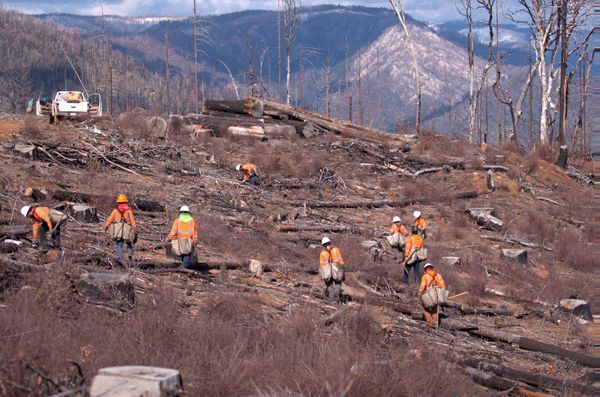
The company says it buries wood deemed unusable as timber.
Photo courtesy of Mast Reforestation
At the Colorado site, logs are being buried using "vault" technology, with high-tech sensors and sealing protocols, and legal trusts to ensure that if wood is buried, it stays there for 1,000 years or more. Companies, including tech behemoths like Google, are willing to pay a premium for credits created by the practice of vaulting and other carbon storage strategies because they come with a guarantee that carbon from "trash wood" will be sealed off for centuries. Such credits, each of which represents the verified reduction, avoidance, or removal of one metric tonne of carbon dioxide, are also tradable certificates. Corporations often use them to fund climate action projects—such as reforestation, renewable energy, or methane capture—allowing them to offset unavoidable emissions.
Another BiCRS company, based in Washington, Mast Reforestation, was founded to solve "one problem," says its CEO, Grant Canary. "How to scale reforestation after wildfire." The company buries burnt logs from wildfire-damaged land that are otherwise unmerchantable. "A common question is whether that wood could be used for building materials or energy instead," he says. "Emphatically no. We work where the timber is too burned, too small-diameter, or too remote to pay the transport costs and be economically processed." Buyers for a batch of more than 4,000 credits issued in April of 2026 from a burial site in Montana include Bain & Company, BMO, and the Royal Bank of Canada.
In a method called carbon casting, Arkansas company Graphyte collects timber and agricultural residues (like sawdust and rice hulls), dries them, compresses them into dense blocks, and buries them. The company, incubated by Bill Gates’s Breakthrough Energy Ventures, which invests in startups developing technologies that combat climate change, recently signed a major 10-year deal with JPMorgan Chase to provide 60,000 metric tons of carbon removal credits.
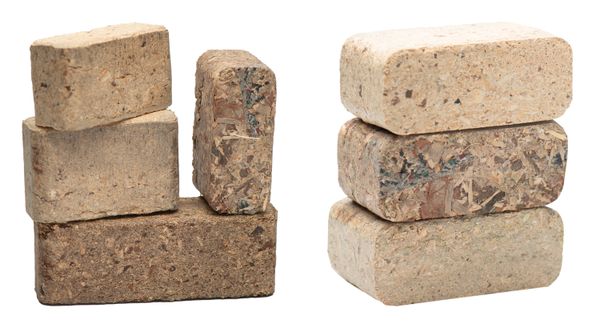
Arkansas company Graphyte compresses agricultural and timber waste into blocks that it then buries.
Photo courtesy Graphyte
See the full story on Dwell.com: Why Are We Burying All This Wood?
Related stories:
- Glass-Like Dimmer Knobs I Had to Touch and More Engaging Objects at the Afternoon Light Design Fair
- A Private Club Comes to NY’s "People’s Beach"—and Everything Else You Need to Know About This Week
- It’s a Porta-Potty. It’s an Off-Grid Charger. It’s Klumpen.
Read More
By: Bridget Goldberg
Title: Why Are We Burying All This Wood?
Sourced From: www.dwell.com/article/wood-vaulting-biomass-storage-duravault-carbon-credits-2e6e568c
Published Date: Tue, 19 May 2026 19:10:44 GMT