.png)
The quality and deals are there—and the reason behind them goes all the way back to the Cold War.
When Lenart Zajc was 12 years old, he started exploring the attic of his family’s home in Novo Mesto, Slovenia, looking for old things he might be able to sell. The first scoop was six chairs he sold for €30, which he quickly realized was far too cheap—because people are really interested in vintage goods, especially when they fall into the category of midcentury-modern design.
Today Lenart, now 17, runs RetroExYu, an Etsy shop specializing in vintage lamps, furniture, and home decor from the former Yugoslavia region, sourced from flea markets, local homes, and secondhand shops. "Ninety percent of the sales go to the United States," says Lenart’s brother Martin, who helps with marketing (as the better English speaker, he does most of the talking on our video call). The rest of the sales go to Western Europe. They very rarely sell locally—Slovenia has a lower cost of living, and Lenart has priced his goods for what the international market will bear: "Here it’s too expensive."
If you’re one to poke around on Etsy, you might have noticed there’s an abundance of really great midcentury-modern home decor from Eastern European shops like this. (An Etsy spokesperson declined to share how many sellers are operating in these categories in Eastern Europe, noting only that Etsy has 860,000 active sellers in the EU.) There’s lots of tables and chairs, lamps and clocks, art and tapestries, and lots of random things like these green plastic drawer pulls. It’s often pretty reasonably priced too, at least considering the vintage condition and rarity.
The U.S. and Western Europe has been lusting over midcentury modern for a couple of decades now, and the category is pretty picked over. But Eastern Europe’s unique history has meant there’s been far lower demand for items from this era where they were made—often down to people’s memories of the time they’re associated with. In the 1970s, Slovenia was still part of communist Yugoslavia, and unlike Americans, who could associate midcentury-modern design with the enormous optimism of the postwar years, Eastern Europeans spent the era on the other side of the heavily militarized Iron Curtain that separated East and West for 45 years, starting just after the Second World War and lasting until 1991. (While technically independent, Yugoslavia had its own repressive communist regime.) Behind the Iron Curtain, midcentury design was accompanied by an atmosphere of restricted freedoms and government control.
But the East still produced a lot of great midcentury-modern design. In a curious twist of history, home goods became a flashpoint for the two sides of the Cold War. The East was keen to show its citizens—and the West—that a socialist society could provide not just what you needed to live well, but well-designed furniture and appliances. This promise never quite came to fruition, as the East suffered chronic consumer goods shortages—the products were often inaccessible to the people. But today, items from this era are increasingly available on the vintage market, where they’re proving popular for being well-made and unique.
RetroExYu has several beautiful Meblo Guzzini lamps, sleek chrome-and-glass coffee tables, and funky space-age mirrors. There’s also a striking blue 1970s Iskra clock that Etsy describes as a "rare find, already in 2 baskets," listed for $580 plus $80 postage (the new tariffs have significantly hiked up U.S. shipping costs). Iskra clocks were commonly used in public buildings across Yugoslavia—this one is from the train station where Lenart’s father worked. "We are happy that items can be used again and have a new life in a new home. We love doing this, especially Lenart," says Martin, as Lenart nods. "This business is his passion."
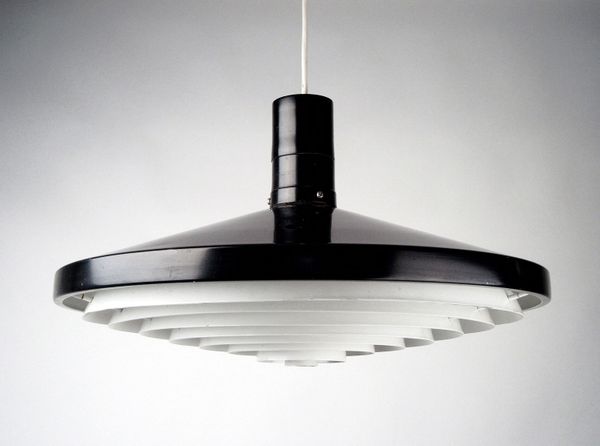
The P605 pendant lamp, made in East Germany.
Photo from Alamy
Vintage finds from behind the Iron Curtain often tell a story. The P 605, a functional yet stylish pendant lamp that’s easy to repair, is an East German design that came about when a patio heater company had to repurpose some materials. Today you can get one from Etsy for $500, though it was an expensive lamp back in the day too—Gordon Freiherr von Godin, director of the DDR Museum in Berlin, estimates the P 605 would have cost 60 to 120 marks, when a monthly salary was 600 to 700 marks.
"People in East Berlin struggled to buy things, even if they had the money. My mom always had to hunt for things that weren’t in the shops. You had to ask people you knew if they were able to get what you needed, and at what cost. It was tough," says von Godin, who grew up in East Berlin before the wall fell when he was 19. "This is something we have to recognize when we talk about [Eastern] design. They are design objects today—they weren’t design objects in 1974. East German design is something special, but it’s important to know why this specialty came about."
The DDR Museum is a moving and engaging showcase of life in former East Germany, from the pressures and dangers of life under communism to a recreated family apartment. It’s a popular destination, but most visitors are from Western countries, says von Godin—people who are interested in peeking behind the Iron Curtain to see what was on the other side. "But we don’t get too many visitors from Eastern countries. I think they already know, from how they grew up."
For many, it’s simply too soon to look back. "The time after the Second World War was a very dark period for Hungary. No one wants those times back," says Marti Fabulya, who runs the Etsy shop RetroCubeHome from her home in Békéscsaba, Hungary. Severe poverty was followed by increased production overseen by the state, which meant people mostly had the same stuff: "In the 1960s and ’70s, these items flooded the country—homes were full of this design. So today, many people look at those items and just think how glad they are that we got rid of all that."
But a desire for greener living is prompting people to embrace vintage, especially among Hungarians who grew up in the postcommunist era. "Among the younger generation I think people are starting to look at this and see great design. They don’t think of them as everyday objects. They see it as a form of art and beauty," says Fabulya.
RetroCubeHome sells a lot of Hungarian soft furnishings, with a nice selection of works by textile designer Éva Németh, whose rugs and tapestries were made in a factory in Békéscsaba. "She was the chief designer, and there were maybe a hundred women working in this factory," says Fabulya. "There are people still living here whose relatives used to work there, and they have kept many pieces. I think our little town can be really proud of them."
A third of Fabulya’s orders come from the United States. "I never imagined people from the other side of the globe would reach me," says Fabulya, who started her Etsy shop six years ago. "And they’re willing to pay a lot!" Because her parcels are small, Fabulya hasn’t been hit as hard as others by recent tariffs, but it now costs $40 to send a tapestry to the U.S., and customs take a little longer. Tariffs have made the Eastern European vintage market less of a steal for sure, but for many collectors who want these historic items, the increased postage isn’t a dealbreaker—they’re already willing to pay hundreds of dollars. Fabulya knows she sells a rare product, one she says "people are still willing to buy."
Designers like Németh had to operate within the requirements of state-owned manufacturing, which usually dictated which materials could be used and which designs could be produced. Design became an area where the socialist government in the East could flex in the ongoing battle of ideologies with the West, and nowhere was this more keenly felt than in Germany, where the Iron Curtain literally divided the country. The goal was to bring social welfare design to life. "But they made their first prototypes at a time when East German industrial production was shattered. Items existed in very limited production, and there was no consumer demand because people didn’t have money to buy furniture," says Greg Castillo, a professor in architecture and design at the University of California, Berkeley.
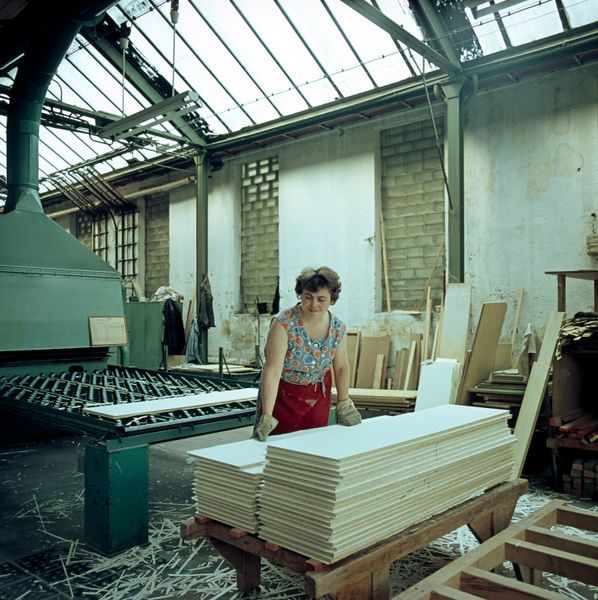
Furniture production in process at the state-owned factory Volkseigener Betrieb Möbelkombinat Hellerau in the German Democratic Republic (GDR) in 1969.
Photo by Harald Lange/Getty Images
East German design items might have appeared at shows and in magazines but never made it into stores—their function was to show off the socialist furniture industry. Castillo is a fan of the work of Bauhaus alumnus Franz Erlich, who worked at Werkstätten Hellerau in Dresden around 1950 (a rare Erlich chair currently on Etsy is listed at $2,700). "There can’t be more than a hundred of those in the world," says Castillo, who spent time in Germany in the early 1990s researching his book, Cold War on the Home Front. "So in a sense the chair is underpriced because of the lack of understanding or interest in this artifact—what it really is, or means."
The West participated in this culture war of the home as well—if anything, America lit a fire with propaganda when it brought an unmatched home goods extravaganza to the American National Exhibition in Moscow in 1959, keen to demonstrate which superpower could provide a better standard of living. Egged on by President Nixon in what’s become known as the Kitchen Debate, Soviet Premier Khrushchev promised that in seven years’ time, the East would have caught up. The pressure was on to deliver, or at least, to make it look good.
One showpiece that looked good in catalogs is Peter Ghyczy’s Garden Egg chair. It’s a spectacular space-age design that now sits in the permanent collection of the V&A Museum in London after being acquired for the 2008 "Cold War Modern" exhibition. (Etsy has one, if you have $3,000 to spare.) "Ghyczy told us it was a test piece for a plastics company, which was trying to sell the raw material but no one understood what to do with it," says Jana Scholze, who cocurated the V&A show. "A few were produced, but they were expensive to make. They were shiny from being lacquered many times by hand. But the whole idea behind a plastic chair was to mass-produce it from a mold"—the Garden Egg chair was more of an idea than an actual product for the people.
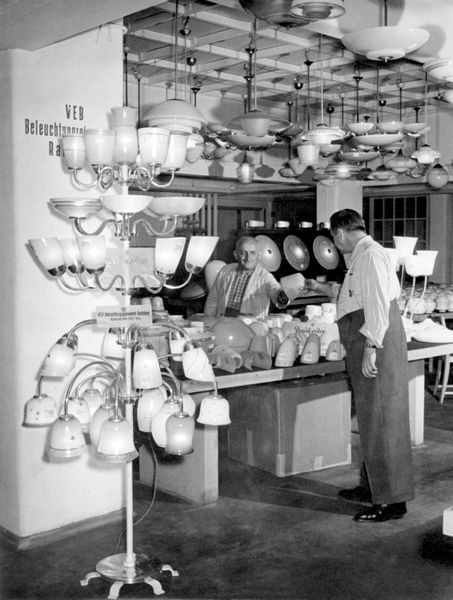
The GDR state-owned VEB Beleuchtungsglaswerk Radeberg booth at the Leipzig trade fair in 1955. The fair is one of the oldest in the world, and was a key part of Cold War diplomacy.
Photo from Getty Images
See the full story on Dwell.com: Why Is There So Much Great Midcentury-Modern Decor From Eastern Europe on Etsy?
Related stories:
- This January, Fix Your Bite-Sized Home Decor Problems First
- Design for Kids, Reviewed by Actual Kids
- How DTC Homeware Brands Decide Which Colors to Bet Big On
Read More
By: Jessica Furseth
Title: Why Is There So Much Great Midcentury-Modern Decor From Eastern Europe on Etsy?
Sourced From: www.dwell.com/article/why-is-there-so-much-great-midcentury-modern-decor-from-eastern-europe-on-etsy-5736f7f0-e6f13504
Published Date: Wed, 04 Feb 2026 14:07:00 GMT