.png)
It hides at the rear of a mostly brick addition to a historic 1913 German residence.
Houses We Love: Every day we feature a remarkable space submitted by our community of architects, designers, builders, and homeowners. Have one to share? Post it here.
Project Details:
Location: Münster, Germany
Architect: Andreas Schüring Architekten
Footprint: 2,650 square feet
Structural Engineer: Jan Kattert
From the Architect: "In the surroundings of the Train Barracks built in 1913, two-story brick houses for officers were erected along Weißenburgstraße. While the main barracks building was demolished in 2008 and other parts even earlier, some residential houses and the commandant’s house were preserved. On the site, the car-free garden settlement Weißenburg emerged—a deliberate counter-design to its former military use. House No. 24, also built in 1913, now forms a striking urban landmark within this ensemble. Although the building is not listed in a legal sense, it fulfills the criteria of a culturally defining structure: typical of its era, closely interwoven with its surroundings, and character-shaping for the street.
"Amid the traces of the historic barracks along Weißenburgstraße, the house contributes significantly to the character of the neighborhood a quality that the new design both acknowledges and enhances. Interestingly, the house hardly appears military in its architectural expression. With its almost sugar-coated ornamentation, it seems playful and charming—a clear contrast to the strictness of typical barracks architecture of that period. A relic from the barracks era, a laundry shed was given a subtle, muted green tone. This color, chosen in consultation with the city, was also applied to outbuildings and technical installations such as electrical boxes and the air-source heat pump. As a result, previously disturbing elements visually recede and blend discreetly into the overall appearance, while the architectural character of the neighborhood is preserved.
"The new structure evolves as an organic continuation of the existing building. A morphing transition from the solid brick body grows a new volume that unfolds within the mansard roof into a glass lantern. The old building remains legible, yet its geometry and tectonics are carried forward. The mansard’s inflection softens and from the historic eaves emerges a shading canopy. The historic façade becomes the starting point of a movement that culminates in light at the roof.
"Inside, the building opens upward: a central stairwell connects the levels and allows daylight to reach down to the basement. The new steel staircase is filigree and open, with a continuous handrail and perforated steps that let light pass freely. A light floor made of open steel grating in the attic replaces a closed slab above the void and channels daylight deep into the house. The entrance recesses into the interior as a precisely cut niche—framed by a plain steel plate deliberately contrasting with the historic brick facade. This creates a staged path through the house, ending at the top beneath the roof in an open studio space—a place of curiosity, offering wide views over the city’s rooftops. The glazed rear facade opens the building toward the garden. Generous roof overhangs, a historic cornice that transforms into a protective canopy, and closed wall sections on the south side provide effective summer heat protection, even without conventional shading systems."
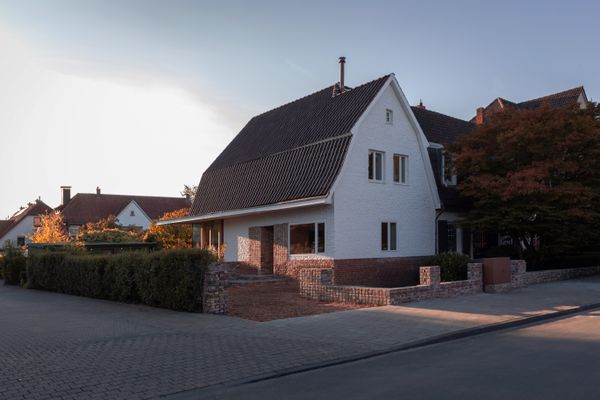
Andreas Schüring Architekten renovated this historic 1913 residence in Münster, Germany
Photo courtesy of Andreas Schüring Architekten
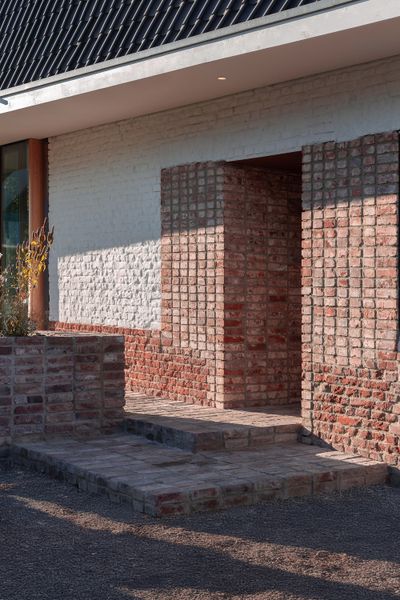
Photo courtesy of Andreas Schüring Architekten
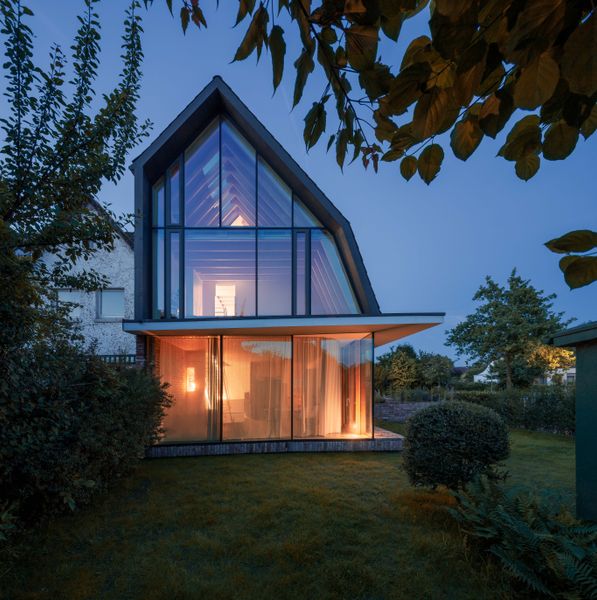
Photo courtesy of Andreas Schüring Architekten
See the full story on Dwell.com: You’d Never Believe This Angular Glass Facade Stands Among Former Military Barracks
Related stories:
- Going Back to Brutalist Was the Plan for This Concrete Croatian Flat
- This Belgian Castle Was Once a Retreat for the Wealthy. Now Solo Agers Call It Home
- Budget Breakdown: A Family’s Vibey New York Vacation Home Gets a Gut Reno for $1.2M
Read More
By: Grace Bernard
Title: You’d Never Believe This Angular Glass Facade Stands Among Former Military Barracks
Sourced From: www.dwell.com/article/brick-to-light-andreas-schuring-architekten-renovated-military-home-f268d7ec
Published Date: Tue, 10 Mar 2026 12:02:19 GMT