.png)
Macworld
The MacBook Neo has certainly created a lot of attention for Apple and the Mac. But if you’re on the outside (a.k.a. a dedicated Windows PC user) looking in, you probably shrugged it all off as the usual Apple hype.
But Microsoft seems to be convinced that the hype is real, because it recently “commissioned” a report by Signal65 to convince everyone that Windows PCs are the better value. Presented as a serious whitepaper, “Windows 11 PCs Compared to MacBook Neo” takes the MacBook Neo and compares it to four different Windows laptops, and explains the “total value each system brings to the table.”
Two of the laptops in Sigal65’s report, the Lenovo Yoga 7i and the HP OmniBook X Flip, are priced at $1,199 and $949, respectively. “The Yoga 7i occupies a category the MacBook Neo does not compete in,” says the report, which also concludes that the Yoga’s and OmniBook’s actual market is the same as the MacBook Air. It’s not clear why they’re even in the study, so let’s move on.
The other two PC laptops are the HP OmniBook 5 and the Lenovo IdeaPad Slim 3x, $599 and $449, respectively, according to the study (though we couldn’t find the IdeaPad for that price). Both laptops are 16-inch models, and the large form factors play a role in their ability to outperform the 13-inch MacBook Neo. For example, the report touts the battery advantage these PC laptops have over the Neo, but the report fails to mention that the OmniBook 5’s 60 watt-hour battery and the IdeaPad Slim’s 52 watt-hour battery are much larger than the Neo’s 36.5-watt-hour battery. If anything, it’s a relief that those bigger batteries offer longer life.
Foundry
Of course, Signal65’s benchmarks show the PC laptops outperforming the MacBook Neo in most of its tests. And it also points out how they offer better specs: more ports, more storage, and more robust external display support. Advantage to the PCs in these aspects. As for the contention that the 16GB of RAM in these PCs is better than the Neo’s 8GB, PCWorld rightfully points out that “extra memory may not give as much of a performance boost as you’d hope in Windows 11.”
When it comes to the display, our sister site, PCWorld, said the IdeaPad Slim 3X’s display “is the weakest part of the experience,” and that “in real life, it feels not just unusually dim, but also dull.” As for the LED display on the OmniBook 5, PCWorld reported that “the contrast ratio is limited and darker scenes in movies and games can look washed out. Brightness is mediocre; it’s enough in many situations, but a sunlit window can begin to overwhelm the display. Outdoor use is largely out of the question.” So, bigger isn’t necessarily better.
And there’s one major aspect that the report doesn’t cover at all, and that’s the build quality of these laptops. The OmniBook 5 case is completely made of plastic, while the IdeaPad Slim 3X offers a combination of aluminum and plastic. (PC users love plastic, apparently.) Meanwhile, the MacBook Neo offers an all-aluminum case in four fun colors and a top-notch display that looks as good or better than displays in more expensive laptops.
Would you be willing to sacrifice a little bit of processing speed for a display that’s a pleasure to use and construction that’s equally beautiful and durable? Apple understands that a lot of people would. Microsoft, meanwhile, wants you to read a whole paper on why it doesn’t matter.
The ‘platform advantage’
Then there’s the “platform advantage” offered by Copilot+ and Windows 11. Which, I guess, is because Windows is the dominant operating system in business. Windows certainly has an advantage with “bloatware, ads, and other grossness” (those are the words of PCWorld). In their review of the IdeaPad Slim 3X, PCWorld found that the laptop’s “software is a bit obnoxious out of the box, as it tends to be on consumer Lenovo laptops. For example, McAfee antivirus pops up and encourages you to buy a subscription.” That’s a “platform advantage” I can live without.
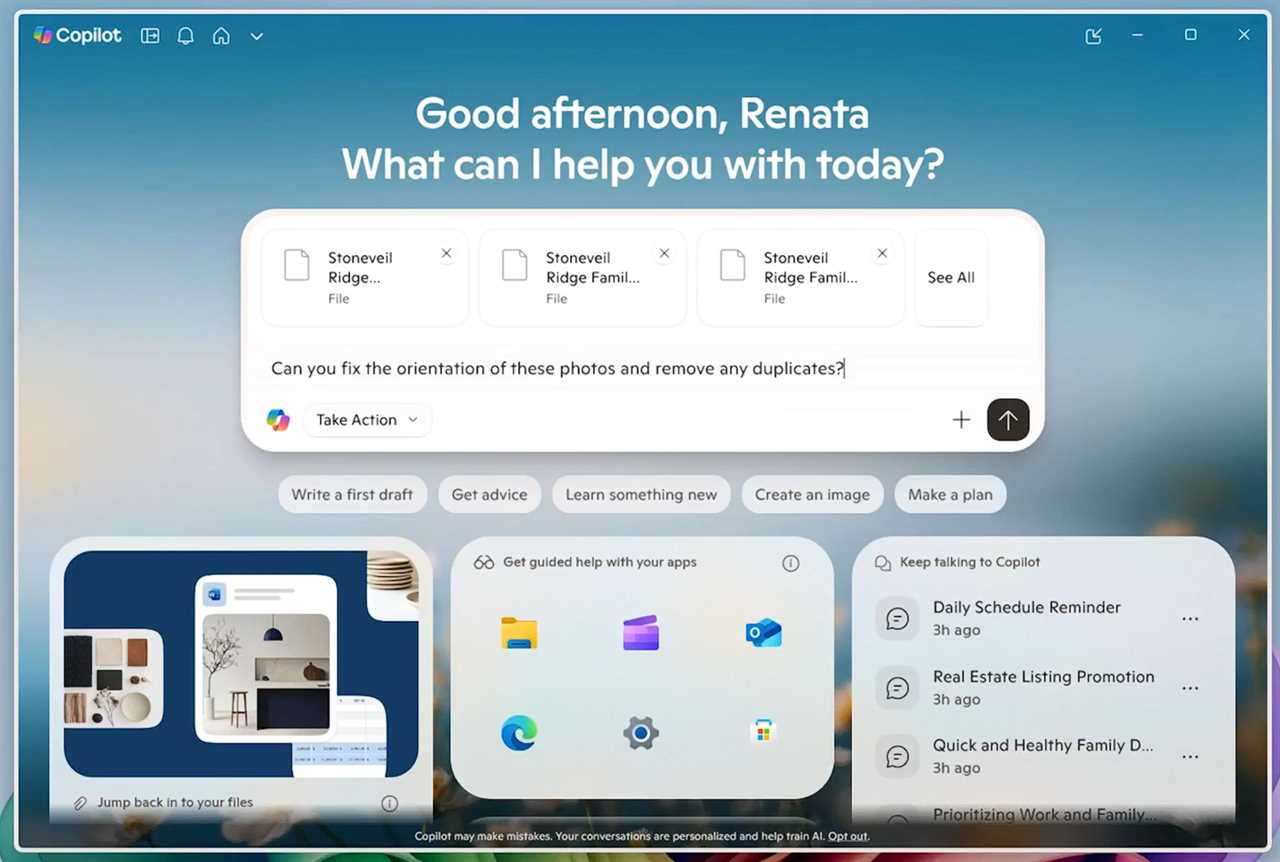
If you’re concerned about Apple’s absence in the AI space, just look at the criticism of Microsoft Copilot. Apple has time to catch up.
Microsoft
As for Copilot, PCWorld recently called it “the new Internet Explorer,” which isn’t a compliment, in case you’re too young to remember Internet Explorer. Another PCWorld article opines that “Copilot just seems like a garbage buffet of artificial stupidity, licensing issues, and design decisions that don’t put users first.” Yikes. I mean, what do you expect from something Microsoft says is intended solely for “entertainment purposes”?
The report also describes the “value” that Microsoft offers to college students, which includes a free year of Microsoft 365 Premium. That sounds like a good deal, until you realize that Apple includes its own iWork apps on every Mac for free. Also, many colleges and universities already offer free access to Office 365, regardless of whether you’re using Windows or a Mac. Plus, there’s Google Workspace, Libre Office, or some other online office suite. Overall, the value of Office 365 isn’t really a benefit.
The laptops also include free year-long access to Xbox Game Pass Ultimate, but after that, you need to pay $23 per month to keep it. Students can also get a free Xbox Design Lab Wireless Controller. OK, I’ll admit Apple can’t compete with PC’s dominance in games, and PCs have an advantage here. But try gaming on one of these laptops, I’ll wait.
But let’s not be too harsh on Microsoft; after all, as PCWorld puts it, “The $600 MacBook Neo is Microsoft’s nightmare,” and it needed to do something to respond to the MacBook Neo hype. But if you need to publish a dubious whitepaper to convince people that your laptops aren’t terrible, well, you might have a bigger problem.
Read More
Title: Microsoft’s very serious MacBook Neo whitepaper is a joke
Sourced From: www.macworld.com/article/3140022/microsoft-commissioned-a-whole-macbook-neo-study-because-its-totally-not-worried.html
Published Date: Fri, 15 May 2026 13:38:57 +0000