.png)
Last spring, 3,000 British soldiers of the 4th Light Brigade, also known as the Black Rats, descended upon the damp forests of Estonia’s eastern territories. They had rushed in from Yorkshire by air, sea, rail, and road. Once there, the Rats joined 14,000 other troops at the front line, dug in, and waited for the distant rumble of enemy armor.
The deployment was part of a NATO exercise called Hedgehog, intended to test the alliance’s capacity to react to a large Russian incursion. Naturally, it featured some of NATO’s heaviest weaponry: 69-ton battle tanks, Apache attack helicopters, and truck-mounted rocket launchers capable of firing supersonic missiles.
But according to British Army tacticians, it was the 4th Brigade that brought the biggest knife to the fight—and strictly speaking, it wasn’t even a physical weapon. The Rats were backed up by an invisible automated intelligence network, known as a “digital targeting web,” conceived under the name Project ASGARD.
The system had been cobbled together over the course of four months—an astonishing pace for weapons development, which is usually measured in years. Its purpose is to connect everything that looks for targets—“sensors,” in military lingo—and everything that fires on them (“shooters”) to a single, shared wireless electronic brain.
Say a reconnaissance drone spots a tank hiding in a copse. In conventional operations, the soldier operating that drone would pass the intelligence through a centralized command chain of officers, the brains of the mission, who would collectively decide whether to shoot at it.
But a targeting web operates more like an octopus, whose neurons reach every extremity, allowing each of its tentacles to operate autonomously while also working collaboratively toward a central set of goals.
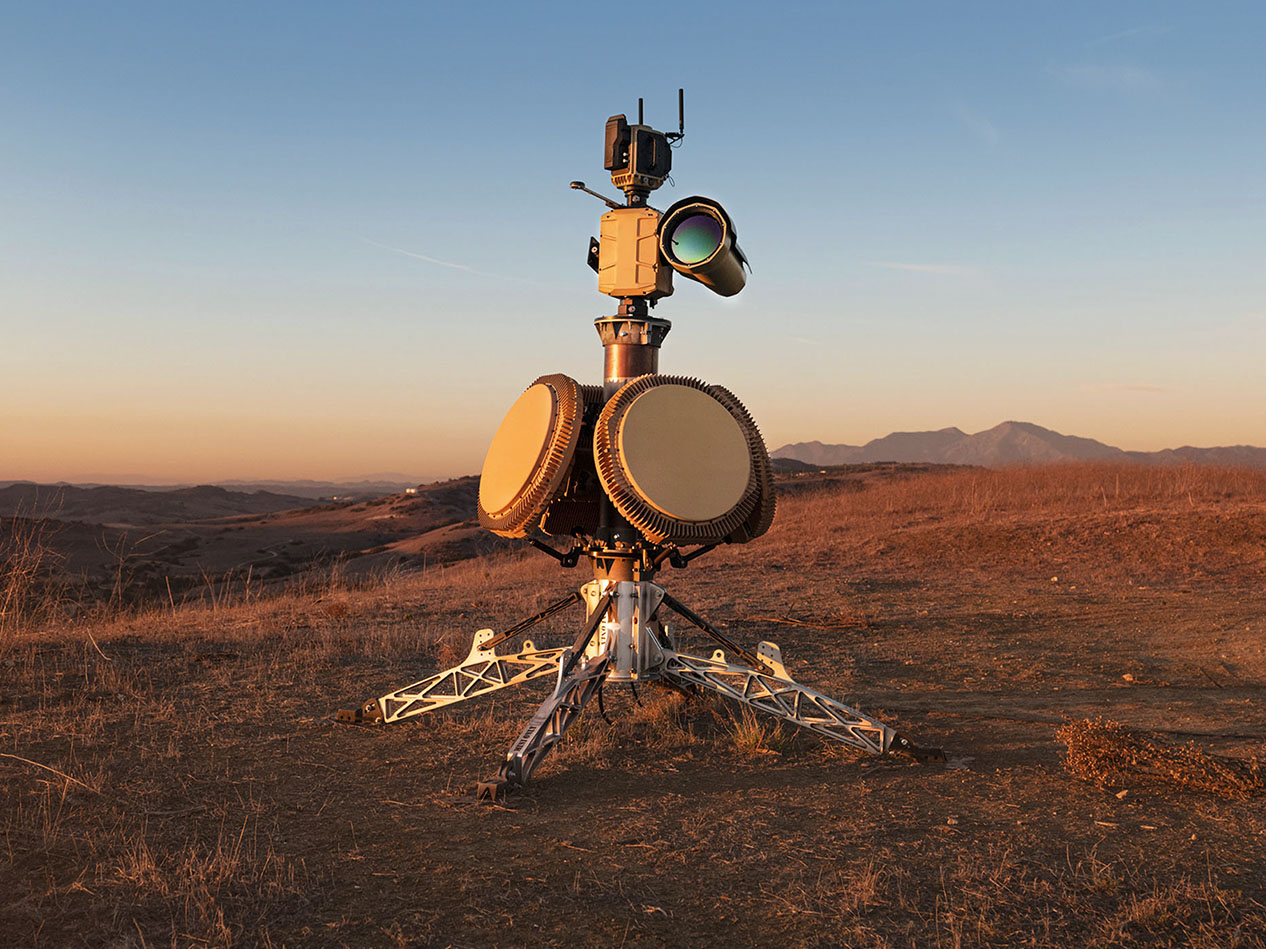
During Hedgehog, the drones over Estonia traced wide orbits. They scanned the ground below with advanced object recognition systems. If one of them spied that hidden tank, it would transmit its image and location directly to nearby shooters—an artillery cannon, for example. Or another tank. Or an armed loitering munition drone sitting on a catapult, ready for launch.
The soldiers responsible for each weapon interfaced with the targeting web by means of Samsung smartphones. Once alerted to the detected target, the drone crew merely had to thumb a dropdown menu on the screen—which lists the available targeting options based on factors such as their pKill, which stands for “probability of kill”—for the drone to whip off into the sky and trace an all but irreversible course to its unsuspecting mark.
Eighty years after total war last transformed the continent, the Hedgehog tests signal a brutal new calculus of European defense. “The Russians are knocking on the door,” says Sven Weizenegger, the head of the German military’s Cyber Innovation Hub. Strategists and policymakers are counting on increasingly automated battlefield gadgetry to keep them from bursting through.
“AI-enabled intelligence, surveillance, and reconnaissance and mass-deployed drones have become decisive on the battlefield,” says Angelica Tikk, head of the Innovation Department at the Estonian Ministry of Defense. For a small state like Estonia, Tikk says, such technologies “allow us to punch above our weight.”
“Mass-deployed,” in this case, is very much the operative term. Ukraine scaled up its drone production for its war against Russia from 2.2 million in 2024 to 4.5 million in 2025. EU defense and space commissioner Andrius Kubilius has estimated that in the event of a wider war with Russia the EU will need three million drones annually just to hold down Lithuania, a country of some 2.9 million people that’s about the size of West Virginia.
Projects like ASGARD would take these figures and multiply them with the other key variable of warfare: speed. British officials claim that the targeting web’s kill chain, from the first detection of a target to strike decision, could take less than a minute. As a result, a press release noted, the system “will make the army 10 times more lethal over the next 10 years.” It is slated to be completed by 2027. Germany’s armed forces plan to deploy their own targeting web, Uranos KI, as early as 2026.
The working theory behind these initiatives is that the right mix of lethal drones—conceived by a new crop of tech firms, sprinted to the front lines with uncommon haste, and guided to their targets by algorithmic networks—will deliver Europe an overwhelming victory in the event of an outright war. Or better yet, it will give the continent such a wide advantage that nobody would think to attack it in the first place, an effect that Eric Slesinger, a Madrid-based venture capitalist focused on defense startups, describes as “brutal, guns-and-steel, feel-it-in-your-gut deterrence.”
But leaning too much on this new mathematics of warfare could be a risky bet. The costs of actually winning a massive drone war are likely to be more than just financial. The human toll of these technologies would extend far behind the front lines, fundamentally transforming how the European Union—from its outset, a project of peace—lives, fights, and dies. And even then, victory would be far from assured.
If anything, Europe could be laying its hand on a perpetual hair trigger that nobody can afford for it to pull.
Build it, then sell it
Twenty companies participated in Project ASGARD. They range from eager startups, flush with VC backing, to defense giants like General Dynamics. Each contender could play an important role in Europe’s future. But no firm among them has more tightly captured the current European military zeitgeist than Helsing, which provided both drones and AI for the project.
Founded in 2021 by a theoretical physicist, a former McKinsey partner, and a biologist turned video-game developer, with an early investment of €100 million (then about $115 million) from Spotify CEO Daniel Ek, Helsing has quickly risen to the apex of Europe’s new defense tech ecosystem.
The Munich-based company has an established presence in Europe’s major capitals, staffed by a deep bench of former government and military officials. Buoyed by a series of high-profile government contracts and partnerships, along with additional rounds of funding, the company catapulted to a $12 billion valuation last June. It is now Europe’s most valuable defense startup by a wide margin, and the one that would be most likely to find itself at the tip of the spear if Europe’s new cold war were to suddenly turn hot.
Originally, the company made military software. But it has recently expanded its offerings to include physical weapons such as AI-assisted missile drones and uncrewed autonomous fighter jets.
In part, this reflects a shift in European demand. In March 2025, the European Commission called for a “once-in-a-generation surge in European defence investment,” citing drones and AI as two of seven priority investment areas for a new initiative that will unlock almost a trillion dollars for weapons over the coming years. Germany alone has allocated nearly $12 billion to build its drone arsenal.
“You raise money, you create technology using this money that you raised, and then you go to market with that.”
Antoine Bordes, chief scientist, Helsing
But in equal measure, the company is looking to shape Europe’s military-industrial posture. In conventional weapons programs in Europe, governments tell companies what to build through a rigid contracting process. Helsing flips that process on its head. Like a growing number of new defense firms, it is guided by what Antoine Bordes, its chief scientist, describes as “a more traditional tech-startup muscle.”
“You raise money, you create technology using this money that you raised, and then you go to market with that,” says Bordes, who was previously a leader in AI research at Meta. Government officials across Europe have proved receptive to the model, calling for agile contracting instruments that allow militaries to more easily open their pocketbooks when a company comes to them with an idea.
DPA PICTURE ALLIANCE/ALAMY
Helsing’s pitch deck for the future of European defense bristles with weapons that will operate across land, air, sea, and space. In the highest reaches of Helsing’s imagined battlefield, a constellation of reconnaissance satellites, which the company is collaborating on with Loft Orbital, will “detect, identify and classify military assets worldwide.”
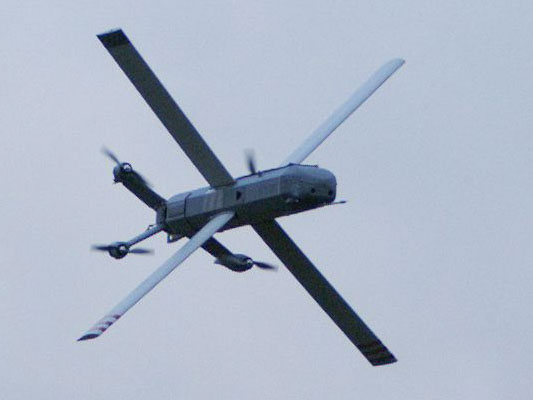
Lower down, the company’s HF-1 and HX-2 loitering munition drones—so called because they combine the functions of a small reconnaissance drone and a missile—can stalk the skies for long periods before zeroing in on their targets. To date, the company has publicly disclosed orders for around 10,000 airframes to be delivered to Ukraine. It won’t say how many have been deployed, although it told Bloomberg in April that its drones had been used in dozens of successful missions in the conflict.
At sea, the company envisions battalions of drone mini-subs that can plunge as deep as 3,000 feet and rove for 90 days without human control, serving as a hidden guard watch for maritime incursions.
Helsing’s newest offering, the Europa, is a four-and-a-half-ton fighter jet with no human pilot on board. In a set of moody promo pictures released in 2025, the drone has the profile of an upturned boning knife. Carrying hundreds of pounds of weaponry, it is meant to charge deep into heavily defended airspace, flying under the command of a human pilot much farther away (like Tom Cruise in Top Gun: Maverick if his costars were robots and he were safely beyond the range of enemy anti-aircraft missiles). Helsing says that the Europa, which resembles designs offered by a number of other firms, is engineered to be “mass-producible.”
Linking all these elements together is Altra, the company’s so-called “recce-strike software platform,” which served as part of the collective brain in the ASGARD trials. It’s the key piece. “These kill webs are competitive in attack and defense,” says General Richard Barrons, a former commander of the United Kingdom’s Joint Forces Command, who recently coauthored a major Ministry of Defense modernization plan that champions the deterrent effect of autonomous targeting webs. Barrons invited me to imagine Russian leaders contemplating a possible incursion into Narva in eastern Estonia. “If they’ve done a reasonable job,” he said, referring to NATO, “Russia knows not to do that … that little incursion—it will never get there. It’ll be destroyed the minute it sets foot across the border.”
With a targeting web in place, a medley of missiles, drones, and artillery could coordinate across borders and domains to hit anything that moves. On its product page for Altra, Helsing notes that the system is capable of orchestrating “saturation attacks,” a military tactic for breaching an adversary’s defenses with a barrage of synchronized weapon strikes. The goal of the technology, a Helsing VP named Simon Brünjes explained in a speech to an Israeli defense convention in 2024, is “lethality that deters effectively.”
To put it a bit less delicately, the idea is to show any potential aggressors that Europe is capable, if provoked, of absolutely losing its shit. The US Navy is working to establish a similar capacity for defending Taiwan with hordes of autonomous drones that rain down on Chinese vessels in coordinated volleys. The admirals have their own name for the result such swarms are intended to achieve: “hellscape.”
The humans in the loop
The biggest obstacle to achieving the full effect of saturation attacks is not the technology. It’s the human element. “A million drones are great, but you’re going to need a million people,” says Richard Drake, head of the European branch of Anduril, which builds a product range similar to Helsing’s and also participated in ASGARD.
Drake says the kill chain in a system like ASGARD “can all be done autonomously.” But for now, “there is a human in the loop making those final decisions.” Government rules require it. Echoing the stance of most other European states, Estonia’s Tikk told me, “We also insist that human control is maintained over decisions related to the use of lethal force.”
Helsing’s drones in Ukraine use object recognition to detect targets, which the operator reviews before approving a strike. The aircraft operate without human control only once they enter their “terminal guidance” phase, about half a mile from their target. Some locally produced drones employ similar “last mile” autonomy. This hands-free strike mode is said to have a hit rate in the range of 75%, according to research by the Center for Strategic and International Studies. (A Helsing spokesperson said that the company uses “multiple visual aids” to mitigate “potential difficulties” in target recognition during terminal guidance.)
HELSING
That doesn’t quite make them killer robots. But it suggests that the barriers to full lethal autonomy are no longer necessarily technical. Helsing’s Brünjes has reportedly said its strike drones can “technically” perform missions without human control, though the company does not support full autonomy. Bordes declined to say whether the company’s fielded drones can be switched into a fully autonomous mode in the event that a government changes its policy midway through a conflict.
Either way, the company could loosen the loop in the coming years. Helsing’s AI team in Paris, led by Bordes, is working to enable a single human to oversee multiple HX-2 drones in flight simultaneously. Anduril is developing a similar “one-to-many” system in which a single operator could marshal a fleet of 10 or more drones at a time, Drake says.
In such swarms a human is technically still involved, but that person’s capacity to decide upon the actions of any single drone is diminished, especially if the drones are coordinating to saturate a wide area. (In a statement, a Helsing spokesperson told MIT Technology Review, “We do not and will not build technology where a machine makes the final decision.”)
“The international community is crossing a threshold which may be difficult, if not impossible, to reverse later.”
Morris Tidball-Binz, UN Special Rapporteur
Like other projects in its portfolio, Helsing’s research on swarming HX-2s is not intended for a current government contract but, rather, to anticipate future ones. “We feel that this needs to be done, and done properly, because this is what we need,” Bordes told me.
To be sure, this thinking is not happening in a vacuum. The push toward autonomy in Ukraine is largely driven by advances in jamming technologies, which disrupt the links between drones and their operators. Russia has reportedly been upgrading its strike drones with sharper autonomous target recognition, as well as modems that enable them to communicate among themselves in a sort of proto-swarm. In October, it conducted a test of an autonomous torpedo said to be capable of carrying nuclear warheads powerful enough to create tsunamis.
Governments are well aware that if Europe’s only response to such challenges is to further automate its own lethality, the result could be a race with no winners. “The international community is crossing a threshold which may be difficult, if not impossible, to reverse later,” UN Special Rapporteur Morris Tidball-Binz has warned.
And yet officials are struggling to imagine an alternative. “If you don’t have the people, then you can’t control so many drones,” says Weizenegger, of the German Cyber Innovation Hub. “So therefore you need swarming technologies in place—you know, autonomous systems.”
“It sounds very harsh,” he says, referring to the idea of removing the human from the loop. “But it’s about winning or losing. There are only these two options. There is no third option.”
The need for speed
In its pitches, Helsing often emphasizes a sense of dire urgency. “We don’t know when we could be attacked,” one executive said at a technology summit in Berlin in September 2025. “Are we ready to fight tonight in the Baltics? The answer is no.”
The company boasts that it has a singular capacity to fix that. In September 2024 it embarked on a project to develop an AI agent capable of controlling fighter aircraft. By May of the following year the agent was operating a Swedish Gripen E jet in tests over the Baltic Sea. The company calls such timelines “Helsing speed.” The Europa combat jet drone is slated to be ready by 2029.
European governments have adopted a similar fixation with haste. “We need to fast-track,” says Weizenegger. “If we start testing in 2029, it’s probably too late.” Last February, announcing that Denmark would increase defense spending by 50 billion kroner ($7 billion), Prime Minister Mette Frederiksen told a press conference, “If we can’t get the best equipment, buy the next best. There’s only one thing that counts now, and that is speed.”
That same month, Helsing announced that it will establish a network of “resilience factories” across Europe—dispersed and secret—to churn out drones at a wartime clip. The network will be put to its first real test in the coming months, when the German government finalizes a planned €300 million order for 12,000 Helsing HX-2s to equip an armored brigade stationed in Lithuania.
The company says that its first factory, somewhere in southern Germany, can produce 1,000 drones a month—or roughly six drones an hour, assuming a respectable 40-hour European work week. At that pace, it would fill Germany’s order in a year. In reality, though, it could take longer. As of last summer, the facility was operating at less than half its capacity because of staffing shortages. (A company spokesperson did not respond to questions about its current production capacity and declined to provide information on how many drones it has produced to date.)
It will take a lot of factories for Europe to fully arm up. When Helsing unveiled its resilience factory project, one of its founders, Torsten Reil, wrote on LinkedIn that “100,000 HX-2 strike drones would deter a land invasion of Europe once and for all.” Helsing now says that Germany alone should maintain a store of 200,000 HX-2s to tide it over for the first two months of a Russian invasion.
Even if Europe can surge its capacity to such levels, not everyone is convinced that massed drones are a winning pitch. While drones now account for somewhere between 70% and 80% of all combat casualties in Ukraine, “they’re not determining outcomes on the battlefield,” says Stacie Pettyjohn, director of the defense program at the Center for a New American Security. Rather, drones have brought the conflict to a grinding stalemate, leading to what a team of American, British, and French air force officers have called “a Somme in the sky.”
This dynamic has led to remarkable advances in drone communications and autonomy. But each breakthrough is quickly met with a countermeasure. In some areas where jamming has made wireless communication particularly difficult, pilots control their drones using long spools of fiber-optic filament. In turn, their opponents have engineered rotating barbed wire traps to snare the filaments as they drag along the ground, as well as drone interceptors that can knock the unjammable drones out of the sky.
“If you produce millions of drones right now, they will become obsolete in maybe a year or half a year,” says Kateryna Bondar, a former Ukrainian government advisor. “So it doesn’t make sense to produce them, stockpile, and wait for attack.”
Nor is AI necessarily up to the task of piloting so many drones, despite industry claims to the contrary. Bohdan Sas, a founder of the Ukrainian drone company Buntar Aerospace, told me that he finds it amusing when Western companies claim to have achieved “super-fancy recognition and target acquisition on some target in testing,” only to reveal that the test site was “an open field and a target in the center.”
“It’s not really how it works in reality,” Sas says. “In reality, everything is really well hidden.” (A Helsing spokesperson said, “Our target recognition technology has proven itself on the battlefield hundreds of times.”)
Zachary Kallenborn, a research associate at the University of Oxford, told me that in Ukraine, Russian forces have been known to deactivate the autonomous functionalities of their Lancet loitering munitions. In real-world conditions, he says, AI can fail—“And so what happens if you have 100,000 drones operating that way?”
Death’s darts
In September, while reporting this story, I visited Corbera, a town perched on a rocky outcrop among the limestone hills of Terra Alta in western Catalonia. In the late summer of 1938, Corbera was the site of some of the most intense fighting of the Spanish Civil War.
The site is just as much a reminder of past horrors as it is a warning of future ones. The town was repeatedly targeted by German and Italian aircraft, a breakthrough technology that was, at the time, roughly as novel as modern drones are to us today. Military planners who led the Spanish campaigns famously used the raids to perfect the technology’s destructive potential.
For the last four years, Ukraine has served a similar role as Europe’s living laboratory of carnage. According to Bondar, some Ukrainian units have begun charging Western companies a fee to operate their drones in battle. In return, the companies receive reams of real-world data that can’t be replicated on a test range.
“We need to keep reminding ourselves that the business of war, as an aspect of the human condition, is as brutal and undesirable and feral as it always is.”
General Richard Barrons, former commander, United Kingdom Joint Forces Command
What this data doesn’t show is the mess that the technology leaves behind. In Ukraine, drones now account for more civilian casualties than any other weapon. A United Nations human rights commission recently concluded that Russia has used drones “with the primary purpose to spread terror among the civilian population”—a crime against humanity—along a 185-mile stretch of the Dnipro River. One local resident told investigators, “We are hit every day. Drones fly at any time—morning, evening, day or night, constantly.” The commission also sought to investigate Russian allegations of Ukrainian drone attacks on civilians but was not granted sufficient access to make a determination.
A European drone war would invite similar tragedies on a much grander scale. Tens of millions of people live within drone-strike range of Europe’s eastern border with Russia. Today’s ethical calculus could change. At a media event last summer, Helsing’s Brünjes told reporters that in Ukraine, “we want a human to be making the decision” in lethal strikes. But in “a full-scale war with China or Russia,” he said, “it’s a different question.”
In the scenario of an incursion into Narva, Richard Barrons told me that Russia should also know that once its initial attack is repelled, NATO would use long-range missiles and jet drones—abetted by the same targeting webs—to immediately retaliate deep within Russian territory. Such talk may be bluster. The point of deterrence is, after all, to stave off war with the mere threat of unbearable violence. But it can leave little room for deescalation in the event of an actual fight. Could one be sure that Russia, which recently lowered its threshold for using nuclear weapons, would stand down? “The mindset that these kinds of systems are now being rolled out in is one where we’re not imagining off-ramps,” says Richard Moyes, the director of Article 36, a British nonprofit focused on the protection of civilians in conflict.
ANDURIL
To this day, Corbera’s old center lies in ruins. The crumbled homes sit desolate of life but for the fig trees struggling up through the rubble and the odd skink that scurries across a splintered beam. Walking through the wasteland, I was taken by how much it resembles any other war zone. It could have been Tigray, or Khartoum. Or Gaza, a living hellscape where AI targeting tools played a central role in accelerating Israel’s cataclysmic bombing campaign. What particular innovation wrought such misery seemed almost beside the point.
“We need to keep reminding ourselves that the business of war, as an aspect of the human condition, is as brutal and undesirable and feral as it always is,” Barrons told me, a couple of weeks after I was in Corbera. “I think on planet Helsing and Anduril,” he went on, “they’re not really fighting, in many respects. And it’s a different mindset.”
A Helsing spokesperson told MIT Technology Review that the company “was founded to provide democracies with technology built in Europe essential for credible deterrence, and to ensure this technology is developed in line with tight ethical standards.” He went on to say that “ethically built autonomous systems are limiting noncombatant casualties more effectively than any previous category of weapon.”
Would such a claim, if true, bear out in a gloves-off war between major powers? “I would be extraordinarily cautious of anyone who says, ‘Yeah, 100% this is how the future of autonomous warfare looks,’” Kallenborn told me. And yet, there are some certainties we can count on. Every weapon, no matter how smart, carries within it a variation of the same story. “Lethality” means what it says. The only difference is how quickly—and how massively—that story comes to its sad, definitive end.
Arthur Holland Michel is a journalist and researcher who covers emerging technologies.
------------Read More
By: Arthur Holland Michel
Title: Europe’s drone-filled vision for the future of war
Sourced From: www.technologyreview.com/2026/01/06/1129737/autonomous-warfare-europe-drones-defense-automated-kill-chains/
Published Date: Tue, 06 Jan 2026 11:00:00 +0000
Did you miss our previous article...
https://trendinginbusiness.business/technology/this-magnetic-charger-saves-your-apple-watch-in-a-pinch-70-off