.png)
Macworld
Apple has turned 50, and this week I realized that I’ve been writing professionally about the company for two-thirds of its existence. (Excuse me while I try not to turn into dust and blow away in the gentle spring breeze.)
Like so many people, I have a story about discovering and falling in love with the Mac, and how it changed my life. My college newspaper switched to an all-Mac production workflow a year after I arrived on campus with my Apple IIe, and once I started using the Mac I would never go back. Not only did my work at that college paper set me on my career path in general (journalism), but technology (and the Mac) in particular.
In the late 1980s and early 1990s, before the world discovered the internet, it was readily available on college campuses. By the time I left UC San Diego, I had started a magazine distributed only over the internet. Unfortunately, I was born way too early to start a career on the internet.
Fortunately, when a bad economy led me to go to graduate school rather than seek out a job, my career parth was laid before me. My Mac obsession only continued–I pored over issues of Mac magazines before buying my first PowerBook. And I became a graduate assistant for a class that was focused on desktop publishing, which is where I met Pam Pfiffner.
As amazing and revelatory as the Mac was for me as a writer and editor…I rapidly discovered that the Apple of the period was a mess.
Pam was a senior editor at MacUser magazine, and before too long, I began asking her if the magazine might be hiring summer interns. In hindsight, I feel like I basically bullied her into giving me a job, but I spent the summer of 1993 writing about CD-ROMs and other extremely 1990s things. When they offered me a full-time job, I couldn’t say no.
A rough start
But as amazing and revelatory as the Mac was for me as a writer and editor of print and online publications, I rapidly discovered that the Apple of the period was a mess. My first day as a full-time employee, a copy editor popped his head over the cubicle wall and asked me if I had heard anything about layoffs. Welcome to the media, kid.
John Sculley was the CEO of Apple in those days, and while there’s a lot to commend from that era, it had just about reached its stagnation point when I arrived on the scene. I felt very much like I had arrived at the party just in time to clean things up.
Windows 95 arrived, and even though all of us Mac stalwarts objected to it as a pale imitation of the Mac–“Windows 95: So what?” was our defiant cover when it launched–it was, in truth, a body blow to Apple. The company had squandered its lead over Microsoft, still couldn’t ship a next-generation version of Mac OS, and its sales began to crater.
Foundry
This is roughly the point where my family began to ask me if it was especially wise for me to make Apple my area of specialization. And I admit, I asked myself the same thing–but I just couldn’t see myself willingly abandoning ship to write about Windows XP workstations or whatever. I was in the business to write about the Mac, not about technology in general.
1997 was the moment that Apple hit rock bottom. Steve Jobs was back, but the prognosis didn’t look good. The publishers of the two big Mac magazines at the time, Ziff-Davis and IDG, decided that they’d cut their losses by merging MacUser and Macworld into a single magazine, laying off more than half the employees in the process.
That decision came two weeks before Steve Jobs stood on stage at Macworld Expo in Boston and announced (with Bill Gates on a video link-up) that Microsoft had invested in Apple and recommitted to releasing Microsoft Office for the Mac. A few months later, Jobs announced the iMac. Things started to turn around–too late for all of my former colleagues and competitors, but just in time for those of us who were lucky enough to get a job at the new Macworld.
Things get really interesting
From there, it was a wild ride. The iMac announcement alone drove enormous interest in Apple, and reinvigorated everything we were doing. Steve Jobs got rid of all the old Apple connectivity standards (ADB, Mac Serial, SCSI) and replaced them wholesale with USB, which was a huge shock to Mac users. I spent the summer of 1994 writing and editing stories about how USB worked, what USB devices would be available once the iMac arrived, and how we were all going to survive without floppy disks or SCSI hard drives.
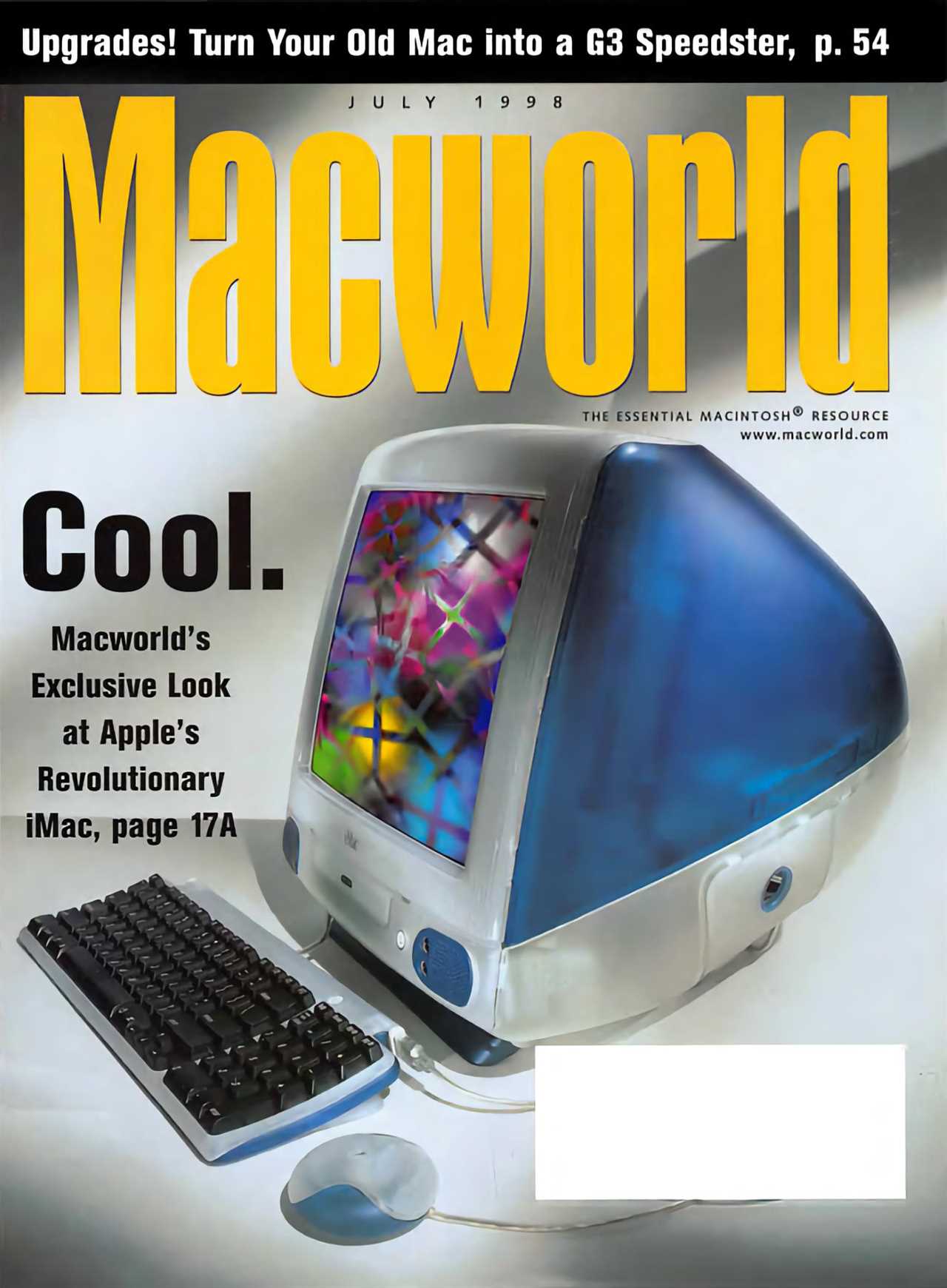
The iMac gave Apple and Macworld new life.
Foundry
From that moment, it was clear that Steve Jobs was not ever going to worry about maintaining links to the past, because his focus was on dragging Apple into the future. It was a jolt of lightning that woke up the entire computer world, and certainly changed our fate at Macworld.
The next few years were a wild ride. The iMac’s success brought in enough cash to keep Apple alive while it developed Mac OS X, large portions of which underpin every major Apple platform to this day. The arrival of the iPod in 2001 would eventually (after the company released a Windows-compatible version, anyway) introduce the Apple brand to a generation of customers who had never, ever bought an Apple product before.
In the 2000s, Apple really took flight. Steve Jobs and retail head Ron Johnson’s idea of building a chain of Apple Stores was mocked as a guaranteed failure, but they became the perfect place to sell iPods, and once iPod buyers were in the store, they were exposed to everything the Mac had to offer. The “iPod halo effect” was real, and the Mac was reinvigorated by a user base that had never even seen classic Mac OS.
Of course, the iPhone changed everything once again. It was Apple’s first non-Mac to truly be a computer–not that Steve Jobs wanted anyone to think of it that way. Remember, the iPhone launched without any support for third-party apps, though even the day it was announced, it was obvious to a lot of us that we were headed for some sort of iPhone App Store.
The original iPhone was so limited that when it launched, there was no way to take a screen shot! To cover it at Macworld, we had to jailbreak the phone, tether it via USB, and issue unix shell commands at the moment we wanted to take the screen shot. Then we had to transfer that image back, over that USB connection, via another unix shell command.
Similarly, there were six months between the iPhone’s announcement and release. And while I certainly made hay about having been able to touch it in January–a story I recently recounted as my official Jeopardy! ancedote–it left us in a real bind when it came to covering it. Everyone wanted to know more about the iPhone, but nobody had one! And if you were, let’s say, a magazine, you probably wanted to put it on your cover!
We ended up contracting with an artist who created a 3-D model of the iPhone (and its earbuds) and then posed it in photorealistic renders for our cover and interior art. That’s right–the first Macworld cover photo of the iPhone was CGI.
Since the release of the iPhone, Apple has been on a rocketship ride. The company Tim Cook took over just as Steve Jobs passed away was a fraction of the size of the Apple of today. Apple has more customers than ever, and the Mac–a 42-year-old product!–is the biggest it’s ever been.
It has been a wild ride to write about it for the last 33 years, at Macworld since 1997, and in this particular space since 2015. I can’t wait for whatever happens next–and to write about it here.
Read More
Title: Thanks for the wild ride, Apple. Let’s keep it going
Sourced From: www.macworld.com/article/3103792/thanks-for-the-wild-ride-apple-lets-keep-it-going.html
Published Date: Thu, 02 Apr 2026 10:15:00 +0000
Did you miss our previous article...
https://trendinginbusiness.business/technology/best-macbook-backpacks-bags-cases-and-sleeves