.png)
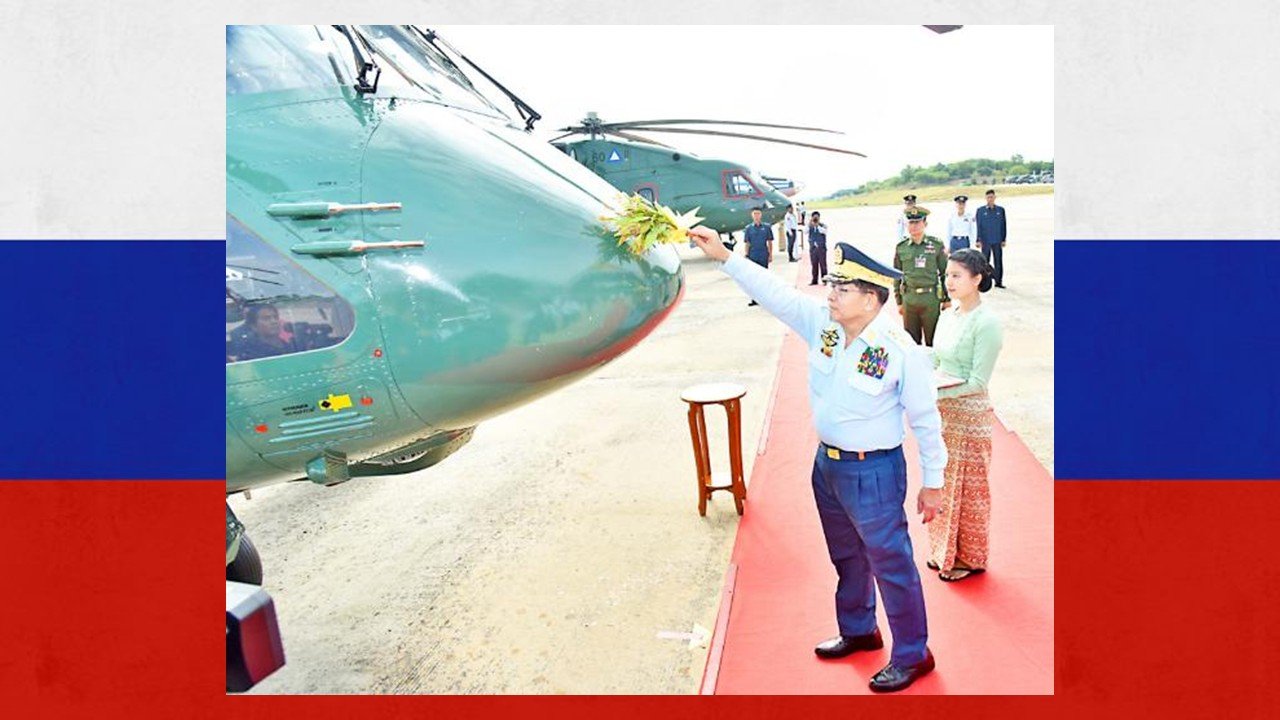
Russia’s support for Burma (Myanmar)’s military junta has intensified since the February 2021 coup and deepened further after Russia’s 2022 invasion of Ukraine, drawing the two sanctioned regimes into closer alignment.
While China remains the dominant external actor economically, Russia has become the junta’s primary defense partner.
The core of the relationship is military supply. Russia has delivered six Sukhoi Su-30 jets, the last arriving in December 2024, along with Mi-38T helicopters, munitions, and a range of drones.
According to some reports, Russian personnel have been servicing aircraft inside Burma.
According to ACLED, between February 2021 and March 2026, the junta conducted 5,912 airstrikes, killing at least 4,865 people, and 931 drone attacks, killing at least 366 more.
The UN identified airstrikes as the leading cause of civilian casualties, with deaths from aerial attacks rising 52 percent in 2025 compared to the previous year.
Russia has also supplied advanced drones, including the fixed-wing Albatross-M5, the Orlan-10E with optical and thermal imaging and 16-hour endurance, the kamikaze-style VT-40, and a reported shipment of Zala Lancet suicide drones manufactured by Kalashnikov Concern.
These systems outperform the commercial drones used by resistance forces and are equipped with infrared cameras enabling night attacks.
Russian-supplied anti-drone systems can intercept and disable resistance UAVs. Following drone training support from Russia and China in early 2024, the junta established a dedicated Drone Warfare Command.
It has not been fully verified, but there have been reports of Russian technicians having been spotted at Burma Air Force bases, involved in drone operations.
No comparable Chinese technicians have been reported on the ground; Chinese training is believed to take place inside China.
In May 2025, Burma’s defense minister traveled to Moscow to meet Russia’s deputy defense minister to discuss military technology and training cooperation. Russia has reportedly supported drone operations in Rakhine and Kachin states.
The junta has also adopted Russian battlefield tactics. Nationwide conscription introduced in 2024 has added an estimated 100,000 soldiers to the military’s ranks, who are deployed in human wave attacks against rebel positions, mirroring tactics used by Russian forces in Ukraine.
In February 2026, Russia and Burma formalized the relationship with a five-year military cooperation agreement running to 2030, announced after Russian Security Council Secretary Sergei Shoigu visited Naypyidaw.
Additional cooperation includes a satellite imagery center Russia established in Naypyidaw, enhancing the junta’s battlefield awareness, and joint naval exercises.
The relationship is reciprocal. Burma is the only Southeast Asian nation to have endorsed Russia’s invasion of Ukraine and has reportedly supplied Russia with mortar shells and tank-targeting systems.
The two countries also collaborate on energy. Burma began importing Russian gasoline and fuel oil in 2022, filling a gap left when Western and Asian companies, including Chevron, TotalEnergies, Malaysia’s Petronas, and Thailand’s PTTEP, exited the country.
The junta established a purchasing committee headed by a close ally of Min Aung Hlaing to manage fuel imports. Burma was also planning a pipeline to receive Russian energy routed through India or China.
In March 2026, three Russian naval vessels docked in Yangon. State media in Russia and Burma portrayed the arrival as a goodwill mission which involved sports competitions and joint exercises.
However, sources close to Burma’s parallel National Unity Government reported they were likely delivering weapons and potentially fuel.
Russia’s Rosatom signed an agreement to build a small modular nuclear reactor in Burma, and the two countries signed a memorandum to construct a port and oil refinery at the Dawei Special Economic Zone on the Andaman coast.
A broader investment agreement covers transport infrastructure, metallurgy, agriculture, and telecommunications.
Most of these projects remain aspirational, constrained by Burma’s weak economy, ongoing conflict, and Russia’s limited capacity under its own sanctions regime.
In addition to the direct support the generals receive from Beijing and Moscow, they are also receiving military hardware from China and Russia’s close ally, North Korea.
In September 2025, the U.S. Department of the Treasury sanctioned five individuals and one entity for selling weapons to the Burma military regime through North Korea’s Korea Mining Development Trading Corporation (KOMID), also known as the 221 General Bureau, which serves as Pyongyang’s primary arms dealer and exporter of ballistic missile-related equipment.
The Burma broker was Royal Shune Lei Company Limited, which first arranged a weapons deal with KOMID in 2022. Since late 2023, its CEO and an employee traveled to China for multiple business meetings with KOMID representatives.
Kim Yong Ju, KOMID’s deputy representative in Beijing, coordinated the sale of two types of aerial bomb guidance kits, bombs, and airborne monitoring equipment for the Burma Air Force.
The meetings and visa arrangements for a Burma delegation to visit North Korea were conducted through Beijing.
Royal Shune Lei had already been sanctioned by the EU in December 2023, and by Canada and the United Kingdom in October 2024, before being sanctioned by the United States in September 2025.
Another member of the axis of autocracies, Iran, has been providing the junta with jet fuel. From October 2024 to December 2025, Iran delivered approximately 175,000 tons of jet fuel to Burma in nine shipments via two tankers, Reef and Noble, according to shipping documents reviewed by Reuters and satellite imagery analysis by the U.S. firm SynMax Intelligence.
Iran also dispatched shipments of urea, a key ingredient in junta munitions, including bombs dropped from drones and paragliders.
Burma Port Authority data shows at least 109,604 metric tonnes of aviation fuel were imported in 2025, a 69 percent increase from 2024 and the highest total since the coup, despite sanctions.
According to Amnesty International, the junta’s airstrikes increased from approximately 2,500 in 2024 to roughly 5,600 in 2025, with deaths rising from around 1,700 to 2,200.
The Iranian deliveries are closely tied to entities linked to the Islamic Revolutionary Guard Corps, which dominates Iran’s illicit trade networks. Jet fuel commands a 33 percent premium over crude, meaning the nine confirmed shipments may have earned Iran more than $120 million in hard currency.
The tankers used AIS spoofing, broadcasting false locations while loading at Bandar Abbas, and conducted ship-to-ship transfers to obscure the origin and destination of the fuel.
Both Russia and China block UN Security Council action against the junta and share an interest in preventing its defeat and the emergence of a Western-aligned government in Burma.
Russia’s strategic objectives are to sustain arms sales, secure energy contracts, and demonstrate that Western isolation efforts have failed.
Analysts note, however, that Russia has a history of not intervening decisively to save partners facing collapse, as seen in Syria and Venezuela.
The post Russian Weapons and Support Are Sustaining the Burma Junta appeared first on The Gateway Pundit.
------------Read More
By: Antonio Graceffo
Title: Russian Weapons and Support Are Sustaining the Burma Junta
Sourced From: www.thegatewaypundit.com/2026/03/russian-weapons-support-are-sustaining-burma-junta/
Published Date: Tue, 31 Mar 2026 13:30:20 +0000
Did you miss our previous article...
https://trendinginbusiness.business/politcal/entitled-passengers-storm-frontier-flight-after-refusing-to-pay-for-extra-baggage-chaos-ensues-as-police-drag-them-off-plane-video